Privacy engineering explained: How to build products people can trust


Privacy engineering is the discipline of building privacy into software, apps, and systems from the start. Companies collect and process large amounts of user data, and weak safeguards can increase the risk of misuse, unauthorized access, unnecessary exposure, or leaks. Privacy engineering helps teams design systems that reduce these risks, limit unnecessary data use, and protect people from privacy-related harms.
In this guide, we’ll explain what privacy engineering is and how it differs from data security. We’ll also explore how businesses can use it to protect people’s data and support compliance with applicable privacy regulations.
What is privacy engineering?
The aim of privacy engineering is to manage privacy risks and privacy-related harms throughout the system lifecycle. It combines technical design, system architecture, governance, and security practices to help ensure that privacy is considered before, during, and after a product is built.
Defining privacy engineering and its purpose
Privacy engineering applies privacy principles to the design, development, deployment, and maintenance of systems. The related concept of privacy by design, or data protection by design and by default in some legal frameworks, aims to embed privacy and data protection into products, services, and systems from the start.
This means going beyond legal checklists or isolated security controls. Privacy becomes a core design requirement: teams consider what data is collected, why it's needed, how long it's kept, who can access it, and how risks can be reduced. The goal is to create systems that protect user privacy, minimize unnecessary data exposure, and support responsible data use.
Also read: What is data privacy and why it matters: A complete guide.
Privacy engineering vs. data security vs. privacy by design
Privacy engineering is often confused with data security and privacy by design. While these concepts overlap, each plays a different role:
- Privacy by design: A broader principle that embeds privacy into systems, products, and processes from the design stage onward. In some legal frameworks, this is expressed as data protection by design and by default.
- Privacy engineering: A discipline focused on turning privacy principles into practical system requirements, controls, processes, and architecture throughout the system lifecycle. It covers design, implementation, privacy risk management, governance, and compliance support.
- Data security: The controls, tools, and practices that protect data from unauthorized access, alteration, loss, or disruption. It includes encryption, backups, firewalls, and access controls.
Think of it this way: privacy by design sets the principle, privacy engineering turns that principle into practice, and data security provides some of the controls that help protect sensitive information.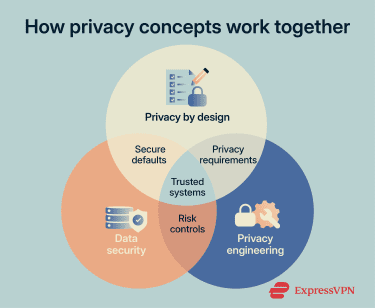
Why privacy engineering matters
One of the core reasons privacy engineering has become so important is that it bridges gaps between disciplines that might otherwise leave systems exposed to privacy risks and privacy-related harms. It brings together compliance considerations, governance, system design, and technical engineering challenges.
This is important because organizations are collecting and managing growing volumes of data. Instead of following a simple linear lifecycle, data is often continuously processed, shared, and repurposed for analytics, automation, or AI model training. Without proper controls, this can introduce additional risks to privacy, governance, and compliance.
The business and customer benefits of privacy engineering
Today, people expect greater transparency and control over their data, while governments have introduced stricter privacy regulations and enforcement to hold organizations accountable. These laws often require businesses to rethink how they collect, store, share, and use data.
Privacy engineering can help reduce the risk of fines, disruptions, and lawsuits arising from non-compliance.
Beyond legal risks, poor privacy practices can cause major harm to businesses and consumers. A single data breach can cost organizations millions of dollars, depending on the incident, industry, and response. It can also erode trust among consumers, partners, and industry bodies. Solid privacy fundamentals can help limit the impact of incidents and reassure customers.
Addressing privacy flaws reactively is often more expensive and time-consuming than identifying them earlier in the software development lifecycle (SDLC).
Common privacy risks in modern systems
Any application, cloud service, website, or operating system that interacts with users and processes personal or user-related data may create privacy risks. As such, privacy engineering is relevant in a wide range of contexts.
Effective privacy engineering starts with being able to identify and assess the risks:
- Weak security controls: Inadequate authentication, access controls, and monitoring systems can expose sensitive data to unauthorized access, misuse, or unnoticed activity.
- Excessive or improper data use: Poor governance, unclear notices, or weak consent and preference controls can lead organizations to collect, sell, retain, track, or share personal data in ways people may not expect or accept.
- Cyber threats and attacks: Cybercriminals may exploit vulnerabilities, deploy malware, or use social engineering to target organizations, infrastructure, or individuals.
- Data exposure risks: Weak encryption, poor key management, insecure protocols, or misconfigured storage can leave data inadequately protected in transit or at rest.
- Fragmented systems and infrastructure: Disconnected or legacy data systems can create blind spots across the data lifecycle, including inconsistent retention, incomplete deletion, duplicate records, weak access controls, and reduced visibility.
- Organizational and internal risks: Lax governance and oversight can increase risks associated with bring your own device (BYOD) policies, large Internet of Things (IoT) inventories, missed updates, and delayed security patches.
- Third-party and regulatory risks: Vendors, processors, and cross-border data transfers can raise concerns about accountability, international transfer rules, data residency, and compliance responsibilities.
Core principles of privacy engineering
Privacy engineers rely on core principles to guide decisions throughout the system lifecycle. These principles shape everything from data flows to specific system features:
- Data minimization: As a rule of thumb, the less personal data an organization collects and keeps, the less risk it faces. Businesses should also limit retention, delete data once it’s no longer needed, and use aggregation, anonymization, or pseudonymization where appropriate.
- Purpose limitation: Systems should collect data only for specific, legitimate purposes. Data shouldn’t be used for unrelated or incompatible purposes without a valid legal basis, appropriate notice, and, where required, consent.
- Data accuracy and quality: There should be controls to keep data accurate and up to date where necessary. Bad data can cause issues through misidentification, wrongful profiling, and incorrect automated decisions.
- Transparency: Organizations should clearly communicate to users or stakeholders what data is being collected, why, and how it will be used. This supports informed decisions, accountability, and the exercise of privacy rights.
- User control: Data subjects should have appropriate control over their data, including ways to access, correct, delete, restrict, or object to certain uses of their data, where applicable. These controls depend on the organization’s policies and relevant data laws.
- Security: This entails implementing controls to protect data from unauthorized access, breaches, loss, and other threats. Strong security relies on secure-by-design practices and may include approaches such as least privilege, encryption, monitoring, and zero-trust policies.
- Accountability and auditing: Privacy engineering practices should be measurable, documented, and reviewable. Organizations should be able to demonstrate that they maintain records, document data flows, monitor controls, and conduct regular reviews or audits.
How privacy engineering works in practice
Privacy engineering works best when it is applied across the system and throughout its lifecycle. In practice, this means combining risk assessment, data mapping, privacy reviews, and technical controls.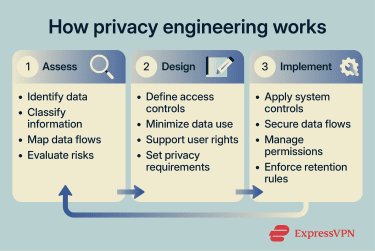
Assessing privacy risks in software development
Without a clear understanding of the privacy risk landscape, it’s difficult to engineer effective solutions. Carrying out thorough risk assessments at regular intervals, and before major changes, helps organizations identify pressing risks.
Common steps in a privacy assessment include:
- Identify personal data: Establish visibility into the personal data collected, including sensitive data, and classify or tag it appropriately.
- Map data flows: Determine how data is collected, stored, accessed, shared, retained, transferred, and deleted.
- Perform privacy impact assessments (PIAs): Evaluate how new features, processes, or high-risk data uses may affect privacy and compliance.
- Analyze attack and misuse risks: Identify potential weak points that could lead to data exposure, unauthorized access, excessive access, or improper data use.
Designing privacy-conscious systems
From planning and design to deployment and maintenance, privacy should be treated as a core project requirement alongside functionality, security, and usability.
Here’s how that often looks in practice:
- Robust access controls: Enforce role-based or attribute-based access controls (RBAC/ABAC) to determine who can access which data, under what conditions, and for what purpose.
- API data minimization: Send, request, and expose only the data needed when interacting with internal, third-party, or external services.
- Data collection handling: Where appropriate, validate, filter, and classify data as early as possible, while keeping server-side checks and safeguards in place.
- Reliable data subject request (DSR) handling: Design data operations so that access, correction, deletion, and restriction requests can be completed reliably while preserving system integrity and legal records where required.
- Data-in-use protection: In addition to encrypting data at rest and in transit, systems should protect data while applications and users process it, using controls such as least-privilege access, masking, monitoring, and secure processing where appropriate.
- Privacy testing and reviews: Regularly test systems for privacy risks, such as exposed endpoints, misconfigured storage, unintended data sharing, excessive permissions, broken retention rules, and unreliable DSR workflows.
Privacy engineering for web, mobile, and backend systems
Different systems present unique privacy engineering challenges. However, the overarching goal remains the same: protecting user data and supporting responsible data use while maintaining performance and usability.
For websites, common risks include insecure communications, excessive tracking, third-party scripts, exposed APIs, and unnecessary data collection. Designing sites to enforce HTTPS and apply clear, enforceable consent controls for non-essential cookies and similar tracking technologies is important. Avoiding unnecessary or sensitive data in browser storage, such as local storage or session storage, can also reduce exposure.
For mobile apps, broad permissions can create privacy concerns. Developers should request access only to permissions that support essential app features. Publishers should be transparent about their data collection practices, provide meaningful privacy choices where appropriate, and respect operating-system permission settings. Whatever data is collected should be stored securely and retained only as long as needed.
Backend systems play an essential intermediary role between users and front-facing layers. From a privacy engineering perspective, the focus is often on data governance, access control, retention, consent enforcement, privacy-aware monitoring and logging, and secure data flows.
It’s also important to ensure that user consent and preferences are actually enforced. Those working on the backend must also understand how deletion requests propagate across systems and be familiar with the overall data flow.
Implementing privacy engineering in your organization
Adopting privacy engineering practices can lead to structural, procedural, and cultural changes that create friction. However, these changes lay the foundation for more privacy-conscious systems with greater resilience. As such, organizations should approach implementation as an ongoing change-management effort rather than a one-time compliance task.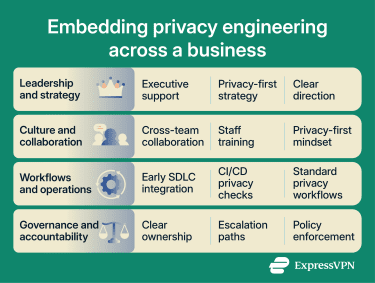
Building a privacy-first culture across teams
Creating a privacy-first culture means making privacy a core value across the organization, from leadership to development teams. While there’s no guaranteed recipe that will work in every situation, the following steps are a good starting point:
- Train employees on privacy practices: Ensure that staff understand data protection duties, secure data handling, ethical data use, and role-specific responsibilities.
- Encourage cross-team collaboration: Strengthen communication among legal, compliance, product, and engineering teams to streamline privacy workflows.
- Assign privacy ownership: Appoint a privacy lead, privacy team, or data protection officer (DPO), as required, to oversee compliance and risk management.
- Make privacy part of development sprints: Integrate privacy considerations into product development cycles rather than treating them as last-minute fixes.
- Encourage open reporting: Make it easy for staff to raise privacy concerns, ask questions, and escalate potential issues.
Choosing tools and workflows that support privacy
Making privacy engineering a part of daily operations can be easier with the following tools and practices:
- Shift earlier in the SDLC: Important privacy-related decisions should be considered and implemented as early as possible. This avoids having to force changes later, which is more expensive and disruptive.
- Integrate into continuous integration/continuous deployment (CI/CD) pipelines: CI/CD tools automate the building, testing, and deploying of software changes. Integrating automated privacy and security checks here can increase the chance of catching technical issues earlier, while design reviews and governance checks cover risks that scans may miss.
- Use privacy management tools: Software can support tracking, analysis, and management of personal data across complex systems. Examples include tools that support data mapping, consent management, and automated handling of DSRs.
- Centralize secrets: Secure vaults support centralized management, controlled access, rotation, auditing, and use of API keys, tokens, and credentials across systems and teams. They also help avoid hardcoding secrets in codebases and repositories.
- Standardize privacy policies: Define consistent data-handling guidelines across systems and teams. This helps align everyday practices with legal and compliance requirements and strengthens enforcement.
- Monitor and audit data flows: Track how data moves using automated pipeline monitoring tools. Logs can improve visibility and detect issues, but they ought to be purpose-limited, access-controlled, retained only as long as needed, and designed to avoid capturing unnecessary personal data.
Defining ownership and governance
Privacy engineering is most effective when stakeholders understand their role and support the organization’s privacy practices. Clear accountability helps ensure that teams follow agreed processes. This starts with defined ownership of privacy-related concerns across teams such as engineering, product, legal, and security.
Companies should define privacy roles, such as privacy leads, privacy compliance officers, or DPOs, where required. These roles should be clearly defined, with responsibilities that other employees understand. Where a formal DPO is required, the role should be independent, adequately resourced, and connected to senior management.
Furthermore, there should be a clear decision-making authority and escalation paths for choices affecting data collection, use, and sharing. These decisions should be guided by clear internal policies.
Aligning internal policies with existing governance, risk, and compliance (GRC) frameworks can help streamline processes and avoid compliance gaps. Governance structures and practices should be reviewed regularly.
Privacy engineering and regulatory compliance
Privacy engineering can support compliance by helping organizations embed legal requirements into systems and processes from the start.
Privacy engineering and compliance with GDPR, CPRA, and other laws
In many regions, privacy laws set specific requirements for how businesses collect, store, use, share, and process personal data. Two prominent examples of significant regulations are:
- General Data Protection Regulation (GDPR): The European Union’s privacy law applies to organizations established in the EU and, in some cases, organizations outside the EU that handle personal data of individuals in the EU. It requires principles such as data minimization, transparency, purpose limitation, security, and individual rights.
- California Consumer Privacy Act (CCPA): As amended by the California Privacy Rights Act (CPRA), California’s privacy law gives residents rights over their personal information. The CPRA added protections, including the right to correct inaccurate personal information, expanded rules governing sensitive personal information, and stronger enforcement through the California Privacy Protection Agency (CPPA).
Other regulations, such as Brazil’s General Data Protection Law (LGPD) and Canada’s Personal Information Protection and Electronic Documents Act (PIPEDA), share similar privacy principles, though their scope, terminology, and requirements differ.
Privacy engineering can help with compliance by:
- Implementing data minimization and purpose limitation to collect only necessary data.
- Embedding user rights management into systems.
- Using security measures like encryption and pseudonymization to protect personal data, especially sensitive data.
- Automating data retention policies to avoid storing data longer than needed.
What poor privacy engineering can cost a business
Inadequate privacy engineering can hurt a business in numerous ways. Cyberattacks can clearly cause direct harm, but privacy failures can also stem from poor governance, excessive data collection, weak consent enforcement, or failure to manage user rights.
Risks of inadequate privacy protections can include:
- Fines and other enforcement actions that stem from non-compliance.
- Loss of customer trust, which can contribute to churn, lower engagement, or reduced revenue.
- Negative publicity that harms brand perception and long-term growth.
- Operational disruption caused by investigations, remediation, control redesign, and process changes.
- Legal fees, settlements, or compensation claims, depending on the law and harm involved.
- Strained relationships with vendors, investors, and partners.
Lessons from common data privacy failures
The costs of inadequate privacy engineering are made clear by many incidents that led to regulatory penalties, legal settlements, remediation costs, and loss of customer trust.
Facebook / Cambridge Analytica scandal
In 2018, reports revealed that Cambridge Analytica harvested data from millions of Facebook users without proper consent. The consulting firm used a third-party app and Facebook’s then-permissive developer access to collect information about app users and many of their Facebook friends. The data was used for voter profiling and targeted political advertising.
Facebook later faced a $5 billion Federal Trade Commission (FTC) penalty and agreed to a $725 million U.S. class-action settlement. In response, Facebook/Meta said it investigated app developers, restricted developer access, and suspended many apps; the FTC order also required a stronger privacy program and greater oversight.
Also read: Facebook data breach: How to protect your data.
23andMe data exposure
In 2023, attackers used credential stuffing to access about 14,000 23andMe user accounts. 23andMe said its core systems were not breached, but the attackers used compromised accounts to access information from approximately 5.5 million DNA Relatives profiles and 1.4 million Family Tree profiles connected to those accounts.
Using the DNA Relatives feature, the cybercriminals accessed genetic information about millions of users, the vast majority of whose accounts were not compromised.
In response, 23andMe required password resets, moved to required two-step verification, and advised customers to use strong, unique passwords. The company also agreed to a proposed $30 million settlement that included three years of security monitoring for affected customers.
TikTok privacy failures
In 2025, Ireland’s Data Protection Commission (DPC) fined TikTok €530 million after finding GDPR infringements related to transfers of European Economic Area user data to China and transparency. The regulator ordered TikTok to bring its processing into compliance within six months.
TikTok disputed the decision and pointed to Project Clover as part of its data-protection safeguards. As of April 2026, TikTok was allowed to continue EU-to-China data transfers while its appeal proceeds.
Also read: Is TikTok safe? Risks and how to protect yourself.
The future of privacy engineering
New privacy regulations, growing consumer expectations, and advancing technology mean that organizations may need to rethink their data protection practices.
The role of AI in strengthening privacy
AI introduces new privacy risks, but it can also give privacy and security teams new tools to support privacy engineering. Common uses include improving detection, supporting compliance workflows, and reducing unnecessary data exposure:
- AI-powered threat detection: AI can analyze patterns and anomalies to help detect suspicious activity, data exposure, or security threats earlier.
- Automated de-identification: Purpose-built tools can help detect, mask, redact, or pseudonymize personal information in datasets, reducing exposure if data is misused or breached.
- Privacy-aware AI models: Automated tools can help monitor how businesses collect, process, and retain data, flagging potential compliance risks in real time. These tools can reduce manual effort, but they should support, not replace, legal, governance, and privacy reviews.
Emerging trends in privacy-enhancing technologies
Here are the key trends that are likely to shape the future of privacy engineering:
- Zero-trust architecture: Instead of assuming internal systems are safe, zero-trust requires continuous verification before granting access. This can reduce unauthorized access to sensitive data.
- Privacy-enhancing technologies (PETs): Techniques such as differential privacy, homomorphic encryption, secure multiparty computation, and federated learning can reduce the exposure of personal data during analysis or model training. Federated learning can reduce the need to centralize training data, but it may need additional safeguards, such as secure aggregation or differential privacy, to reduce privacy leakage.
- Decentralized identity: Decentralized identity and verifiable credential systems can let people prove specific claims without exposing more personal information than necessary. Depending on the design, they may reduce centralized data storage and exposure to breaches.
- Post-quantum cryptography: As quantum computing advances, some widely used public-key encryption and signature methods may become vulnerable. Organizations can prepare by inventorying cryptographic systems, planning migration paths, and adopting approved quantum-resistant algorithms where appropriate.
FAQs: Common questions about privacy engineering
How do you start privacy engineering with a small team?
What are the most common privacy engineering mistakes?
How do you measure the success of a privacy engineering program?
Which teams should be involved in privacy engineering?
Can privacy engineering slow down product development?
Take the first step to protect yourself online. Try ExpressVPN risk-free.
Get ExpressVPN