
Plenty of Fish scams: Red flags to watch for and how to stay safe



Plenty of Fish (POF) lets users send messages without matching first, which lowers the barrier to contacting others. This makes it easier for scammers to initiate conversations quickly and with little friction. Fake profiles, fraudulent payment requests, and phishing links are common across dating platforms, and the lower barrier to entry can make them easier to carry out on POF.
What is Plenty of Fish and why do scammers use it?
POF is a long-running dating app and website that launched in 2003 and is now part of Match Group, the same company behind Tinder, Hinge, and OkCupid.
The platform offers safety features like selfie verification, automated message filtering, and in-app reporting. Automated message filtering can flag suspicious messages or behavior, and reported accounts can be reviewed by moderators. However, POF's safety page notes that no verification or screening process can guarantee a user is safe.
Also, unlike some dating apps that restrict messaging to mutual matches or paid subscribers, POF allows free users to send a limited number of messages to people they haven't matched with. This makes it easier for scammers to initiate contact with others without paying for access.
Common types of Plenty of Fish scams
Most scams on POF fall into a few common categories of online dating scams.
Romance and investment scams
A romance scam starts with a fake profile designed to appear genuine. The scammer typically builds a relationship over days or weeks, then introduces a financial request. Common stories include medical emergencies, travel costs to meet in person, or short-term financial trouble.
Another variation involves the scammer posing as a successful cryptocurrency investor and encouraging the person to trade on a fraudulent or spoofed trading platform that the scammer controls. Often called pig butchering scams, they lead to much larger losses because the person believes they're seeing real returns.
Related: How to protect yourself from military scams
Catfishing and fake identities
Catfishing is when someone creates a fake identity to deceive another person. Catfishers typically use stolen photos, fabricated personal details, and invented backstories. Some use images from other people's social media accounts, while others may rely on stock photos or AI-generated images that can appear realistic and may not show up in reverse image searches.
In some cases, the fake identity is used to build trust before the person is asked for money or personal information or to take actions such as clicking on malicious links.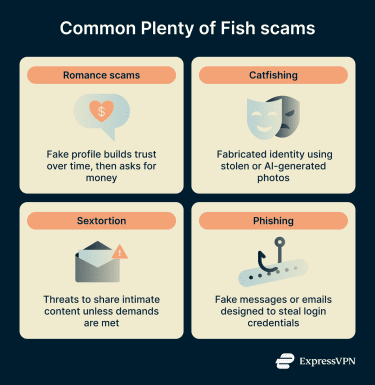
Sextortion scams
Sextortion is when someone threatens to share intimate images or videos unless their demands are met, usually for money or additional explicit material.
It often begins with a normal conversation. The person may steer the interaction toward sharing explicit content, sometimes on the app and sometimes after moving the conversation elsewhere. Once they have that material, they threaten to send it to the person's friends, family, or colleagues.
The FBI Internet Crime Complaint Center (IC3) received over 75,000 sextortion-related reports in 2025, according to its annual report.
Phishing and verification scams
Phishing scams on dating sites like POF typically involve messages or emails used to steal login credentials or personal information. One common approach is a fake "account verification" email that may appear to come from POF support, with a link to a fake login page designed to capture credentials (a tactic known as credential harvesting).
How to spot a Plenty of Fish scammer
No single sign confirms that a profile is a scam. Treat each sign as a signal, not proof.
Signs of a fake profile
Fake profiles often share a few recognizable traits:
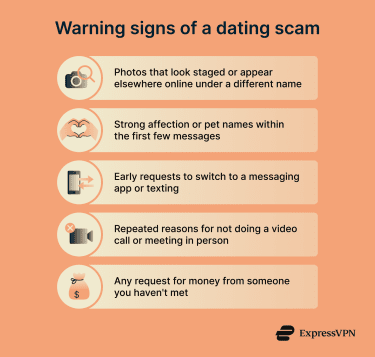
- Photos: Images that look overly polished, staged, appear elsewhere online under a different name, or show inconsistencies across images (lighting, age, or style).
- Profile details: Very little personal information, or only one or two photos.
- Descriptions: Generic bios such as "I love to travel and laugh" without specific details.
- Account activity: A recently created profile that already appears unusually complete.
- Location: Details that don't line up, such as a listed location that doesn't match the person's background.
Red flags in messages and behavior
Certain patterns in conversation can signal a potential scam:
- Tone: Strong expressions of affection early in the conversation, sometimes using terms like "dear" or "my love."
- Language: Messages that feel generic, repetitive, or slightly unnatural.
- Contact requests: Suggest moving the conversation to messaging apps such as WhatsApp, Telegram, or text messaging early on to avoid platform moderation or reporting.
- Availability: Repeated excuses for being unable to meet or join a video call. Similar patterns appear in reported cases, including claims of working overseas or frequent travel.
- Money: Requests for financial help, even small amounts or under urgent circumstances.
Why scammers try to move conversations off the platform
Moving a conversation off POF isn't always a sign of a scam, but it's a pattern that appears frequently in reported cases. Conversations on external apps aren't subject to POF moderation, so they can continue even if the profile is reported or removed.
It can also make it harder to review or report what was said. In some cases, moving off the app is followed by requests to click links, share codes, or send money.
Related: Scams to watch out for on Hinge
How to stay safe on Plenty of Fish
These steps can help reduce risk while using dating apps like POF.
Protecting your personal and financial information
Limit what you share in your profile and in early conversations. Details like your full name, workplace, home address, and daily routine can give someone material to build a more convincing persona or target you outside the app. This information can also be used for identity theft.
Keeping conversations within the app for longer can also reduce the amount of personal contact information you expose before you've built trust.
Avoiding phishing attempts and suspicious links
Don't click links sent by matches, especially ones claiming to verify your identity or resolve an account issue.
If you receive an email that appears to be from POF, keep in mind that POF says it will never email users asking for their username and password, ask them to share their screen, or require payment for customer support. Check the sender's address for misspellings or unfamiliar domains. Phishing emails typically use addresses that resemble but don't exactly match the official domain.
But in some cases, scammers can spoof a sender address (a tactic known as email spoofing) or use a domain that closely resembles the real one, such as replacing a letter with a number. If you're unsure whether an email is legitimate, avoid clicking any links in it and contact POF support directly.
Verifying who you're talking to
A reverse image search can show whether a profile photo appears on other websites or is linked to a different name. Upload the image to Google Images and look through the results. If the same photo shows up under multiple identities, the profile is likely fake.
A video call is one of the simplest ways to check whether someone looks like their photos. If a match repeatedly refuses or makes excuses to avoid one, treat that as a warning sign, especially if other red flags are present. It can help confirm appearance, but it doesn't fully verify identity and may still be manipulated in some cases, such as with pre-recorded video or similar techniques.
What to do if you suspect a scam
If you think you're being scammed, acting early can make a difference. These steps apply whether you've been asked for money, received suspicious links, or noticed multiple red flags in a conversation:
- Stop contact and avoid further engagement: Stop responding. Don't confront the person or tell them you suspect a scam. Continuing the conversation gives them more opportunities to pressure you or adjust their approach.
- Save evidence and document the interaction: Before blocking or reporting the account, take screenshots of the conversation, the person's profile, and any links or payment requests they've sent. Make sure timestamps and account names are visible where possible. Save these outside the app in case the conversation is no longer available after reporting or blocking. These records can support a report to law enforcement if you choose to file one later.
- Report the profile to POF: POF allows users to report profiles through its in-app tools. In the app, open the person's profile, tap the shield icon to open the Safety Toolbox, then tap Report. Reports are reviewed by POF's moderation team.
What to do if you've been scammed
These steps can help limit further damage and create a record of what happened.
Secure your accounts and personal information
Change the passwords on any accounts the scammer may have accessed or that share credentials with your POF account. Enable two-factor authentication (2FA) where available. This adds an extra step to the login process. This makes it harder for someone else to access your account, even if they have your password.
If you shared personal details like your address or identification documents, monitor your accounts for signs of identity theft.
If you're based in the U.S., you can place a fraud alert or credit freeze through Equifax, Experian, or TransUnion. A fraud alert asks lenders to take extra steps to verify your identity before opening new accounts. A credit freeze restricts access to your credit report, which can prevent new credit accounts from being opened in your name.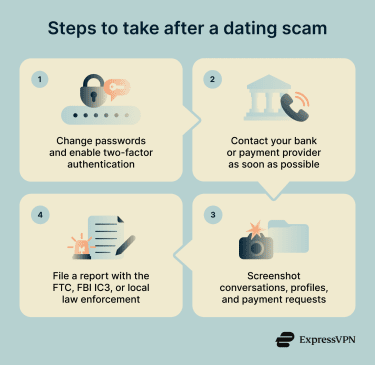
Contact your bank or payment provider
If you sent money, contact your bank or payment provider as soon as possible. For wire transfers, contact your bank or transfer provider immediately and ask whether the transfer can be stopped, recalled, or reversed. This is more likely to work if the transfer is still pending, but it depends on the provider, timing, and transfer network. Credit card payments may be reversible through a chargeback, depending on the issuer and how quickly you act. On the other hand, gift card payments and cryptocurrency transfers are generally much harder to recover.
Related: Do banks refund scammed money?
Report the scam to the relevant authorities
If you're in the U.S., you can report online scams to the Federal Trade Commission (FTC) or the FBI IC3. These reports are used to track patterns and support fraud investigations. If you're outside the U.S., contact your local consumer protection or cybercrime authority.
You can also contact local law enforcement. Filing a police report creates an official record, which may be useful in cases involving identity theft or when a bank or insurer requests documentation.
If you're dealing with sextortion, the FBI recommends reporting through IC3 and not complying with the demands. According to the FBI, paying typically leads to additional requests rather than an end to the threats.
FAQ
Why do scammers ask to move chats off Plenty of Fish?
Do scammers use stolen photos on dating apps?
Can a video call confirm if someone is real?
Should I share my phone number on dating apps?
What should I do if someone asks me for money?
How can I check if a profile photo is fake?
Can I recover money lost in a dating scam?
Contact your bank or payment provider as soon as possible. Filing a report with the FBI Internet Crime Complaint Center (IC3) may also help in cases involving financial fraud.