
DDoS attack tools explained: Risks, warning signs, and ways to stay protected



Denial-of-service (DoS) and distributed denial-of-service (DDoS) attacks are significant cyber threats capable of taking down websites, overwhelming networks, and costing organizations hundreds of thousands of dollars per hour in downtime.
At the center of these attacks are DDoS attack tools: software programs that provide the means to execute DDoS attacks. Some tools, like IP stressers, were originally built for legitimate network stress testing, but the same capabilities can be weaponized for malicious purposes, making them a dual-use threat that's difficult to regulate.
How do DDoS attacks work?
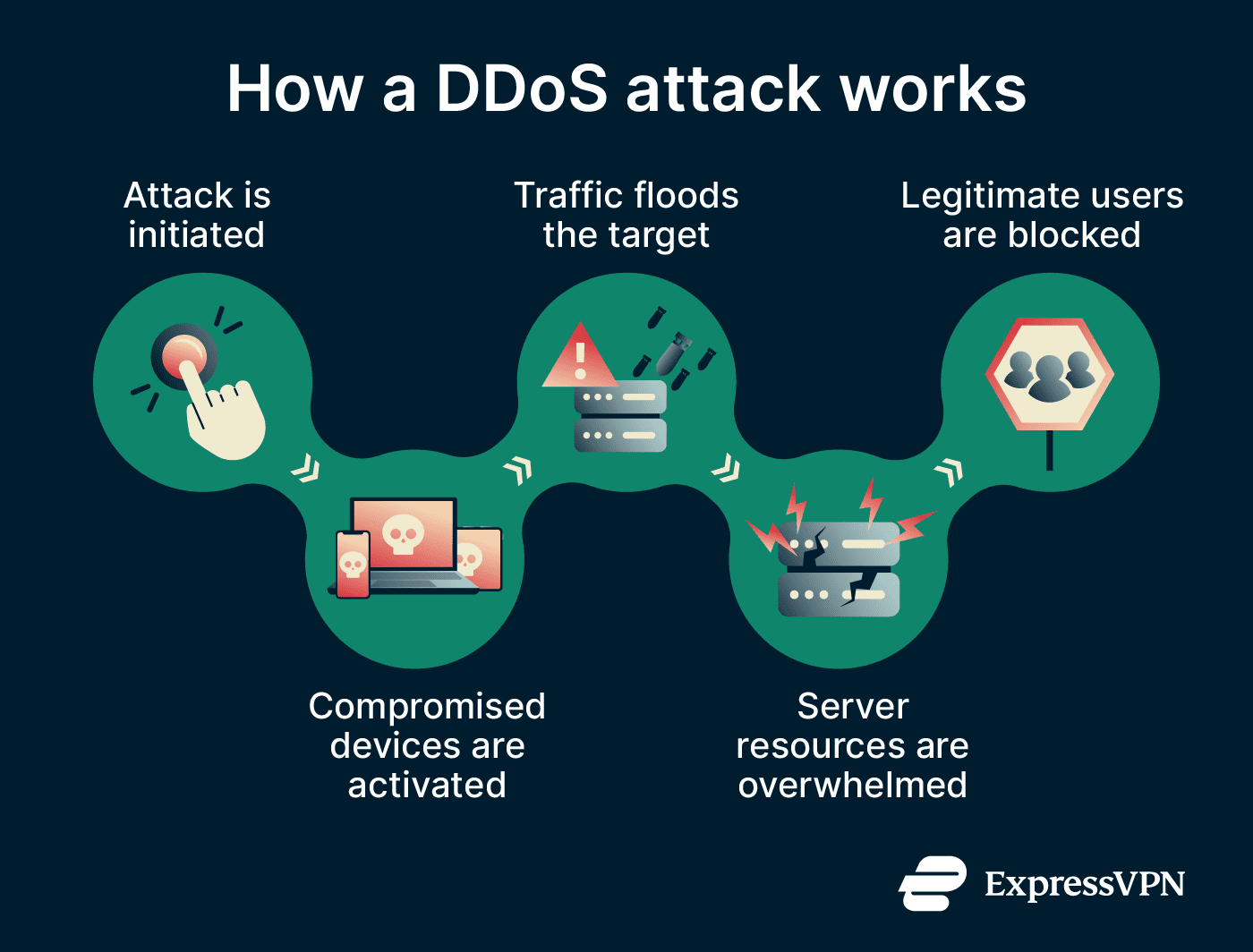
A DDoS attack is a type of cyber attack that works by directing a massive volume of internet traffic at a target from multiple sources at once. A standard DoS attack comes from one machine, while a DDoS attack scales that up by coordinating hundreds or thousands of compromised devices. These devices could be a botnet, which is a network of infected computers or other devices controlled remotely by an attacker.
The result is that the target system becomes so overloaded with requests that it can’t respond to legitimate users. For end users, this looks as if the website has gone down or the service is unavailable.
The first widely recognized DDoS attack occurred in 1999, when an unidentified attacker used the Trinoo tool to knock the University of Minnesota’s network offline. Michael "Mafiaboy" Calce later made DDoS attacks notorious in 2000 by targeting major websites such as Yahoo, Amazon, eBay, and CNN.
Why do attackers perform DDoS attacks?
There are many reasons attackers perform DDoS attacks, ranging from something as simple as petty revenge on a competitor to something more complex, like a smokescreen to distract IT teams while a concurrent cybercrime occurs. Politics and activism are another motivation, as there have been various groups in the past that have targeted websites in specific countries for political reasons.
Extortion and blackmail are also common drivers behind DDoS attacks. A noteworthy example of this is the "Operation Dating Disaster" case involving the cybercriminal collective CybSec Group, which targeted the online dating platform AnastasiaDate between 2015 and 2016. The attackers launched repeated DDoS attacks that caused the website to go offline for several hours each day and demanded ransom payments to stop the disruptions.
Investigators later discovered that the group had also targeted online stores, payment systems, and gaming websites, using DDoS attacks as a means of financial extortion.
What are DDoS attack tools?
DDoS attack tools are software programs used to carry out DDoS attacks: to flood targets like servers, networks, or online services with more traffic than they can handle, forcing them offline or degrading their performance. Some of these tools, like IP stressers, were originally designed for legitimate network stress testing, but cybercriminals can use them for malicious purposes.
The following are some noteworthy DDoS attack tools:
- Low Orbit Ion Cannon (LOIC): An open-source application initially built to assist with network stress testing, but now widely associated with DoS and DDoS attacks.
- High Orbit Ion Cannon (HOIC): Another open-source application that’s associated with DDoS activity and expands on LOIC’s capabilities through additional functionality.
- Slowloris: A tool that disrupts servers by exhausting connection resources rather than generating massive traffic volumes.
- R-U-Dead-Yet (R. U. D. Y): Targets web forms to gradually exhaust server resources, allowing attackers to cause disruption with minimal bandwidth usage.
Types of DDoS attacks
The types of DDoS attacks these tools execute can be classified using various criteria, such as the protocol they use, their specific attack mechanisms, or which layer of the Open Systems Interconnection (OSI) model (a framework that breaks network communication down into seven distinct layers) they target. Below are some common classifications of DDoS attack types.
Volumetric attacks
Volumetric attacks, as the name suggests, are designed to overwhelm a server or network with sheer volume to a point where it’s unable to respond to legitimate traffic. The volumes of these attacks are usually measured using bits per second (bps), packets per second (pps), or connections per second (cps). These attacks can leverage Internet of Things (IoT) botnets to amplify their reach by exploiting the sheer number of connected devices available.
Protocol attacks
Protocol attacks target vulnerabilities in network protocols like User Datagram Protocol (UDP) or Transmission Control Protocol (TCP) in order to exhaust a system’s resources by exploiting how connections are handled.
A noteworthy example is the SYN flood attack, which exploits the TCP three-way handshake mechanism (a three-step process through which a client and server establish a connection). The attack works by sending connection requests but never completing them, leaving the target server with no ports available to accept legitimate connections.
Application layer attacks
Application layer attacks target Layer 7 of the OSI model, focusing on overwhelming targets using mechanisms like HTTP GET and POST (the standard methods browsers use to submit and retrieve data from web servers).
What makes these attacks particularly dangerous is that they’re able to exhaust server resources, as a single GET request could potentially trigger a lengthy database lookup. For example, an attacker could request a page that queries an entire product catalog or runs a full search across millions of records, forcing the server to do significant work. Additionally, these attacks mimic legitimate user behavior and are much harder to distinguish from genuine requests.
Low and slow attacks
As the name suggests, these attack types aim to exhaust resources using a stream of slow traffic. Rather than overwhelming a target with huge traffic spikes, they keep server connections open for extended periods by sending data extremely slowly, consuming available resources and preventing legitimate users from connecting. They’re also capable of remaining undetected for long periods because they resemble regular traffic.
Common consequences of DDoS attacks
Alongside website or server downtime, DDoS attacks can hinder revenue, overburden security teams, and erode customer trust.
Service downtime and lost revenue
The first risk of a DDoS attack is downtime that leads to lost revenue. According to a 2026 report from Splunk, a Cisco-owned security and observability platform, unplanned downtime now costs Global 2000 companies an estimated $600 billion annually, with the average cost reaching $15,000 per minute.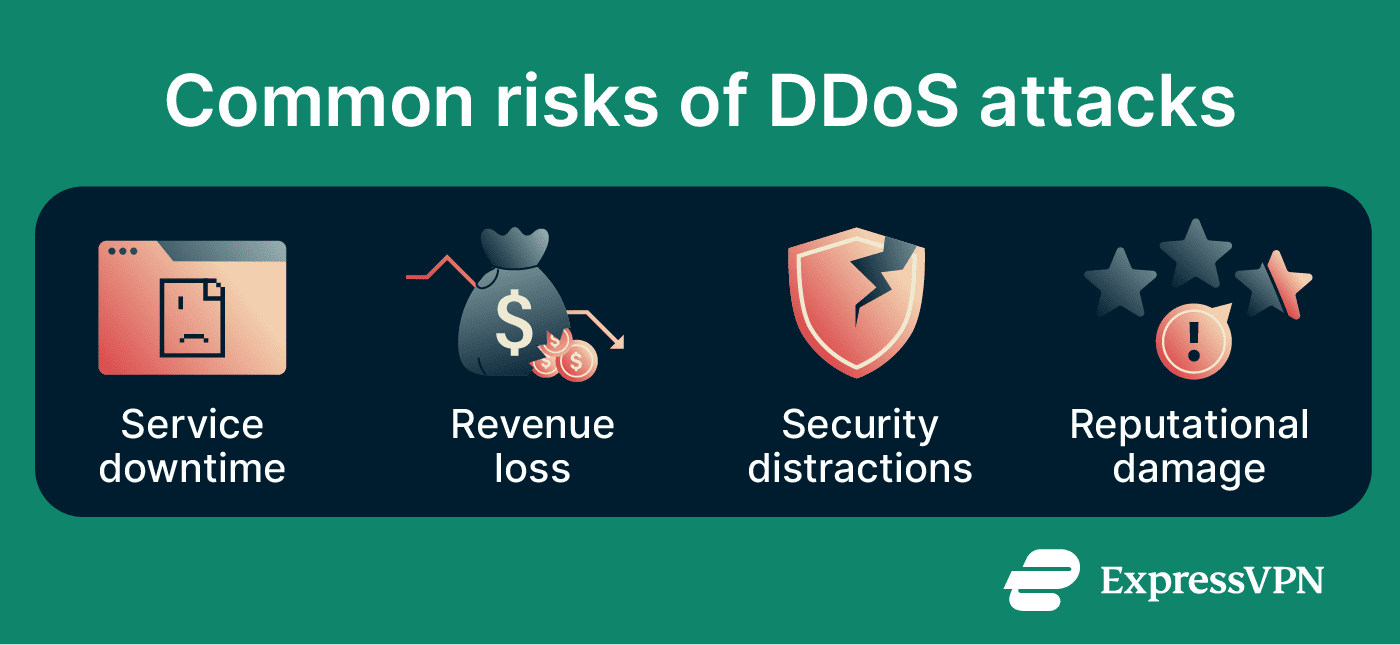
Security distractions during attacks
One of the less obvious but highly dangerous risks of DDoS attacks is their use as a diversion. Attackers can synchronize DDoS attacks with operations like privilege escalations, credential theft, lateral movement, or data exfiltration, a tactic known as a DDoS smokescreen.
A noteworthy example of a DDoS smokescreen was the attack on the Internet Archive, which was hit by a series of DDoS attacks in 2024. While its security team focused on mitigating the assault, attackers breached the system and stole data on more than 31 million users. This is why it’s vital to have cyber threat monitoring tools that can distinguish a DDoS event from a concurrent intrusion.
Reputation and customer trust damage
Repeated service disruptions can damage how customers perceive a brand. This risk is especially high in sectors where users expect real-time access, such as online gaming, financial services, and e-commerce. A player disconnected mid-match, a trader unable to complete a transaction, or a customer blocked at checkout may not see a technical outage as a minor inconvenience. They may see it as a sign that the service is unreliable, unsafe, and ultimately not worth returning to.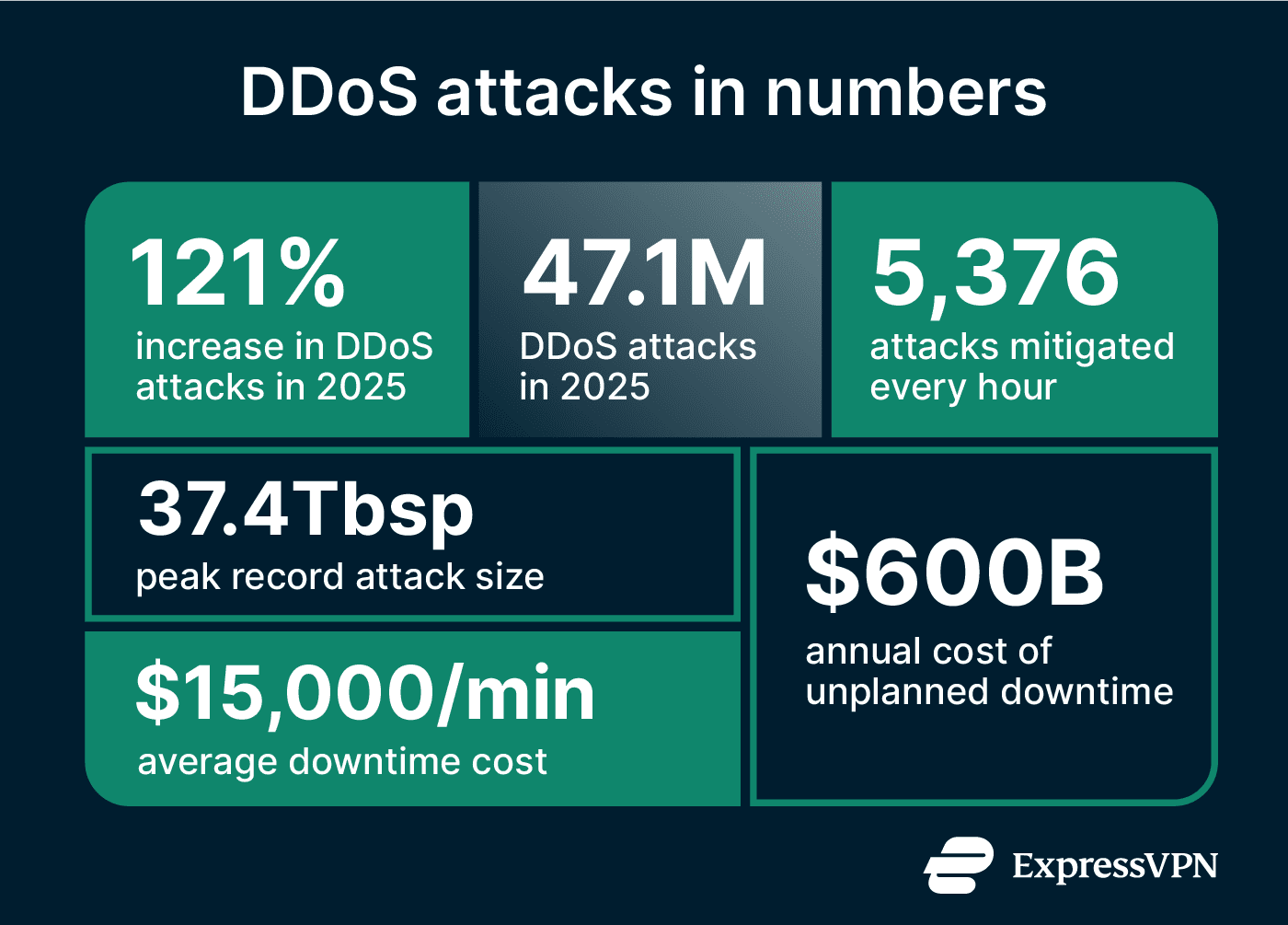
Signs your website may be under a DDoS attack
Detecting a DDoS attack early can help reduce the damage it causes, and below are the most common indicators to watch for.
Sudden traffic spikes
A sudden and unexplained surge in incoming traffic, especially from unusual geographic locations or a large number of IP addresses, is a key early signal of a DDoS attack. Even if it’s not an ongoing attack, it could signal that one is imminent because cybercriminals often begin by probing infrastructure for weaknesses before launching a full-scale assault.
Slow website performance
Before a website goes fully offline, it often becomes noticeably slow, and in some cases, it might just stay in a degraded state. This can happen when server resources are partially consumed by attack traffic via sub-threshold DDoS attacks, which degrade performance without triggering standard alerts.
Packet loss is another indicator worth monitoring, as unusually high packet loss during what appears to be normal traffic levels can be an early sign that the network is being flooded.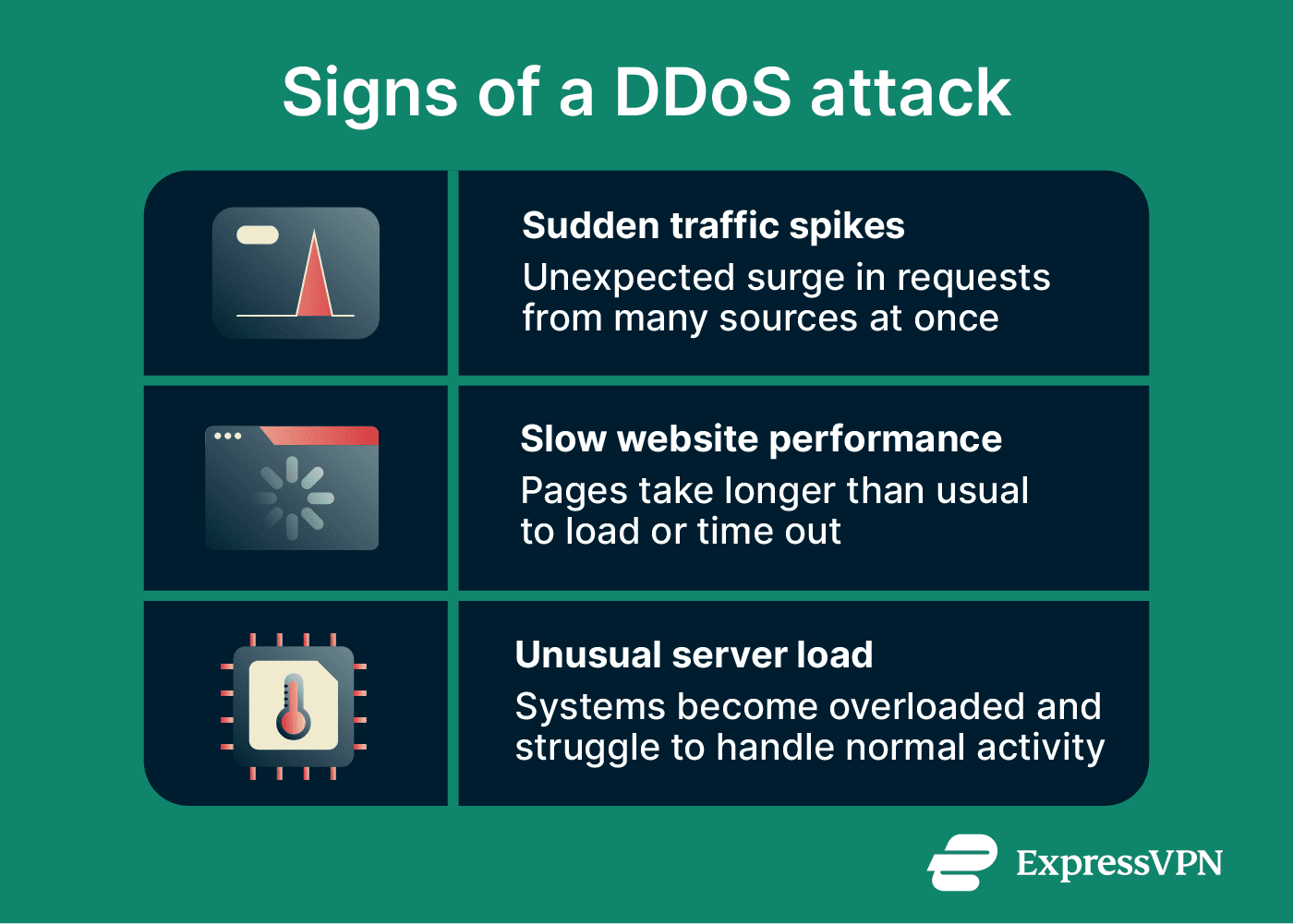
Unusual server or network behavior
Beyond immediately noticeable traffic spikes and slowdowns, DDoS attacks can produce unexpected behavior in server logs and network configuration metrics. This could involve server CPU or memory usage spiking without a clear cause, or connection tables filling faster than normal. This is especially prevalent in low-and-slow attacks like Slowloris.
Since many web servers only write access logs after a request completes, these attacks can persist without generating log entries, and network administrators must rely on other unusual behavior indicators, like lots of partial HTTP requests or a large number of connection attempts.
What to do in the event of a DDoS attack
Below are some key steps covering how to respond effectively to DDoS attacks, from initial confirmation through to customer communication.
- Confirm the attack and identify targets: Check server logs and network monitoring tools to confirm the source and pattern of the traffic, while also checking for activity that could indicate a secondary attack.
- Contact your hosting provider or internet service provider (ISP): Your ISP might have the functionality to filter and mitigate malicious traffic causing a DDoS attack, and notifying them early gives them more time to help reroute or filter malicious traffic before it overwhelms your infrastructure.
- Activate mitigations and update firewall rules: Activate any DDoS mitigation or content delivery network (CDN) protections you have in place, such as Cloudflare or Amazon Web Services (AWS) Shield, and update firewall rules to block known malicious IP ranges or traffic from regions you don’t serve. Be cautious about over-blocking, as aggressive filtering can block legitimate users.
- Preserve logs and telemetry: Preserve logs throughout the attack, as this data can help with post-incident analysis.
- Monitor for concurrent intrusion activity: DDoS attacks are sometimes used as a smokescreen for concurrent malicious activity such as a data breach or network intrusion.
- Communicate with users and customers: A brief, factual status update reduces reputational damage and demonstrates that the situation is being managed. Avoid speculating on cause or duration until you have confirmed information.
How to protect against DDoS attacks
Effective DDoS attack prevention requires multiple overlapping controls. Rate limiting, firewalls, traffic filtering, and load balancing each address different attack vectors, and they work best in combination.
Rate limiting
Rate limiting caps how many requests a single IP address can make within a given timeframe, cutting off sources that send traffic at volumes no legitimate user would generate. It’s one of the most straightforward and widely used DDoS prevention tools.
Best practices for rate limiting include setting appropriate thresholds and using allowlists and blocklists to ensure legitimate traffic isn’t blocked and malicious traffic is filtered. Our dedicated guide to rate limiting goes into more depth about the various mechanisms and how they all work.
Web application firewalls
A web application firewall (WAF) sits between a web application and incoming traffic, using configurable rules to inspect and block requests that match known attack signatures or suspicious patterns. WAFs are particularly effective against application-layer attacks, which mimic legitimate traffic and bypass simpler filtering mechanisms.
Additionally, modern AI-driven WAFs use behavioral analysis to identify attack patterns and adapt dynamically, rather than relying on static signature matching.
Traffic filtering and monitoring
Real-time traffic monitoring and filtering tools analyze incoming request patterns, flag anomalies, and block malicious IPs before they can overwhelm resources. Monitoring logs for unusual spikes or irregular request behavior lets teams identify and respond to attacks earlier, rather than reacting once performance has already degraded.
Load balancing
Load balancers distribute incoming traffic across multiple servers, preventing any single server from becoming a bottleneck. Modern cloud-based load balancing solutions like Amazon’s Elastic Load Balancing (ELB) are capable of scaling automatically based on traffic received, helping ensure services stay operational during a DDoS traffic flood.
Caching
A cache is simply a storage area that keeps copies of recently or frequently used data, ensuring it’s available more quickly during repeated usage. This allows servers or websites to serve pre-saved versions of frequently requested content, so fewer requests need to reach the origin server at all. During an attack, this reduction in origin server load can be the difference between staying online and going down.
Best practices for organizations
For organizations, it’s important to have a proactive approach towards DDoS attack mitigation, combining a comprehensive technical setup with clear best practices.
- Develop a dedicated incident response plan: Define roles, responsibilities, and escalation paths specifically for DDoS scenarios, including situations where a concurrent breach attempt may be underway using DDoS as cover.
- Partner with a DDoS attack protection service: Cloud-based DDoS attack protection services are capable of mitigating various attack types.
- Monitor outbound traffic: Compromised resources can be recruited into botnets that cybercriminals use to attack other targets, meaning it's important to monitor outbound traffic for anomalous patterns.
- Track metrics to improve further: Tracking incident response metrics like mean time to detect (MTTD), mean time to acknowledge (MTTA), mean time to recovery (MTTR), and mean time to contain (MTTC) is crucial, as it allows organizations to have a baseline that they can work to improve over time.
- Regular auditing: Reviewing and auditing organizational infrastructure on a regular basis ensures that any vulnerabilities can be spotted and fixed before they’re exploited.
When DDoS activity is illegal (and when it’s not)
The legality of DDoS activity depends almost entirely on authorization. While the tools can overlap, the line between legitimate security testing and criminal activity is clear.
Why unauthorized DDoS activity is illegal
Launching a DDoS attack without authorization is a criminal offense in most jurisdictions. Still, not all countries have cybercrime legislation in place. This means enforcement depends heavily on whether the attacker operates from a country with adequate legal frameworks.
In the US, DDoS attacks violate the Computer Fraud and Abuse Act (CFAA), with potential federal felony charges carrying up to 10 years in prison.
In the EU, the Directive 2013/40/EU on attacks against information systems criminalizes the intentional disruption of information systems.
In the UK, the Computer Misuse Act 1990 makes it illegal to intentionally impair the operation of a computer or prevent or hinder access to a program or data. The Act also makes it illegal to make, supply, or obtain stresser or booter services that could be used to facilitate DDoS attacks.
Safe and ethical security testing
There are legitimate contexts for stress testing network infrastructure. These require explicit written authorization from an organization or system owner, controlled testing environments isolated from production systems, and clear scope boundaries agreed upon before testing begins.
Anyone conducting ethical testing has to operate within these specified parameters.
Ethical testing should also be typically scheduled during agreed-upon maintenance windows with relevant IT and security teams notified in advance, as even authorized tests can unintentionally disrupt services if not carefully managed. Testers should also document scope, methods, timestamps, and outcomes throughout, both for accountability and to demonstrate that activity remained within authorized parameters.
Another thing to be cautious of is the variety of publicly marketed "stress testing" services. The FBI has repeatedly found that the vast majority of such services are illegal DDoS-for-hire operations that use legitimate-sounding branding as a facade. As part of Operation PowerOFF, U.S. and international law enforcement agencies have seized more than 100 domains associated with DDoS-for-hire services in recent years.
Future of DDoS attacks and mitigation
DDoS attack volumes are breaking records while the tools to launch them get cheaper and more automated. However, defensive capabilities are also improving, with the most recent attacks being mitigated via automated systems.
Evolving DDoS attack tools and tactics
According to Cloudflare’s Q4 2025 DDoS threat report, global DDoS attacks surged by 121%, reaching 47.1 million incidents across 2025, with an average of 5,376 attacks mitigated every hour. The most significant recorded attack, driven by the Aisuru-Kimwolf botnet, peaked at 31.4 Tbps, a scale capable of disrupting significant infrastructure.
AI is also being incorporated into attack tooling, providing attackers the ability to automate traffic shaping, which helps mimic user behavior and evade detection. The pattern analysis capability also gives AI-driven attacks the option to dynamically adjust parameters like packet size, protocol type, and target endpoint, making these attacks far more versatile and adaptable.
IoT devices are being recruited into botnets at scale, largely because many don’t have the vulnerabilities in their firmware patched. The Aisuru-Kimwolf botnet, for instance, is a result of its operators scanning for vulnerable devices on the internet and infecting whatever devices they could with malware.
Stronger defensive technologies
The primary advancement in defensive technologies has been the automation of mitigation measures. For example, according to the report mentioned above, Cloudflare blocked 20.5 million DDoS attacks in the first quarter of 2025, 700 of which exceeded 1Tbps in volume. A notable portion of these were blocked automatically.
The rise of cloud-native DDoS mitigation platforms is also an emerging trend, combining AI-driven detection, global traffic distribution, and human security expertise to thwart malicious actors.
FAQ
Can small websites be targeted by DDoS attacks?
How long does a DDoS attack usually last?
Can a firewall stop every DDoS attack?