What is a script kiddie? How they attack and why it matters


“Script kiddies” is typically a derogatory term used to describe people who use ready-made hacking tools to launch attacks, lacking the skills to create their own.
In the past, that lack of skill limited how much damage they could do, but with the evolution of AI, the technical barrier for carrying out cyberattacks has dropped dramatically. Someone with little to no coding experience can now potentially knock websites offline, probe systems for weaknesses, or target poorly protected accounts.
This guide explains who script kiddies are, how their attacks work, why AI can make their efforts more effective, and what practical steps you can take to reduce your risk.
What is a script kiddie?
A script kiddie (also known as a “skiddie”) is a person who attempts to break into computer systems or cause online disruptions using pre-written scripts or tools. The term combines “script,” referring to pre-existing code, and “kiddie,” implying immaturity or a lack of expertise. They often follow step-by-step guides or online tutorials, running commands or programs often without fully understanding what’s happening behind the scenes.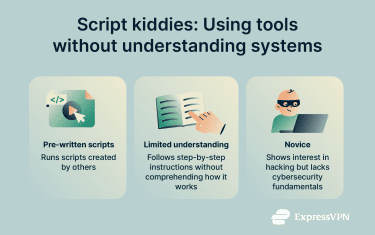
Why AI has made script kiddies more dangerous
Script kiddies have always relied on pre-existing tools, but AI has changed what level of automation they can do without any technical experience. As a result, the pool of potential malicious actors online has grown significantly. Cybercriminals with limited skills now have access to tools that can scale attacks in ways that wouldn’t have been possible in the past.
In fact, AI safety and research company Anthropic’s August 2025 Threat Intelligence Report documented a case of an AI system handling an unprecedented portion of a cyberattack autonomously. The attack was a serious operation that targeted around 17 organizations across government, healthcare, emergency services, and religious
institutions with minimal human input.
In addition, since AI makes these attacks easier and less time‑consuming, attackers are likely to broaden their targets. Modern automated tools give cybercriminals the chance to target smaller or less obvious entities that they may have previously ignored.
Script kiddie vs. skilled hacker
Skilled hackers usually invest time in learning programming, networking, and security concepts. Their intent is more deliberate and often falls into clearer categories. Some are ethical, often called white-hat hackers, and work to find and fix security flaws with permission. Others, known as black-hat hackers, intentionally break the law for personal gain and are often part of ransomware syndicates.
Script kiddies tend to sit outside these categories, typically lacking both strong skills and a defined ethical stance.
Learn more: For a detailed explanation of hacker types, see our guide to white-hat, gray-hat, and black-hat hackers.
Common script kiddie attacks
Below are some of the most common types of attacks associated with script kiddies, explained in simple terms.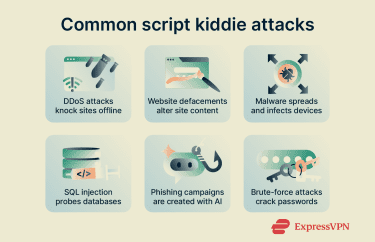
Distributed denial-of-service (DDoS) attacks
A DDoS attack aims to overwhelm a website or online service by flooding it with traffic until it becomes unavailable. Imagine thousands of people trying to enter a small store at the same time. The door gets blocked, and no one can get in. Botnets (large networks of compromised devices under remote control) commonly generate this traffic.
For example, researchers at Aqua, a cloud-native security company, reported on a suspected script kiddie that targeted 30+ million devices to create massive botnets in 2024. The attacker reportedly exploited vulnerabilities in a variety of servers and devices, including Internet of Things (IoT) devices, leveraging existing tools rather than using advanced hacking skills to carry out the activity.
Website defacements
Website defacement happens when someone changes how a website looks without permission. This might include replacing the homepage with a message, image, or nickname. Script kiddies may do this to show off or prove they gained access. While it may look harmless, it can damage trust, embarrass website owners, and signal deeper security problems that others could exploit.
Malware deployment
Malware is short for malicious software, meaning programs designed to cause harm. Script kiddies may spread malware that disrupts systems, spies on users, or gives someone else control over a device. In some cases, infected devices can slow down, crash, or become part of larger attacks without the owner realizing it.
Advances in AI have led to advances in malware. In fact, a Google Threat Intelligence Group (GTIG) report from 2025 stated that some malware developed by AI can now dynamically rewrite its code to evade detection.
Structured Query Language (SQL) injection attempts
SQL injection (SQLi) is a type of attack that targets websites with databases. It involves entering specially crafted input into forms such as login fields to manipulate database queries and potentially reveal or change data. These attacks can appeal to script kiddies because they’re easy to automate with readily available tools, making the barrier to entry relatively low.
SQLi peaked in earlier eras of web development, but it can still be a threat today due to legacy systems, misconfigurations, and insecure coding practices that persist in some environments.
Phishing campaigns
Phishing scams are attempts to trick you into revealing sensitive information, typically through malicious links or fake websites. These attacks can be carried out via almost any form of online communication, from email and text messages to social media. Low-tech scammers often carry out these attacks, but script kiddies may also automate and accelerate phishing campaigns.
For example, prebuilt phishing kits and AI tools can generate convincing emails or fake login pages in large numbers. According to the 2025 Phishing Trends Report by KnowBe4 (specialists in security awareness training), 82% of all the phishing emails they analyzed between September 2024 and February 2025 showed some use of AI.
Password guessing
Brute force attacks are attempts to crack passwords through trial and error. AI has made the automated tools for this process more advanced. A script kiddie can now make more guesses and analyze more data, improving their chances of stealing a password.
How to protect yourself from script kiddies
Protecting yourself from script kiddies doesn’t require expert knowledge or expensive tools. Many attacks succeed because of basic security gaps that are easy to fix. By focusing on simple habits and common sense protections, you can reduce your risk and make yourself a much harder target.
Online practices to safeguard from script kiddies
- Stay wary of phishing scams: Be careful with unsolicited emails or messages, especially those that pressure you into clicking a link or providing sensitive information. There’s a big risk involved in clicking any link from an unknown source. Any request for sensitive data should also be handled with caution. Even if the request is from someone you know, verify it first in case their account has been compromised.
- Practice good password hygiene: Strong, unique passwords avoid common phrases or easy-to-guess information, use a mix of uppercase, lowercase, numbers, and special characters, and use around 12–16 characters. Any device that uses default configurations is a cybersecurity risk, so it’s also a good idea to update your credentials as soon as a new device is set up. Finally, avoid reusing passwords across different sites, because a single breached account might otherwise lead to multiple compromises.
- Limit the personal data you share online: Script kiddies may gather personal data from social media profiles to craft targeted attacks through social engineering.
Tools to protect you from script kiddies
- Two-factor authentication (2FA): 2FA adds an extra layer of security by requiring a secondary confirmation code (usually sent to your phone) when you log into your accounts. It helps protect your accounts in the event that your password is leaked or cracked.
- Software security: Enabling automatic updates for your operating system and apps makes sure they have the latest security patches. It’s also a good idea to reduce the number of unnecessary programs on your device to limit potential entry points for attackers.
- Antivirus and firewall: Antivirus software helps detect and block malware, and a properly configured firewall can monitor and filter incoming and outgoing traffic, preventing attempts at unauthorized access.
- Regular backups: Automatic backups can regularly copy your data to cloud storage or external drives. This makes it more likely that you retain your files if a script kiddie ever compromises your device.
- Private browsers: It’s possible to reduce your online fingerprint by using your current browser’s incognito mode, choosing a more private browser, or utilizing an encrypted browser like Tor.
- Virtual private networks (VPNs): A VPN hides your IP address and encrypts your traffic, reducing IP-based tracking and protecting you on public Wi-Fi networks. ExpressVPN’s Threat Manager feature can also flag suspicious links and downloads, helping to protect you from phishing attempts.
- Dark web monitor: Cybercriminals often sell compromised data on the dark web. If your information is found in a shady dark web marketplace, a dark web monitor can alert you. This can help you to change passwords and cleanse your devices before a script kiddie (or any malicious actor) can inflict further damage.
- Data removal services: Data brokers and people search sites also sell your data for a profit. A data removal service can be used to contact these companies and get them to delete your information. This could stop it from being sold or ending up in a breach where it can be accessed by script kiddies and other cybercriminals.
- Password manager: These tools generate and store unique passwords for you in one place. It makes it easy to use a different, strong password for all your accounts.
FAQ: Common questions about script kiddies
Is it spelled “script kitty” or “script kiddie”?
The most common term is "script kiddie." The term comes from the idea of someone using pre-written scripts without deep knowledge. The word “kiddie” highlights inexperience, not age, and is widely accepted in cybersecurity writing. The term “script kitty” is often considered a misspelling or a joke.
Are script kiddies common in gaming?
Yes, it’s highly likely that they are, especially with the prevalence of distributed denial-of-service (DDoS) and other such cyberattacks in the gaming space. While it’s not always easy to prove how these attacks are carried out, online games would likely attract script kiddies because servers are public and reactions are immediate.
Can a script kiddie do real damage?
Yes, script kiddies may be able to execute effective cyberattacks with the help of AI and other automated tools. However, their ability is generally limited to exploiting known vulnerabilities and running existing exploits; they typically lack the skills to develop sophisticated or highly targeted attacks. Despite this, automated campaigns can still cause significant disruption, especially against poorly secured systems.
What are the best defenses against script kiddies?
The best defenses are basic but consistent security practices. Practices like strong password hygiene, avoiding links from unknown sources, setting up two-factor authentication (2FA), and using a VPN are a good start.
How do script kiddies differ from black hat hackers?
They differ mainly in skill, planning, and intent. Black hat hackers typically understand systems deeply and act deliberately. Script kiddies rely on automation rather than expertise, which limits their control.
Is a script kiddie the same as a beginner hacker?
Not exactly, although the terms are sometimes confused. A beginner hacker is usually interested in learning how the underlying systems work. Script kiddies typically skip the learning phase and depend on shortcuts instead.
Do script kiddies target mobile devices?
Yes, mobile devices can be targets, though it’s likely less often than websites or servers. Phones still run software and connect to networks, and any connected device with weak security can attract attention.
Take the first step to protect yourself online. Try ExpressVPN risk-free.
Get ExpressVPN










 Support Center
  FAQ
FAQ  VPN Setup Tutorials


