 Celebrate with up to 80% off
ExpressVPN Survey: The World Cup Wi-Fi Trap—How a Familiar Network Name Puts Over 70% of Fans at Risk

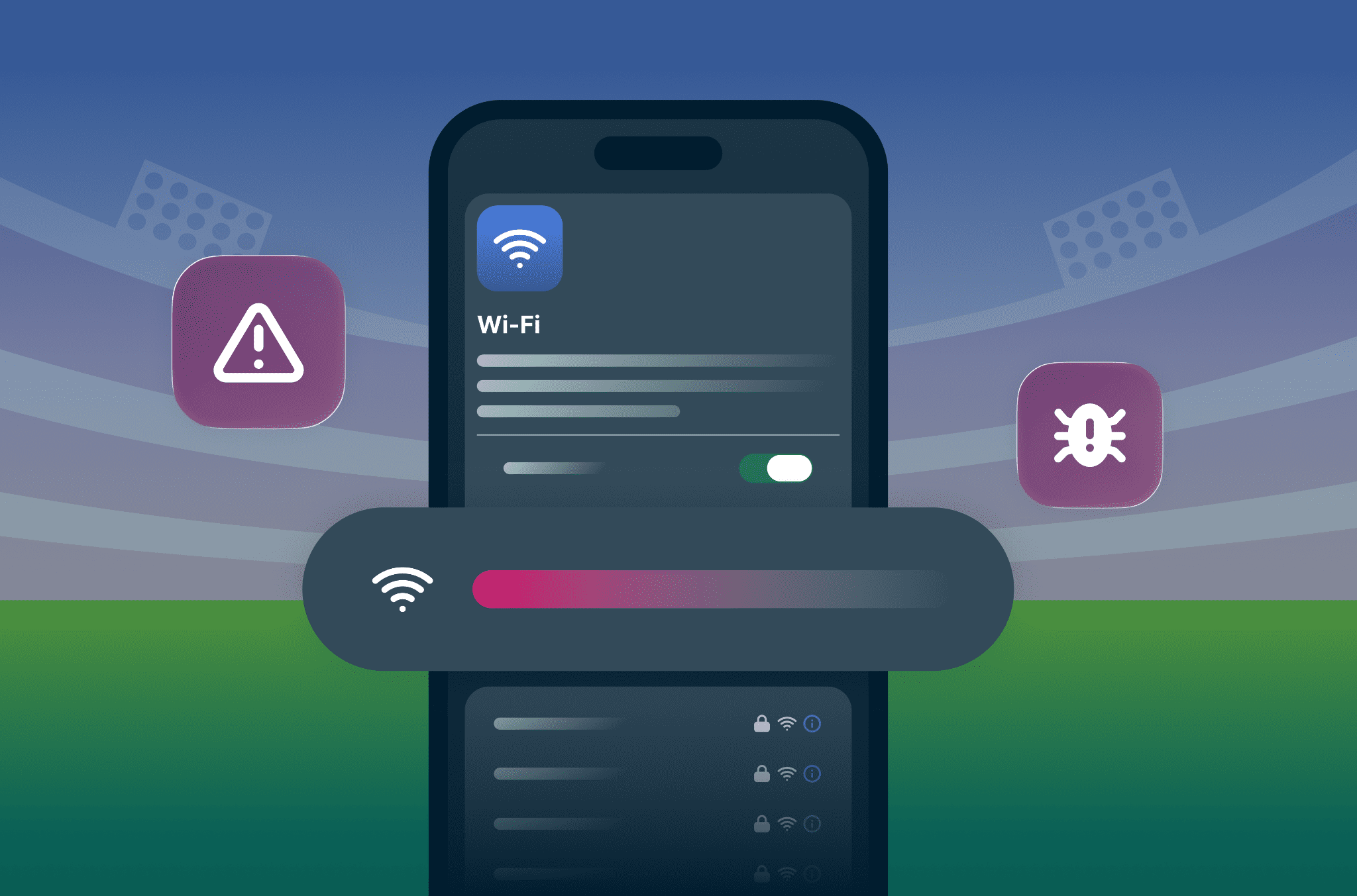
New research across six countries reveals how football fans are putting their personal data at risk ahead of the 2026 FIFA World Cup
- Across all six markets, fewer than 4 in 10 fans say they could spot a fake network, while nearly 3 in 4 would connect to one simply because it uses a familiar venue or event name.
- Knowing the risks isn't stopping many fans: the majority of respondents across all six markets think public Wi-Fi at venues like stadiums, airports, and bars is dangerous, but fans still connect for convenience.
- Gen Z fans are the most willing to trade security for access, with younger respondents consistently the most likely to use public Wi-Fi to follow a match, even when they know it may not be secure.
British Virgin Islands [June 9, 2026] — With an estimated 6.5 million people expected to attend matches during the 2026 World Cup, and millions more following the tournament online around the world, new research from ExpressVPN has uncovered a vulnerability that cybercriminals are ready to exploit: football fans are highly likely to connect to any public Wi-Fi network that looks legitimate.
The survey of 6,000 football fans across the United States, the United Kingdom, France, Germany, Spain, and Australia found that nearly three in four people would trust and connect to a public Wi-Fi network if it used the name of a venue or event they were attending, such as 'MetLife_Stadium_WiFi' or 'Wembley_Guest_WiFi,’ showing how a recognizable name is often all it takes to get fans to connect. In the United States, that figure rises to 82.4%; in the UK, 80.6%; in Germany, 77.2%; in France, 68.3%; in Australia, 65.8%; and in Spain, 62.1%. The problem is that cybercriminals know this too, and setting up a convincingly named malicious network requires very little technical skill.
Yet in the same survey, fewer than 4 in 10 fans in any market said they believed they could distinguish between a legitimate public Wi-Fi network and a fake one. German fans were the least confident of all six markets, with just 19.2% saying they could spot the difference, despite 77.2% saying they would trust a venue-named network. Spanish fans were only slightly more confident at 24.7%, followed by Australia (26.9%), France (31.0%), the UK (33.1%), and the U.S. (37.5%).
Once connected, fans do far more than check scores. Across all six markets, fans reported logging into their social media accounts, email, and banking apps on stadium Wi-Fi and making purchases. UK fans were the most likely to log in to social media on stadium Wi-Fi (56.9%), while U.S. fans led on purchases, with more than 1 in 4 (28.2%) buying tickets, food, or merchandise on an unverified network. Around 1 in 7 fans in both the U.S. and the UK accessed a banking or financial app on stadium Wi-Fi, a pattern seen across all six markets.
Every login, transaction, and message sent on an unverified network is an opportunity for malicious actors to exploit. Many fans have already found that out the hard way. Across all six markets, fans reported experiencing phishing scams, fraudulent charges, and hacked accounts at major sporting events. France reported the highest rate of phishing and scam message experiences at major sporting events, with 29.0% of French fans saying they had been targeted, followed by Spain at 26.1%, the U.S. at 19.6%, Australia at 19.3%, and the UK at 18.0%.
Fans know the risk. They connect anyway.
The research reveals a clear gap between awareness and behavior. In every country surveyed, majorities acknowledged that connecting to public Wi-Fi at venues like stadiums, airports, and bars is risky, including 82.5% of Spanish fans, 75.8% of Australian fans, and 73.4% of U.S. fans.
But when the match is live, caution often gives way to convenience. More than half of U.S. fans (55.5%) have streamed live matches or sports content on public Wi-Fi, alongside 48.9% in Germany, 47.7% in Spain, 46.9% in the UK, 42.4% in France, and 34.4% in Australia. At the World Cup — the biggest live sports event on the planet — that means millions of fans connecting to unverified networks simultaneously, across stadiums, airports, and hotels spanning three countries.
Gen Z: The most exposed generation
That behavior is especially pronounced among younger fans. Across all surveyed markets, Gen Z respondents were consistently more likely to take risks to stay connected online. In the United States, nearly half of Gen Z respondents (47.7%) said they would be willing to use public Wi-Fi to follow a match, even if they knew it might not be secure. That figure was 38.7% in the UK, 30.9% in France, 23.9% in Germany, 23.7% in Spain, and 22.4% in Australia.
Gen Z respondents were also the most likely to have entered personal details to access the internet in the first place. In the United States, 45.3% of Gen Z fans said they had entered personal information, such as an email address or phone number, to access Wi-Fi or sports content during a match or tournament. That figure was 38.8% in France, 38.3% in the UK, 36.4% in Spain, 35.2% in Germany, and 28.2% in Australia.
For cybercriminals, this creates an ideal target: younger fans who are highly connected, comfortable entering personal information, and more willing to accept online risks in exchange for instant access to matches, streams, and live updates. Cybercriminals often take advantage of major live events by launching phishing scams, fake streaming platforms, fraudulent ticket scams, and fake public Wi-Fi networks designed to mimic legitimate venue connections.
"Cybercriminals don’t need sophisticated tools to target football fans. They just need to name their network ‘Wembley_Guest_WiFi’ and wait," said Aaron Engel, CISO at ExpressVPN. "Our research shows the vast majority of fans would connect without thinking twice. Brand trust has become a vulnerability malicious actors are keen to exploit, and the World Cup—with millions of fans travelling to stadiums across three countries—is the biggest opportunity attackers have had in years. Be cautious of things that are too good to be true, such as offers of unreasonably cheap tickets or free access to a paid stream. The irony is that protecting yourself doesn't require sophisticated tools either—a VPN takes seconds to switch on and makes you a significantly harder target. Attackers rely on fans doing nothing. Don't make it that easy for them.”
Using a VPN on public Wi-Fi can help encrypt internet traffic and reduce the risk of interception when connecting through shared or unfamiliar networks while traveling or attending live events.
To read the complete findings, visit: https://expressvpn.com/blog/football-fans-stadium-wifi-risk-survey
Methodology
This survey was commissioned by ExpressVPN in May 2026 in collaboration with online market research provider Pollfish. The survey included football/soccer fans across the United States, the United Kingdom, France, Germany, Spain, and Australia, with 1,000 respondents surveyed in each market. All respondents identified as football fans who closely or casually follow the sport.
About ExpressVPN
Founded in 2009, ExpressVPN helps millions of people worldwide take control of their digital privacy and security. Best known for its award-winning consumer VPN, ExpressVPN has evolved into a broader privacy and security company designed to protect users across every aspect of their online lives.
The company’s expanding portfolio includes the ExpressVPN app powered by its open-source Lightway protocol; ExpressKeys, a zero-knowledge password manager; Identity Defender, a dedicated identity protection app (U.S.); ExpressMailGuard for inbox privacy, and ExpressAI, a private-by-design AI platform built on confidential computing. The umbrella also extends to business and lifestyle solutions, including ExpressVPN for Teams for growing organizations and the Holiday.com eSIM service.
ExpressVPN’s technology and privacy safeguards have been independently audited and verified by leading third-party experts, including PwC, Cure53 and KPMG.
Registered in the British Virgin Islands, ExpressVPN has been part of Kape Technologies since 2021. For more information, visit www.expressvpn.com.
Press Contact:
ExpressVPN Press Team