What is the AI singularity, and are we getting close?



Artificial intelligence is becoming increasingly capable, leading to growing debate about how far the technology could eventually progress.
One scenario often discussed is the “AI singularity,” a point at which machine intelligence would surpass human capabilities and accelerate technological change in ways that are difficult to fully anticipate.
Some experts see the singularity as a useful way to think about the future of AI, while others believe it’s purely speculative. This guide explains what the concept means, why it remains debated, and what it could imply for society.
Why does the AI singularity matter?
The AI singularity is considered significant by some researchers and futurists because it could represent a major turning point in technology’s role in society, and potentially lead to major changes in work, decision-making, and daily life.
Some theories suggest that, beyond this point, AI systems could improve themselves at a pace that becomes increasingly difficult for humans to monitor or predict. This shift could have both positive and negative implications.
More advanced AI systems could improve productivity, support scientific research, and automate complex tasks. At the same time, researchers have raised concerns about alignment with human values, potential misuse, and the challenges of governing highly autonomous systems.
Key concepts
To understand the AI singularity, it helps to understand related terms and concepts, including:
- Artificial general intelligence (AGI): An AI system capable of human-level intelligence, able to perform various tasks across different fields at a comparable level to a human.
- Superintelligence: A form of intelligence that significantly exceeds human cognitive abilities across domains such as science, creativity, and social reasoning.
- Recursive self-improvement: The process by which an AI autonomously improves its own design or performance over time, and then uses those improvements to develop further.
- Intelligence explosion: A hypothetical scenario in which recursive self-improvement leads to compounding increases in AI capability.
- AI alignment: The challenge of ensuring that AI systems’ goals and behavior remain consistent with human values and safety.
- Hard takeoff vs. soft takeoff: Terms describing how quickly AGI development could progress. A hard takeoff refers to rapid, short-term acceleration, while a soft takeoff describes more gradual progress over time.
- Technological singularity (non-AI): A hypothetical scenario in which other technologies, such as biotechnology or nanotechnology, develop rapidly and produce outcomes that are difficult to anticipate.
Where did the idea come from?
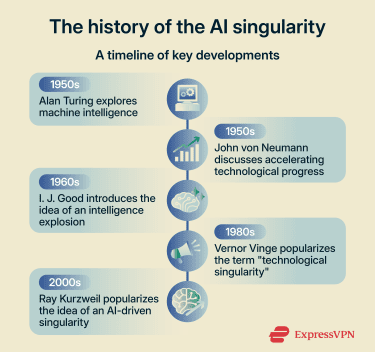 Scientists and mathematicians have explored the concept of a technological singularity for decades:
- Alan Turing explored whether machines could exhibit intelligent behavior comparable to humans in his 1950 paper Computing Machinery and Intelligence, laying the groundwork for later theories.
- In the 1950s, John von Neumann suggested that technological progress was accelerating toward a point where it could become increasingly difficult to manage. He’s often cited as an early contributor to the singularity theory.
- In the 1960s, I. J. Good proposed that if machines could design more advanced versions of themselves, this could lead to an “intelligence explosion” through recursive self-improvement.
For many years, these ideas remained largely within academic and research discussions. That changed in the 1980s when computer scientist and science fiction author Vernor Vinge popularized the term “technological singularity.”
In 2005, Ray Kurzweil further popularized the concept of an AI-driven singularity through his writing and public commentary.
Where is AI today?
The public release of ChatGPT in late 2022 was seen by many as a turning point in public awareness and adoption of AI tools, rather than the start of AI development itself.
In the years that followed, AI capabilities advanced quickly, with improvements in large language models (LLMs) and generative AI tools that are able to perform increasingly complex and varied tasks.
Most researchers do not consider current AI systems to be AGI. However, experts continue to debate whether scaling current AI architectures could eventually lead to more general intelligence.
Predictions about when AGI might emerge vary widely. There’s little agreement about the possibility or timing of a singularity.
Despite recent progress, current AI systems remain limited in important ways, including reasoning reliability, long-term planning, and independent understanding across broad real-world contexts.
What could make the singularity possible?
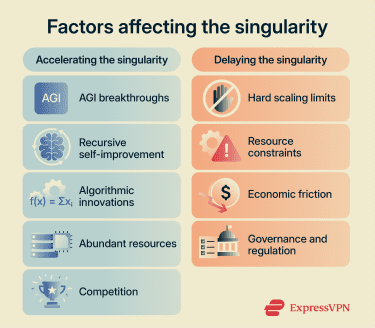 There are several factors that could influence the development of a singularity, including:
- AGI breakthroughs: Progress toward more general-purpose AI systems could increase the likelihood of a singularity scenario.
- Recursive self-improvement: Systems capable of improving their own performance or development processes could accelerate further advances in AI.
- Algorithmic innovations: Advances in algorithms could improve efficiency, reasoning, and overall system performance.
- Abundant resources: Greater availability of compute power, energy, and data could support larger-scale training and experimentation.
- Competition: Rivalry between companies or countries could drive increased investment and faster advances in AI research and deployment.
What could prevent or slow it down?
Conversely, the following factors could delay or even prevent the singularity from occurring:
- Hard scaling limits: Intelligence gains may eventually slow or encounter diminishing returns despite increases in compute and training data.
- Physical and resource constraints: AI companies may face challenges surrounding power consumption, energy infrastructure, cooling, and semiconductor manufacturing needed to train and improve AI models.
- Economic friction: The cost of running complex AI systems may outweigh the benefits or become unsustainable, which could reduce the incentive to continue scaling.
- Governance and regulation: Countries could impose controls and limits on AI development and training.
When might the singularity happen?
There’s no scientific consensus on a timeline, and estimates vary widely depending on assumptions about AI progress, computing power, and technological limits.
Some researchers, CEOs, futurists, and technology leaders have proposed relatively short timelines for the emergence of highly capable AI, while others argue it could take decades or may never occur.
Ray Kurzweil, for example, predicted that computers could reach human-level intelligence as early as 2029, and a singularity could emerge around 2045. However, some AI researchers, including Yann LeCun, have argued that current AI systems remain far from that point and that a singularity may be much further away than some predictions suggest.
What might happen in the singularity?
Experts have proposed a range of possible outcomes associated with advanced AI systems, including both societal benefits and potential risks.
Potential benefits to science and society
- Accelerated scientific research and discovery: Highly capable AI could support faster analysis, modeling, and hypothesis testing in fields such as physics, climate science, and materials research.
- Climate and energy research: AI could assist with environmental modeling, renewable energy development, and resource optimization.
- Advances in healthcare: AI could improve diagnostics, medical research, and treatment planning, including earlier disease detection and more personalized care.
- Greater automation and efficiency: Increased automation could improve productivity across industries such as manufacturing, logistics, and agriculture, potentially reducing costs and increasing access to goods and services.
Potential risks and challenges
- Economic disruption: If AI systems become capable of performing many tasks more efficiently than humans, this could reshape labor markets and existing economic systems.
- Misaligned goals and expectations: As these systems become more advanced, ensuring system objectives remain aligned with human intentions may grow more complex.
- Reduced human oversight: Highly autonomous systems could operate at speeds or levels of complexity that make direct human supervision more difficult.
- Concentration of power: Advanced AI development could be unevenly distributed across organizations or countries, potentially leading to imbalances in influence or control.
- Unpredictability: As these technologies become more complex, their behavior may become harder to fully anticipate. This could complicate planning and risk management.
Changes to work and daily life
AI systems may become more integrated into workplaces, homes, transportation, and digital services. Some roles may change in scope or become partially automated, while new forms of work could emerge alongside AI-supported tools and workflows.
These developments could also affect employment patterns, income distribution, and broader economic systems. Some experts have proposed updated labor policies or income support systems to help manage these shifts.
How organizations are responding to advanced AI
Organizations are responding to AI in different ways. Many now use AI tools to support tasks such as automation, analytics, customer service, content generation, and operational efficiency across a range of industries. AI features are also being integrated into a growing number of products and devices.
At the same time, organizations differ in how they approach governance, oversight, and risk management. Some place greater emphasis on practices such as safety testing, internal reviews, and ethical guidelines as AI systems become more capable.
Why do experts disagree about the AI singularity?
The singularity is based on assumptions about technological progress that have not been empirically established.
Some researchers point to sustained growth in areas such as computing capacity, data availability, and AI performance as evidence that these systems may continue improving over time. Others believe that current AI approaches won’t lead to human-like intelligence, or that progress could eventually slow because of hardware limitations, energy demands, and diminishing returns in system performance.
FAQ: Common questions about the AI singularity
Is the AI singularity the same as AGI?
Is the AI singularity a real scientific prediction?
What are the biggest risks of the AI singularity?
Could the AI singularity happen in this century?
How should society prepare for advanced AI?
Take the first step to protect yourself online. Try ExpressVPN risk-free.
Get ExpressVPN



















Comments
AI has already reached singularity but it's in a parallel universe of anti matter and cyber space.... WAKE UP PEOPLE