
What is a crypto exit scam? Red flags, examples, and how to protect yourself


There have been many crypto projects over the years that promise huge returns but then disappear, either suddenly or via gradual abandonment of the project. These are known as crypto exit scams, and they’re a type of fraud where perpetrators collect funds from investors and fail to deliver on their promises.
Please note: The information provided here is for general educational purposes and not financial or legal advice.
What is an exit scam?
An exit scam is a type of fraud where a person or organization uses the cover of a seemingly legitimate business or project to build trust, collect money from users or investors, and then disappear with those funds.
Exit scams are especially common in the cryptocurrency realm, where regulation is still evolving and varies significantly between jurisdictions. This can make enforcement and fund recovery difficult. As a result, bad actors can set up convincing but fraudulent projects, like fake exchanges, tokens, non-fungible token (NFT) collections, and decentralized finance (DeFi) projects, to extract money from investors.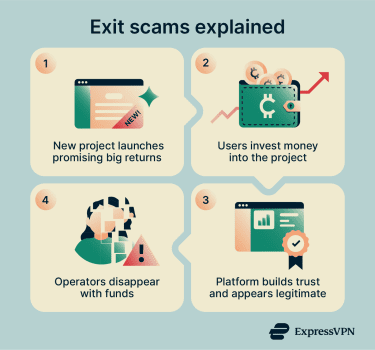
Note that, while this article focuses on crypto exit scams, exit scams aren’t limited to crypto; they also occur in e-commerce, crowdfunding, and service-based businesses. The defining characteristic is always the same: someone collects money and then deliberately “exits” by cutting off all contact.
How an exit scam works
Most exit scams follow a predictable pattern, where scammers build trust and credibility to extract as many funds as possible and then disappear.
The trust-building phase
In this phase, operators build a seemingly legitimate presence. This might include a polished website, a thorough whitepaper, and a product roadmap. Scammers may also promote projects through social media influencers or online forums to create the illusion of legitimacy. Those who have gained some traction on their projects continue building on their relationships and earning further trust.
Some scams also include wash trading, which is when the same entity continues to buy and sell cryptocurrency to give the illusion that the trading volume is higher than it actually is. Wash trading is a serious offense that’s prohibited in the U.S.
The cash-out and disappearance
Once the scammers decide the time is right, they execute the exit. This typically involves shutting down the project's website, social media accounts, and other communication channels. Withdrawal requests are blocked with vague technical excuses, and emails are left unanswered, while team members' online profiles might vanish. There have even been instances where scammers have attempted to evade law enforcement by relocating to another country or going into hiding after an exit scam.
The criminals then move their funds using various techniques. One example is using peel chains, where crypto is transferred through a series of wallets, with small sums being "peeled off” in each wallet. This makes the scammers harder to trace. Another method is using services called crypto tumblers or mixers, which work by mixing many people’s coins and sending them back out in a shuffled order, so it’s hard to tell who originally sent what.
Common types of cryptocurrency exit scams
Cryptocurrency exit scams appear in various contexts. Here are some examples of this type of scam.
Rug pulls
Rug pulls are crypto scams where the people behind a new token or NFT project suddenly abandon it after taking investors’ money. They’re especially common in DeFi, where tokens can often be listed on decentralized exchanges with little or no vetting.
One common type of rug pull involves a liquidity pool. To make a new token tradable, the creators pair it with a more established cryptocurrency, such as Ethereum. As people buy the new token, more value enters the pool, and the token may appear to be gaining momentum. But if the creators still control the liquidity, they can suddenly withdraw the established cryptocurrency from the pool. When that happens, investors are left holding a token that can no longer be easily sold and whose value usually collapses.
“Pump and dump” schemes are closely related to rug pulls. Developers or early holders promote a token through social media and aggressive marketing to increase demand and push up the price. As more investors buy in during this growth phase, insiders begin to sell off their holdings at higher prices. This wave of selling causes the token’s value to drop and leaves investors with losses. If the operators then abandon the project or disappear with the remaining funds, it becomes a full-fledged exit scam.
Ponzi-style projects
Ponzi schemes are investment scams in which early participants are paid using funds from newer ones, which maintains the illusion of legitimacy. The scheme only collapses when new money stops flowing in or when the operators decide to take everything and disappear.
A noteworthy example of this is OneCoin, where the scammers deceived investors out of approximately $4 billion worldwide before disappearing.
Fake exchanges
Fake exchanges present themselves as legitimate platforms for trading or storing cryptocurrency. Users deposit funds, and the platform operates normally until the operators have collected enough to make the exit worthwhile.
Real-world exit scam examples
While there have been many exit scams in the crypto sphere, the ones below are among the most notorious.
PlusToken
PlusToken was one of the largest crypto Ponzi schemes in history. It presented itself as a cryptocurrency wallet and investment platform, promising unusually high monthly returns to users who deposited crypto and bought its PLUS token. Reports vary on the exact promised return, but court-linked reporting says the platform advertised monthly returns as high as around 19%.
The scheme attracted millions of users before collapsing in 2019. Chinese court documents cited by South China Morning Post said PlusToken had about 2.7 million members and involved roughly 14.8 billion yuan, or about US$2.25 billion, in cryptocurrencies.
In June 2019, users began struggling to withdraw funds from the platform. The operators later moved large amounts of crypto, and secondary sources report that they left a message saying, “We have run.” In 2020, Chinese authorities arrested more than 100 people connected to the scheme, and several ringleaders were sentenced to prison terms of up to 11 years.
Bitsane
Bitsane was a Dublin-registered cryptocurrency exchange that had about 246,000 registered users before it disappeared in 2019. The exact number of victims and total amount lost remain unclear.
Withdrawal problems reportedly began in May 2019, with users saying they were unable to withdraw assets. Bitsane’s support team cited “technical reasons,” but by June 17, 2019, the exchange’s website was offline and its Twitter and Facebook accounts had disappeared. Emails to multiple Bitsane addresses were also reportedly returned as undeliverable.
The exchange had listed Aidas Rupsys as CEO and Dmitry Prudnikov as CTO. After Bitsane disappeared, Prudnikov’s LinkedIn profile was deleted, and key employee profiles were scrubbed. Some users reported losing thousands of dollars, while one affected user told Forbes they lost about $150,000 worth of cryptocurrency. Victims also gathered in Telegram and Facebook groups to compare experiences.
Although Bitsane’s listed executives were publicly named, there do not appear to have been widely reported arrests or prosecutions connected to the case.
SQUID
SQUID was a token launched in October 2021 that capitalized on the popularity of Netflix’s Squid Game, despite having no official affiliation with the show. It promoted itself as part of a play-to-earn crypto game inspired by the series.
The token’s price surged rapidly as investors bought in, but many soon found that they could not sell their holdings. The project’s rules involved a secondary token called “Marbles,” and later analysis found that the token contracts made selling practically impossible for ordinary holders while allowing the creators to drain liquidity.
On November 1, 2021, the creators drained about $3.36 million from the project’s liquidity pool, causing the token’s value to collapse to near zero within minutes. The creators’ identities were never publicly confirmed.
How to spot an exit scam
Catching an exit scam early requires knowing what to look for, and many scams share a predictable set of warning signs. Here are some red flags to be aware of when assessing a crypto opportunity.
Common scammer tactics
Scammers rely on specific language patterns and tactics to build urgency and trust. They will entice users with projects that guarantee high returns with little to no risk, and this in itself is an immediate warning sign. Legitimate projects will always explain clearly how their system works and what the actual risks are.
Another common approach is phrasing that signals urgency or attempts to apply pressure, whether it’s a quick deadline or a limited number of spots available in the scheme. These tactics are very common in crypto scam Telegram groups, where fraudsters use private channels and group chats to create hype, manufacture urgency, and pressure members into quick investment decisions.
Liquidity not locked
In many new token launches or Automated Market Maker (AMM)-based DeFi projects, liquidity is often locked or otherwise secured via a third-party service to prevent developers from withdrawing everything at will. Unlocked liquidity is among the primary mechanisms that enable rug pulls.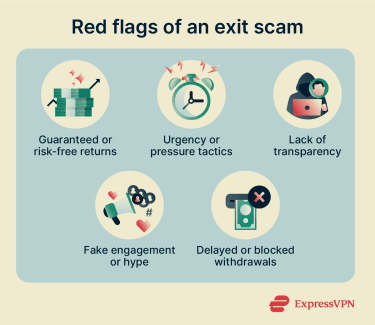
Aggressive marketing with little substance
Heavy promotion across social media and influencer channels isn't inherently a red flag, but it becomes one when it isn't backed by a working product, credible team, or clear use case. Be cautious of influencers promoting a project without disclosing that relationship or projects that display logos of well-known companies as supposed partners without any verifiable proof.
Fake communities
Scammers can create fake communities on platforms like Telegram, WhatsApp, or other messaging services to generate artificial interest in a project. They may also impersonate representatives from well-known crypto exchanges to deceive people into transferring their funds to the scammers under the pretense of receiving rewards.
Key indicators of these fake communities include poor grammar and vocabulary, as well as low-quality images and branding of the organization the scammers are impersonating. That said, AI tools are making it easier for scammers to create high-quality content, so even if it looks professional, you should exercise appropriate caution.
Delayed or blocked withdrawals
One of the clearest late-stage warning signs is difficulty accessing your own funds. Bitsane, for example, cited "technical reasons" for disabling withdrawals before vanishing entirely. Any platform restricting or blocking withdrawals without a clear and verifiable explanation is a cause for concern. Of course, this might only become apparent once you’re involved, in which case it’s time to consider taking the relevant recovery steps to minimize damage.
Due diligence that actually helps
Thorough research is your strongest defense against exit scams. The steps below can reduce the risk of falling for many fraudulent projects before committing any money.
Research and background checks
Before investing in or purchasing from any platform, search for independent reviews outside the platform itself. Check Reddit, forums, and crypto news outlets for mentions of the project and its reputation, as any legitimate project will generate organic discussions; team members might even interact to clarify doubts.
It’s also important to take a closer look at any engagement a project has, as numbers on Twitter and Telegram can be bought and inflated. If you see a project that has lots of followers but its posts rarely get any engagement, it’s a sign that things might not be what they seem.
Verifying team members and contacts
Legitimate projects generally provide transparent information about their team to build trust with their community. Search the names of team members independently and see whether they have a traceable history on platforms like LinkedIn or GitHub and whether their history lines up with their claimed expertise.
If team members are anonymous or their profiles are brand new and sparse, treat the project with caution, though it's worth noting that in crypto, it’s not that uncommon for legitimate teams to be anonymous or pseudonymous. In cases like this, pay close attention to other signals, like source code audits, locked liquidity, and whether there’s a credible whitepaper.
Checking audits, reserves, and transparency
It’s critical to take a look at the project itself and study its tokenomics, which is how a token is issued and distributed and how it provides incentives. Be cautious if a large share of tokens is controlled by founders, insiders, or a small number of wallets, especially if there are no clear lockups, vesting terms, or explanations for that distribution.
Additionally, trustworthy projects will have a legitimate function or serve a purpose in the cryptocurrency ecosystem, with a whitepaper that explains how they do so.
You’ll also find that many legitimate cryptocurrency projects are easily auditable, as their code is open-source and available to vet. This lets anyone take a look under the hood to ensure that nothing malicious is happening.
What to do if you suspect an exit scam
If you suspect that you’ve fallen victim to an exit scam, acting quickly is vital to minimize the damage.
Immediate steps to limit losses
The first step is to stop all transfers to the platform immediately. Don’t send or invest any additional funds, especially if you’re asked to do so to “unlock” your existing balance, as this is another method that scammers use to try to convince victims to invest even more money.
You should also disconnect your wallet and revoke any approvals or permissions you’ve granted to the project. By revoking approval, you stop apps from accessing the contents of your wallet and moving any more funds around. To make this simpler, you can use a tool like revoke.cash to track what approvals you’ve given and revoke them as needed.
What evidence to save right away
Since platforms often go offline in an exit scam, it’s important to save as much evidence as you can before they go down. Some of the key information you should save includes any communication with the project team, wallet addresses, transaction IDs (hashes), and screenshots of the platform. This evidence can prove vital when you report the scam.
Recovery steps after an exit scam
Recovery after an exit scam is difficult, but taking the right steps quickly gives you the best available chance and contributes to broader enforcement efforts.
Reporting the scam
Reporting the scam is the first step you should take in your recovery attempts.
Platforms and exchanges
If the scammer received your funds through a centralized exchange account, report the fraud to that platform's support team. Exchanges can freeze accounts and blacklist wallet addresses associated with fraud, which can help keep scammers from taking your funds off the platform.
You should also report the scam to your payment provider immediately.
Law enforcement and regulators
Ensuring you report the scam to all necessary regulators and authorities in a timely manner is a critical next step. You should report the scam and its website to the following agencies if you’re in the U.S.:
- Federal Trade Commission (FTC)
- Commodity Futures Trading Commission (CFTC)
- Securities and Exchange Commission (SEC)
- Internet Crime Complaint Center (IC3)
Chargebacks and dispute options
Recovering funds from crypto scams is uncommon, especially when payments are made using cryptocurrency. Because blockchain transactions are irreversible by design, funds sent this way typically can’t be retrieved unless the recipient chooses to return them.
That said, it’s still worth reporting the incident to your bank and attempting to dispute the transaction, particularly if you used a credit or debit card. In some cases, banks may be able to reverse or block payments, but this depends heavily on the payment method and how quickly you act. Purchase protection programs like PayPal’s Buyer Protection generally don’t cover cryptocurrency investments or other similar projects like NFTs.
Be cautious of any services that claim they can recover lost crypto funds; these are often recovery scams designed to exploit victims a second time.
FAQ
Why do exit scams happen so often in crypto?
What are the last-minute warning signs before a project disappears?
Can blockchain transactions be traced after an exit scam?