What is catfishing? How to spot it and protect yourself



When you interact with people online, it’s easy to think the person behind the profile is exactly who they claim to be. In many cases, that’s true. However, some people create fictitious identities to manipulate others. This is known as catfishing.
Understanding how catfishing works is the first step toward recognizing it. In this guide, we explain what catfishing is, why people do it, and how to identify common warning signs. We also cover the potential risks and share practical steps you can take to protect your personal information and stay safe when interacting with others online.
What is catfishing?
Catfishing is a form of online deception where someone creates a fake identity to gain trust or mislead others. This often involves using stolen photos, false personal details, or entirely fabricated personas to appear as a real person.
Catfishing most commonly happens on dating apps and social media platforms, but it can occur anywhere online, including gaming platforms, forums, and professional networks like LinkedIn. Because these interactions take place online, it’s easier for someone to misrepresent who they are, especially where identity verification is limited.
Why is it called catfishing?
The term “catfishing” became widely known after the 2010 documentary “Catfish,” in which a man discovers that the person he formed an online relationship with was using a fake identity.
The film explains the title through a story that catfish were supposedly placed in tanks with cod during transport to keep the cod active. That story (much older than the documentary itself) is now generally treated as apocryphal, but in the film it serves as a metaphor for a deceptive person who keeps someone emotionally invested. The term later became even more widely used through “Catfish: The TV Show.”
Common types of catfishing
Catfishing can take different forms depending on the platform and intent. Some of the most common types include:
- Romance catfishing: A fake persona is used to pursue a romantic relationship, often to build emotional dependency before requesting money or personal information. A common example is military romance scams.
- Impersonation of real individuals: The catfish impersonates a real person, sometimes a public figure or mutual contact, to damage their reputation or deceive people in their network. They copy the person’s photos or details to create a convincing profile.
- AI-assisted catfishing: An newer variation in which AI-generated photos, voice clips, or videos are used to make a fake persona appear more convincing and harder to verify. This helps the catfish build trust quickly, which they then abuse to manipulate victims into sharing personal information, sending money, or engaging in scams that rely on perceived authenticity.
- Partial identity catfishing: Instead of creating a completely fake persona, someone may alter key details about themselves, such as age, appearance, or background. This practice, sometimes referred to as kittenfishing, is often done to make the catfish appear more attractive, trustworthy, or credible and make it easier for them to gain attention, build relationships, or avoid accountability.
- Influencer or expert catfishing: This involves creating a fake online persona that appears knowledgeable or successful in a specific field, such as business, crypto, or AI. The individual builds trust by sharing curated content, fake testimonials, or inflated achievements, then monetizes that perceived expertise by selling ebooks, courses, or mentorship programs that may be low-quality or misleading.
How to tell if you're being catfished
While each situation is different, here are some common signs that may indicate a profile or interaction isn’t genuine.
Fake profiles and stolen photos
One of the most common catfishing tactics is using photos taken from someone else's social media account or public profile. The images are often of an attractive, seemingly credible person, but they don't belong to the catfish.
Look out for:
- No tagged photos or social history: Many genuine profiles show consistent activity over time, such as tagged posts, comments from friends, and life events. A sparse or recently created profile with little social context is a red flag.
- Images that appear elsewhere online: A reverse image search can reveal whether a profile photo appears on other accounts or websites under a different name.
- AI-generated images: Some fake profiles use AI images to deceive you. It’s not always easy to spot AI images, but subtle clues like inconsistent backgrounds, distorted hands or accessories, or an overly polished look can be signs of an AI image.
Reluctance to video call or meet
Someone who avoids real-time interaction may not be who they claim to be. They might decline video calls, cancel plans to meet in person, claim their camera or device isn’t working, or give ongoing reasons why they can’t appear live. Some catfish will agree to a phone call to seem more credible but continue to avoid showing their face.
While there can be other reasons for avoiding calls occasionally, consistent avoidance, especially over time, can be a sign that an identity isn’t genuine.
Inconsistent stories and behavior
Catfishing profiles often rely on scripted or improvised details, which can lead to inconsistencies. You might notice changing details about a person’s job, location, or background.
You should also look out for timelines that don’t align. For example, a person may say they just moved to a new city last month but later claim they’ve been working there for years.
Fast emotional intensity
Some catfishing scenarios involve building emotional trust quickly. This can include:
- Expressing strong feelings early in the conversation.
- Using terms of endearment shortly after connecting.
- Talking about long-term plans without having met.
- Creating a sense of urgency in the relationship.
- Frequent messaging in a way that feels intense or overwhelming.
This approach, sometimes referred to as love bombing, can make interactions feel more personal and special, which might reduce the likelihood of careful verification.
Too good to be true
If someone seems practically perfect or aligns with your interests almost too closely, it may be intentional. In some cases, catfish research their targets in advance to mirror their hobbies, values, or preferences.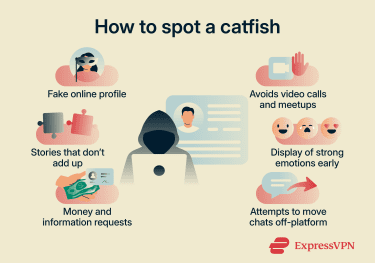
Requests for money or personal information
Requests for money or personal information might involve:
- A sudden financial emergency: A medical crisis, a travel issue, or an urgent debt that requires immediate help. The catfish usually frames the request in a way that makes it difficult to decline.
- Requests for gift cards, crypto, or wire transfers: These payment methods are difficult to trace or reverse, which is why they're commonly used in financial catfishing, romance scams, and crypto scams.
- Asking for personal details: Requests for a home address, workplace, financial information, or login credentials should be treated with caution, regardless of how well you feel you know the person.
Requests like these often come after trust has been established. That said, not every catfish will ask for money. Some are motivated by emotional manipulation, information gathering, or revenge rather than financial gain. The absence of a financial request doesn't rule out catfishing.
Requests to move your conversation to another app
Catfish often try to move the conversation off the original platform quickly. They might suggest switching to private messaging apps, texting, or email soon after you start talking. This can help them avoid platform moderation and make it harder for you to report them.
You should treat this as a warning sign, especially if it happens early. While some people prefer different apps, a legitimate person usually doesn’t rush the move or pressure you.
What are the risks of catfishing?
Catfishing can affect people in different ways depending on the situation. While some cases involve minor deception, others can lead to more serious consequences.
Common risks include:
Emotional harm
Some catfishing victims invest genuine feelings, trust, and vulnerability into a relationship they believe to be real. When the deception is eventually uncovered, the sense of betrayal can be significant or overwhelming. Many victims describe feelings of humiliation, embarrassment, frustration, shame, grief, and anger.
The fact that the person they confided in wasn’t who they claimed to be makes it uniquely difficult to process, often leaving victims questioning their own judgment and ability to trust others in the future.
Financial loss
Catfishing is frequently used to facilitate financial fraud. Once a catfish has established emotional trust with their victim, they may begin making requests for money. These requests can escalate over time, and victims who are emotionally invested may send significant sums before realizing the deception.
In many cases, payments are made via wire transfer, gift cards, or cryptocurrency, which makes them extremely difficult to recover.
Blackmail and extortion
Some catfish accounts deliberately build fake relationships with the sole intent of obtaining compromising material they can use for blackmail. After gaining a victim's trust, they may encourage the sharing of intimate photos, videos, or deeply personal information.
Once this material is in their possession, they threaten to send it to the victim's family, friends, or employer unless payment is made, a practice often referred to as sextortion. The shame associated with the situation often prevents victims from seeking help, which the perpetrator relies upon.
Reputational damage
A catfish might impersonate the victim online, post misleading content in the victim’s name, or share private information and images without the victim’s consent. In some cases, false narratives are deliberately spread through social media to damage relationships, career prospects, or standing in a community.
Even when victims are entirely innocent, the fallout from having private material exposed or false claims made about them can be difficult to undo, and the internet's long memory means such content can resurface for years.
Privacy and security risks
Throughout the course of a catfishing relationship, victims often share a great deal of personal information, such as their home address, workplace, daily routine, phone number, and details about family members. Even seemingly harmless details can be pieced together to build a comprehensive profile that enables stalking, harassment, or targeted attacks.
This gradual erosion of privacy can place the victim and those close to them at risk. In serious cases, the information gathered can be used to physically locate and confront victims in the real world.
Catfish who collect enough personal data might even use it to steal a victim's identity and open fraudulent credit accounts, take out loans, or access existing bank accounts, all in the victim's name. Identity theft can take months to fully unravel, leaving victims with damaged credit scores, unexpected debts, and the considerable burden of proving their innocence to financial institutions and government agencies.
How to protect yourself from catfishing
Preventing catfishing starts with building safe online habits. While it’s not always possible to identify a fake profile immediately, a few practical steps can help you make more informed decisions when interacting with others online.
Verify profiles before you trust
Taking a few minutes to check the basics of someone's online presence can reveal a lot. This doesn't need to be exhaustive. A few straightforward checks can help identify obvious inconsistencies.
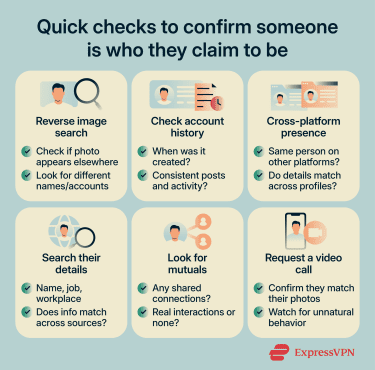
- Run a reverse image search: Right-click on a profile photo and select "Search image" (or use a tool like Google Images) to check whether the photo appears elsewhere online. A genuine profile photo is less likely to appear across multiple unrelated accounts.
- Search their name and details independently: A quick search of the name, workplace, or other details they've shared can help confirm whether the information is consistent across different sources.
- Look for mutual connections: On platforms where mutual connections are visible, check whether you share any.
- Request a real-time video call: A video call or live conversation can help confirm that the person matches their profile. Be aware, however, that AI-generated video is an emerging tactic that can make it harder to confirm the identity of the person behind a profile. Paying attention to whether responses feel natural matters as much as the call itself.
 None of these steps guarantees certainty, but they make it significantly harder for a basic fake profile to go undetected.
Keep personal information private
Another way to limit the potential damage of catfishing is to be deliberate about what personal information you share online and when. This applies to both your public profiles and information shared in private conversations. Some practical tips include:
- Avoid sharing identifying details early on: A home address, workplace, daily routine, or financial information shouldn’t be shared with someone you've only recently met online, regardless of how the relationship feels at that point.
- Be cautious with personal photos: Photos can contain metadata, including location data, and once shared, you have no control over how they're used. This is particularly relevant for photos taken on a smartphone.
- Review your public profile settings: Information visible on your social media profiles, such as your location, employer, or relationship status, can be used to build a more convincing fake persona or to target you more effectively. Limiting what's publicly visible reduces that risk.
Additional tips for staying safe on social media and dating apps
This general advice applies not just to catfishing, but also to other online scams and social engineering:
- Explore the platform's safety features: Most dating apps and social media platforms offer identity verification, reporting tools, and safety guidelines. Familiarizing yourself with these before you need them makes them easier to use.
- Don't let emotional intensity override judgment: If a conversation is moving quickly toward declarations of strong feelings, financial requests, or appeals to secrecy, those are patterns worth pausing on.
- Talk to someone outside the interaction: If you're unsure about someone you've met online, talking it through with a trusted friend or family member can provide a useful perspective. An outside view is often easier to maintain than one formed from within the interaction itself.
What to do if you've been catfished
If you realize you’ve been interacting with a catfish, here are some structured steps that can help limit further contact, protect your information, and support any follow-up actions.
Stop contact and save evidence
Stop all communication with the person on messaging apps, email, social media, and any other channels you may have been using.
Before blocking the account, take the following steps:
- Don't delete the conversations yet: It may be tempting to remove all traces of the interaction, but preserving the evidence first gives you more options.
- Screenshot everything relevant: Conversation logs, profile details, photos they shared, and any requests for money or personal information. These may be needed if you decide to report the incident to a platform or authority.
- Note key details: Username, the platform where you connected, approximate dates of contact, and any names, phone numbers, or email addresses they provided. Even details that seem minor can be useful later.
Once you've saved what you need, block the account on every platform where you were communicating.
Report the account and secure your profiles
Report the account on the platform where you met the catfish. Most social media and dating apps have safety tools that allow you to flag fake profiles. Reporting helps the platform review the activity and may prevent similar behavior from affecting others.
If money, personal data, or private images were involved, report the incident to the appropriate authorities or support organizations as soon as possible. For instance, in the U.S., you can report to the Internet Crime Complaint Center (IC3), which specializes in handling digital extortion and online fraud cases.
You should also secure your online accounts if you shared your credentials. Change your passwords, enable two-factor authentication (2FA) where available, review privacy settings, and check for unusual activity. If you shared financial information with the catfish, take extra steps, such as contacting your bank or placing alerts on your accounts, to reduce the risk of fraud or identity theft.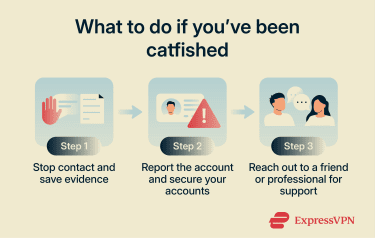
Seeking support and next steps
The aftermath of catfishing can be difficult to process, and it's reasonable to need time and support to work through it. Here are a few steps worth keeping in mind:
- Talk to someone you trust: Whether that's a friend, family member, or mental health professional, having someone to talk to can help put the experience in perspective.
- Recognize that this is a common experience: Catfishing and similar scams affect a large number of people globally. Experiencing it isn’t an indicator of poor judgment.
- Be cautious about follow-up contact: It's not uncommon for catfish to reach out again using a different account or identity, sometimes even posing as someone who can help recover lost money. Treat any unexpected contact from an unknown person with care.
- Give yourself time before re-engaging online: There's no set timeline, but taking a short break from the platform where the incident occurred can be useful while you review your privacy settings and regroup.
FAQ: Common questions about catfishing
Can catfishing happen without asking for money?
Is catfishing the same as a romance scam?
Can someone catfish using AI-generated photos or videos?
How can you verify whether an online profile is real?
Is catfishing illegal?
Why do people catfish?
Take the first step to protect yourself online. Try ExpressVPN risk-free.
Get ExpressVPN