How to remove your information from FastPeopleSearch (step-by-step guide)



FastPeopleSearch is a people search website that compiles publicly available information about individuals and makes it searchable online. The information it displays comes from public records and other publicly accessible sources and may include details such as names, current and past addresses, property records, and possible household or family connections.
While FastPeopleSearch is not a consumer reporting agency, its listings can still raise privacy concerns. Personal details may be easy to access, widely visible, and difficult to keep accurate over time.
This article explains how to request the removal of your information from FastPeopleSearch, how to reduce the chances of it reappearing, and what the platform’s data collection practices mean for your privacy.
Please note: This information is for general educational purposes and not legal advice.
What is FastPeopleSearch, and why does it have your information?
FastPeopleSearch is a U.S. data broker that uses algorithms to gather information from public sources, like other data brokers, government records, property deeds, and various online sources.
The data is aggregated automatically, without manual verification, and the site may host inaccurate information or associate details with the wrong person. FastPeopleSearch does not guarantee the accuracy of its information, nor does it modify data retrieved from its sources, although it does periodically update it.
Basic results for searches by name, number, or address are free. More detailed results, which include background checks, criminal records, etc., typically link to third-party services that offer paid reports. FastPeopleSearch states that it's not a consumer reporting agency and that its data should not be used for employment, credit, housing, or insurance decisions.
Types of personal data it collects
FastPeopleSearch compiles a wide array of personal information:
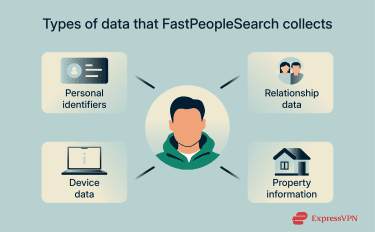
- Personal identifiers: Full names and aliases, IP addresses, current and previous addresses, mobile telephone numbers, email addresses, dates of birth, and estimated ages.
- Relationship data: Names of relatives, household members, and associates, including people who have lived at the same address or are listed as possible family members or roommates.
- Property information: Records of real estate ownership, property values and square footage, past sales and purchase history, and links to rental properties associated with the person.
- Device data: Media Access Control (MAC) address, cookie identifiers, browser or device details, and user settings. It also collects mobile carrier and advertisement data.
Where people search sites like FastPeopleSearch get their data
People search sites do not typically disclose every individual data source they rely on, so it isn’t always possible to identify the full origin of each record shown on FastPeopleSearch. That said, people search sites like FastPeopleSearch typically rely on:
- Public records databases: Public records include property deeds and ownership records, voter registration lists, civil and criminal court filings, marriage and divorce certificates, business licenses, and professional registrations. These records are usually available through local, state, or federal agencies.
- Web crawlers: Programs that scour the internet for specific information about a person.
- Marketing and commercial databases: FastPeopleSearch databases may include data licensed from commercial data providers commonly used in the data-broker industry.
- Other online sources: Many brokers collect data from social media profiles, professional networking sites, and other publicly available web content.
Is FastPeopleSearch legal?
FastPeopleSearch operates legally. It aggregates information from legal public records and complies with U.S. regulations.
In states with stronger privacy regulations, such as California, Oregon, and Texas, residents may have greater power over their data. It’s important to note, however, that because this site is just an aggregator, even if you opt out of having data sold or remove information from FastPeopleSearch, it won’t remove the data from the source it was collected from. That said, removing the data from FastPeopleSearch may reduce its overall visibility.
Why you should remove your info from FastPeopleSearch
Leaving your personal details on FastPeopleSearch exposes you to privacy risks. Having your information publicly exposed isn’t just uncomfortable; it can cause real-world damage in some cases.
Some of the ways that public listings can endanger you include:
- Exposure to scams and identity theft: Scammers may use your personal data to contact you and gather additional information, personalize their phishing attempts, or commit identity fraud. If a scammer can list intimate personal details such as your last five addresses and the names of immediate family members, they may have an easier time convincing you that they’re an authorized party or impersonating a friend or family member.
- Stalking and harassment: Publicly listing your home address, phone number, and family members makes it easier for stalkers or abusive individuals to find and contact you.
- Doxxing and public exposure: Malicious actors can publish your personal details online, exposing you to harassment, threats, or reputational harm.
- Unsolicited marketing: Telemarketers can obtain contact information from data brokers to send unwanted calls and texts to you.
- Physical security risks: Burglars or home invaders may rely on public property details in order to target you.
Long-term impact on digital privacy
Aggregated data typically compounds over time. It may be sold repeatedly, fueling targeted advertising, predictive profiling, and potential phishing scams. The longer the data is allowed to aggregate, the more complete it can become. If left alone, your privacy shrinks and your exposure to risk increases.
How to remove yourself from FastPeopleSearch
Manually removing your information from FastPeopleSearch requires filling out two opt-out forms, first on the site and then another sent via email. The process itself only takes a few minutes.
Step-by-step manual opt-out guide
- Go to the FastPeopleSearch opt-out page.
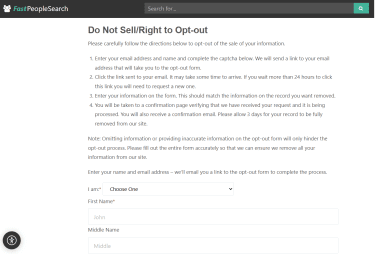
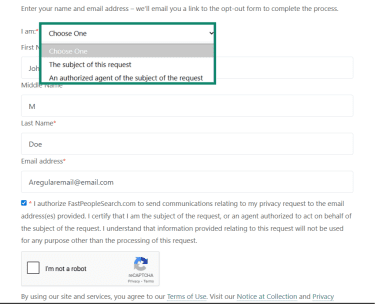
- Fill out the online form. Make sure the information you provide matches the record you want removed. If you’re filling out the opt-out form on behalf of a family member that you’ve obtained verifiable written consent from, use the dropdown menu under the I am section to choose An authorized agent of the subject of the request.
- Submit your removal request.
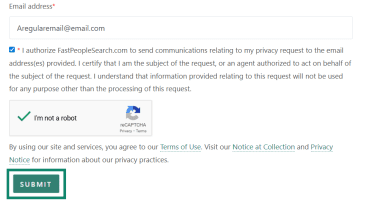
- You still need to complete another form to submit the request. This comes via email. When you receive the email from FastPeopleSearch, click the link to begin the next form.
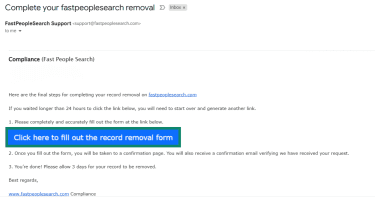
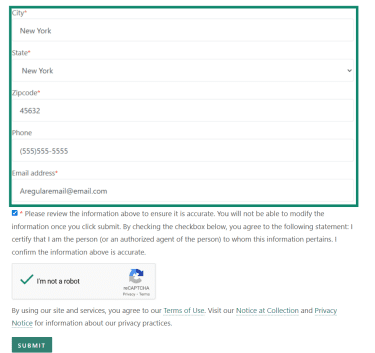
- Fill out the complete form, including any information you want scrubbed, such as your address, phone number, and ZIP code. Click Submit.
What to expect after opting out
After submitting an opt-out request, it takes some time to finalize. Afterward, your information should not appear in FastPeopleSearch’s public search results. However, the removal only applies to FastPeopleSearch itself; it does not delete the underlying public records or prevent other data brokers from displaying the same information.
You should also expect that your information may reappear in the future. According to the FastPeopleSearch privacy policy, the company refreshes its database from external sources, such as public records or details scraped from public webpages.
If those sources still contain your data, your data may be republished in a future update. Because of this, consider resubmitting the removal form periodically or using an automated data-removal tool to handle the process for you.
How long does the removal process take?
The removal process can take several days to complete. To start, it may take a few minutes for you to receive the confirmation email with the second opt-out form. Once received, you’ll need to respond to this within 24 hours. After this, it can take up to 3 days for your request to finalize.
Contacting customer support
You can contact FastPeopleSearch’s customer support by dialing (866) 679-8725. If you don’t want to fill out the online form or you encounter issues while doing so, this is another way to request your data be taken down. You’ll need to provide some personal details, just like with the opt-out form, including your name and address.
What to do if your info reappears?
While you have some control over your information, the truth is that certain details are likely to continually reappear on FastPeopleSearch.
For maximum privacy, your best option is to pair reducing your digital footprint with regularly sending opt-out requests.
Periodically request removal
Occasionally, check FastPeopleSearch and search for yourself. If you notice your data has reappeared, request that it be deleted again. This method isn’t perfect, as your details may be visible in the period between your opt-out requests and site updates. It is also naturally rather time-consuming.
Use privacy tools for continuous protection
Using an automated removal tool is a fairly reliable means of preventing your information from appearing in the long term.
When you sign up for a data removal service, you provide some basic info, like your name and email address. Depending on the tool, you may need to sign an authorization form for it to act on your behalf.
Afterwards, it begins scanning to see if that information appears on sites like FastPeopleSearch. If it finds any hits, the service automatically reaches out to the site and requests that your information be removed.
Once your data has been cleared, it actively monitors brokers and automatically places removal requests if your details crop up again. Most services come with a dashboard that lets you see what information was scrubbed, what wasn’t removed, and from which brokers.
By using data removal tools to monitor your identity, you may be able to reduce the amount of time your information is public. Just as sites like FastPeopleSearch update regularly, removal services continually trawl for your info, so opt-out requests can be sent soon after the information appears.
Limit your online data exposure
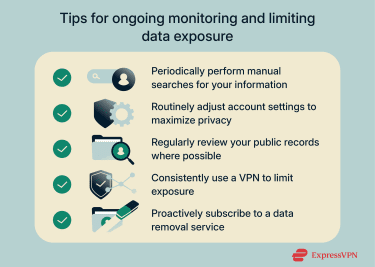
In addition to public records that you can’t control, data brokers typically also collect information from sources you may have a degree of power over. To prevent information from reappearing, change your privacy settings on your social media apps to prevent non-friends from seeing your profile or posts. It’s also a good idea to generally limit the amount of sensitive and personal information you share online, especially on public platforms.
Consider using privacy tools to further obscure your activity. Virtual private networks (VPNs) are one such tool. Using one encrypts all traffic on your device. It also masks your real IP address (and thus your approximate location) from FastPeopleSearch and other sites you visit.
You generally can’t keep data brokers from accessing official public records, but if you regularly review them, you at least know what is potentially exposed about you. It’s also a good idea to stay informed about data breaches. Luckily, many data removal services also alert you to breaches.
FAQ: Common questions about FastPeopleSearch data removal
Is FastPeopleSearch illegal?
No. FastPeopleSearch operates lawfully in the U.S. as a people search website. Like similar services, it publishes information drawn from publicly available and other lawful sources and provides opt-out mechanisms required under applicable state privacy laws.
Why does my info keep showing up on FastPeopleSearch?
FastPeopleSearch automatically aggregates information about people through open sources like public records and social media. Even if you remove your information, if the source it was obtained from hasn’t been changed, FastPeopleSearch may continue to publish your information each time it updates.
Can I remove my family members' info too?
Yes, but only if you have formal, verifiable consent from the family member. When you submit the opt-out form, you can select “An authorized agent of the subject of the request” when it asks whose information you are requesting be removed.
FastPeopleSearch requires proof that you are allowed to act on their behalf. This usually means a signed authorization or another form of documented permission from the person whose data you are removing.
Does FastPeopleSearch sell my data?
FastPeopleSearch may share or monetize access to personal data indirectly, such as by redirecting users to paid third-party services or through advertising. Like many data brokers, it may also allow data to be licensed downstream through partner services.
Are there other people-finder sites that have my data?
FastPeopleSearch is just one of many personal data aggregators. They collect your data from public sources and then post it online. Other people-finder sites may also post or collect your data.
Who can access your data on FastPeopleSearch?
FastPeopleSearch is designed as a free people‑lookup tool. Unlike paid background‑check services, it provides basic personal information for free, making it accessible to anyone with an internet connection. That said, it’s only meant to be accessible to users in the U.S., so the site is generally not available to non-U.S. IP addresses.
Take the first step to protect yourself online. Try ExpressVPN risk-free.
Get ExpressVPN


















 Support Center
  FAQ
FAQ  VPN Setup Tutorials