Expressvpn Glossary
SSL encryption
What is SSL encryption?
Secure Sockets Layer (SSL) encryption is a method for securing data as it travels between a client and a server across a network. It encrypts traffic to prevent eavesdropping, uses digital certificates to verify identity, and protects the integrity of transmitted information. Although the term “SSL” is still widely used, it commonly refers to modern Transport Layer Security (TLS), the protocol that replaced SSL.
How does SSL/TLS encryption work?
SSL/TLS encryption starts with a TLS handshake that establishes a secure session before any application data is exchanged. During this exchange, the server presents a digital certificate, and the client verifies the certificate chain through a trusted certificate authority (CA).
The handshake negotiates cryptographic parameters and creates a shared session key used for symmetric encryption. Once the session is established, all subsequent data is encrypted using this key.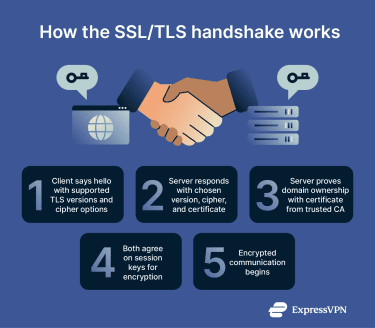
Why is SSL/TLS encryption important?
SSL/TLS encryption forms the foundation of secure communication on modern networks. It protects sensitive information like login credentials, payments, private messages, and form submissions, ensuring that they can’t be intercepted or read by unauthorized parties.
SSL/TLS also helps to prevent passive network sniffing, reduces the risk of man-in-the-middle (MITM) attacks, and verifies server identities through digital certificates. Additionally, it secures communications between applications, APIs, and services, making it a critical foundation for safe and reliable interactions.
Where is it used?
SSL/TLS encryption is used in:
- HTTPS websites and web applications.
- Mobile apps communicating with backend APIs.
- Email transport security.
- Secure portals and remote access systems.
- Virtual private network (VPN) protocols that use TLS for control or tunneling channels.
Further reading
- SSL vs. TLS: Key differences and why TLS is better
- SSL VPN: What it is and why it matters
- What is SSL inspection in network security?