
Expressvpn Glossary
Rail fence cipher (zigzag cipher)

What is a rail fence cipher?
A rail fence cipher is a classical transposition cipher that encodes by placing characters in a zigzag pattern across multiple rows. The number of rows (rails) is the shared key used to perform encoding and decoding.
See also: Transposition cipher, ciphertext, decryption, encryption key, substitution cipher
How does a rail fence cipher work?
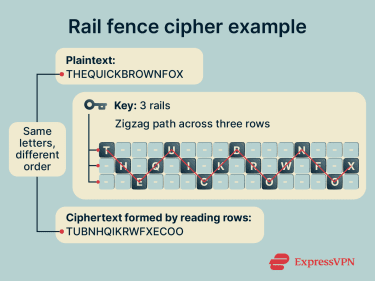
The sender writes the plaintext diagonally up and down across a fixed number of rows, forming a repeating zigzag pattern. After filling the pattern, each row is read from left to right, and the rows are concatenated to form the ciphertext.
For example, with three rows, the text moves from the top row to the bottom row, then back up, repeating the cycle. Decryption reverses the process by reconstructing the zigzag layout with the same number of rows, then reading the letters in diagonal order.
Where is it used?
The rail fence cipher isn’t widely used today, but it still appears in low-risk or educational settings:
- Cryptography education: Demonstrates how transposition rearranges text without changing letter frequency.
- Puzzles and escape rooms: Provides a simple manual cipher for pattern-based decoding.
- Programming exercises: Teaches string manipulation, indexing, and basic algorithm design.
- Cybersecurity challenges: Appears in beginner-level problem-solving tasks.
- Historical discussions: Illustrates the evolution from classical to modern encryption.
Why is the rail fence cipher important today?
The rail fence cipher shows how basic encryption methods work and why they aren’t secure.
- Transposition concept: Shows how rearranging characters can obscure a message without changing the letters.
- Limited security: Demonstrates that simple methods with small key spaces are easy to break.
- Foundational contrast: Shows the difference between classical ciphers and modern encryption approaches.
Risks and privacy concerns
The rail fence cipher provides obfuscation but not strong protection. An attacker can try different rail counts, reconstruct the zigzag layout, and identify readable outputs because letter frequency and language patterns remain unchanged.
It also provides no integrity or authentication, so tampering isn’t detectable. For sensitive messages, a modern, vetted encryption scheme with integrity protection, such as Advanced Encryption Standard (AES), is preferable to a classical transposition method.
Further reading
- What is the Caesar cipher? Definition, history, and examples
- The history of encryption: From ancient codes to digital security
- Hashing vs. encryption: Key differences
- Symmetric vs. asymmetric encryption: What’s the difference
- End-to-end encryption: What it is and why it matters