
Expressvpn Glossary
Transposition cipher
What is a transposition cipher?
A transposition cipher is an encryption method that rearranges the letters or symbols of a message using a defined key. This produces ciphertext that appears random despite using the same alphabet.
How does a transposition cipher work?
Unlike a substitution cipher, which swaps out letters but maintains their order, a transposition cipher maintains the same letters but changes their order.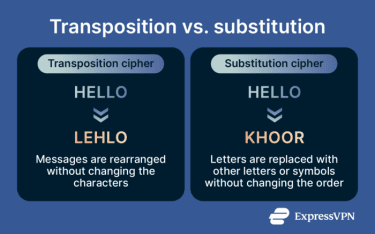 A transposition cipher process usually follows these steps:
- Break the message into sections: The original message is written into a grid or split into equal-length chunks to make it easier to rearrange.
- Use a secret key to shuffle letters: The key is a rule that decides how the message contents will be moved around. It controls the order in which letters or symbols are read or repositioned.
- Create the scrambled message: The reordered letters form the encrypted message. No new symbols are added, and none are removed; the alphabet stays the same.
- Reverse the steps to decode it: To read the message, the receiver uses the same key to undo the rearrangement and restore the original text.
Types of transposition ciphers
- Columnar transposition: Letters are written in a grid and read column by column, with the column order defined by the key. Transposition can be performed once (single columnar transposition) or twice (double columnar transposition) for added complexity. Double transposition can use the same key twice or two different keys.
- Rail fence: A cipher that spreads letters in a zigzag pattern across multiple rows (called “rails”). The rows are then read sequentially. The secret key defines the number of rows.
- Route cipher: Text is placed in a grid and read in a specific path established by the key, such as a spiral or alternating directions.
- Grille cipher (Fleissner grille): The message is arranged within a grid of letters or symbols. The key is a “grille,” a mask or set of coordinates that can be applied to the code to pick out the correct letters of the message.
- Scytale: An ancient cipher that used a strip of parchment wrapped around a cylinder in a spiral. The message was written along the length of the cylinder. When unraveled, the parchment appeared to contain a string of random characters. It could only be decrypted by a cylinder with a matching diameter.
Why is a transposition cipher important?
Transposition ciphers are a crucial part of encryption history. They helped shape early thinking about how information can be hidden without changing its contents.
By rearranging letters rather than replacing them, transposition ciphers introduced the idea of diffusion, where pieces of a message are spread out to make patterns harder to spot. This same concept later became a building block of modern data encryption, where permutations and mixing steps are used to reduce predictability and obscure structure.
Similarly, they’re early examples of the importance of key management and secrecy. Modern symmetric encryption still uses secret key techniques today.
Transposition ciphers are also a useful tool for explaining classical cryptography and cryptanalysis. Their simplicity makes cryptographic concepts and weaknesses easy to understand and practice. For example, they can be used to demonstrate anagramming attacks, pattern recognition, or frequency analysis.
Where are transposition ciphers used?
- Historical military and diplomatic messaging: Used throughout history to send confidential messages in wartime or between diplomats.
- Games and escape rooms: Applied in puzzles to hide messages or secret clues.
- Educational cryptography demonstrations: Employed in teaching to explain encryption, key management, and cryptanalysis.
- Component in modern designs: Incorporated into contemporary algorithms for diffusion or low-stakes obfuscation.
Risks and privacy concerns
While transposition ciphers can hide messages from casual readers, they have significant limitations:
- Preserves letter frequencies: The message’s original letters are unchanged, allowing patterns to be easily identified and used for decryption.
- Remains vulnerable to cribs and known-plaintext attacks: A crib is a piece of text expected or known to be contained in a message. It can allow an attacker to reverse-engineer a transposition key.
- Uses short keys that are brute-forceable: Simple or short keys can be systematically tested to recover the message.
- Creates a false sense of security: Excessive trust in a transposition cipher could lead to important content being put at risk. Transposition ciphers are not strong enough to protect sensitive data such as financial, medical, or other confidential information.
Further reading
- What is the Caesar cipher? Definition, history, and examples
- The secret codes that nobody can crack
- End-to-end encryption: What it is and why it matters