Expressvpn Glossary
Network infrastructure
What is network infrastructure?
Network infrastructure is the combination of hardware, software, and protocols that support connectivity and data transfers between networks. It includes physical components like routers, switches, and cabling, as well as virtual resources that allow devices, users, apps, and systems to share information across private and public networks, including the internet.
Key components of network infrastructure
Network infrastructure generally comprises the following essential components:
- Routers: Devices that direct data between different networks or network segments. They determine the most efficient path for information to reach its destination based on network conditions and configuration.
- Switches: Hardware that connects multiple devices within the same network and forwards data between them.
- Access points: Components that enable wireless devices to connect to a wired network. They broadcast Wi-Fi signals and manage data transmission between wireless clients and the core network.
- Transmission media: The physical channels that carry data between devices in a network. These are divided into two categories, including guided media (such as cables and wiring) and unguided media (such as radio waves, infrared, and microwaves).
- Servers: Hardware or software systems that provide resources and services, such as storage, communication, applications, and data, to other devices on the network. In large-scale environments, these are often hosted in data centers that manage and maintain extensive groups of servers.
- Network controllers: Hardware or software used to monitor, manage, and automate network activity. They help devices join a network, enforce security policies, and optimize data flow, particularly in large-scale or enterprise deployments.
- Network protocols: Sets of rules that define how devices send, receive, and interpret data across a network, enabling communication between hardware and software from different vendors. They also influence how information is transmitted and, in some cases, secure data exchanges.
- Firewalls: Security systems that monitor and filter incoming and outgoing network traffic based on predefined rules. They prevent unauthorized access while allowing legitimate data to pass through and can be implemented as hardware, software, or cloud-based solutions.
Types of network infrastructure
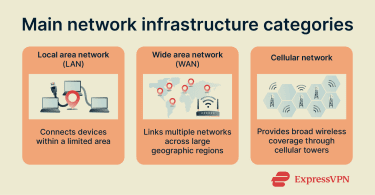 Types of network infrastructure are often defined by scope, starting with local networks and extending to larger, geographically distributed systems.
- Local area network (LAN): Connects devices within a limited area, such as an office building, a home, or a school campus, to enable fast internal communication and resource sharing.
- Wide area network (WAN): Spans large geographic areas, like cities, countries, and continents. It connects multiple smaller networks, with the internet being the largest and most well-known example.
- Cellular network: Provides wide-area wireless coverage using a network of radio towers. This type of infrastructure supports mobile devices and Internet of Things (IoT) systems that need reliable connectivity across large regions.
Metropolitan area networks (MANs) and personal area networks (PANs) also exist. MANs cover medium-sized areas like neighborhoods or university districts, while PANs connect devices within a few meters, such as a phone, headphones, or smartwatch. They’re used in more specific scenarios than the categories above.
Why is network infrastructure important?
Network infrastructure is important for enabling reliable and efficient communication between users, devices, and networks. It forms the backbone of modern connectivity, supporting activities like file sharing, online services, video and audio calls, streaming, gaming, and more.
When supported by effective and secure network management and design, it helps maintain strong performance and uptime, prevent data loss or corruption, and protect online communications from cyber threats.
Security and privacy considerations
Secure network design is critical for protecting communications and ensuring data privacy. It’s typically achieved through measures such as:
- Data encryption: Using virtual private networks (VPNs) and Transport Layer Security (TLS) to encrypt data transfers, making information difficult to intercept or tamper with.
- Network segmentation: Dividing networks into smaller subnets to limit access to sensitive systems and contain potential security threats.
- Firmware updates: Installing updates and applying security patches on a regular basis so that vulnerabilities don’t compromise network data.
- Traffic monitoring: Using security systems (like firewalls) to monitor network traffic and detect unusual or malicious activity.
- Network redundancy: Establishing multiple routes for network traffic to maintain uptime and reliability during hardware or software failures.
- Regular backups: Duplicating critical resources to avoid data loss due to security incidents, system failures, or corruption.
Common challenges in network infrastructure
Organizations often face a range of challenges when designing, deploying, and maintaining network infrastructure, including:
- Network performance: Inefficient network design, poor routing, or outdated hardware can cause slowdowns or downtime, reducing overall reliability and user experience.
- Misconfigured components: Incorrectly configured or outdated routers, switches, and firewalls can create security vulnerabilities and put data at risk.
- Cybersecurity threats: Malicious actors use a range of cyberattacks to compromise networks and steal, alter, or delete sensitive information.
- Resource limitations: Limited bandwidth or infrastructure capacity can restrict performance and make it difficult to scale as network demands grow.
- Network visibility: Lack of insight into network behavior, such as error rates, latency, or traffic patterns, makes troubleshooting and optimization more difficult.
Further reading
- Network topology: Best practices for modern networks
- Internet infrastructure: What it is and how it works
- Network connections: Everything you need to know
- Network architecture: Building secure and modern networks