Expressvpn Glossary
Virtual private server (VPS)

What is a virtual private server?
A virtual private server (VPS) is a virtual machine provided by a hosting or cloud service provider. It’s created by partitioning a physical server into multiple isolated environments, each with its own allocated resources like CPU, RAM, and storage. Even though the hardware is shared, each VPS runs independently with its own OS and can host websites, applications, or databases.
The main benefit of a VPS is that it sits between shared hosting and dedicated servers. It costs less than dedicated hardware but still provides stronger performance, greater control, and more consistent resource availability than basic shared hosting.
How does a virtual private server work?
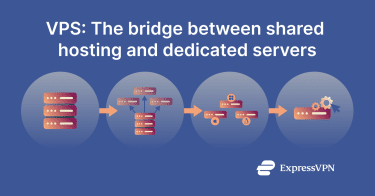 Understanding how a VPS works requires examining the software layer known as the hypervisor. The hypervisor divides a physical server into multiple isolated environments and allocates resources to each one.
Some providers use full virtualization, where each VPS runs its own OS and kernel. Others use container-based virtualization, which shares the host’s kernel but still isolates processes and file systems. These container-based setups are often marketed as VPS but provide lighter isolation.
- Partitioning: The hypervisor splits the physical server into separate virtual environments.
- Control: Users can install and manage their own software without affecting other VPS instances on the same server.
Key features of a VPS
A VPS offers specific capabilities that distinguish it from other hosting types.
- Root access: On most VPS setups, users have full administrative control over their environment to install custom software.
- Dedicated resources: Each VPS has defined CPU, RAM, and storage limits that control how much it can use at any given time, helping ensure predictable performance.
- Customization: Users can choose their OS and configure server-side software to match their requirements.
- Independence: Each VPS operates as its own environment, even though it runs on shared hardware.
- Scalability: Many cloud-based VPS platforms let you adjust CPU, RAM, or storage with minimal downtime, allowing resources to scale as needs change.
Why use a virtual private server?
A VPS gives you a more stable and flexible environment than basic shared hosting.
- Hosting: It can run websites, email servers, or private applications that need custom configurations or specific software.
- Performance: It usually delivers more consistent performance than shared hosting because resources are allocated rather than pooled.
- Sandboxing: It creates isolated environments for development and testing without affecting production systems.
- Privacy: It offers better separation than shared hosting, which can help when managing sensitive business data, provided the VPS is configured securely.
- Remote access: It supports encrypted remote management tools, making it easier for distributed teams to maintain and administer the server.
Security and privacy considerations
VPS security is a shared responsibility. While the provider secures the hardware, the user must secure the virtual environment.
- Protection: Using firewalls and encryption to protect stored and transmitted data.
- Maintenance: Keeping the OS and software updated to patch vulnerabilities.
- Redundancy: Regularly backing up VPS data to prevent loss or corruption.
- Access: Using tools like a virtual private network (VPN) to help secure remote administrative access.
- Segregation: Isolating workloads to reduce cross-tenant risks on shared infrastructure.
Common VPS use cases
VPS technology supports a wide range of applications.
- Web and app hosting: Running websites that receive too much traffic for shared hosting.
- Data analytics and backup servers: Storing and processing large datasets.
- Development or testing environments: Creating staging servers for software deployment.
- Secure email or file storage systems: Managing private communication channels.
- Running specialised services: Hosting private game servers or personal VPNs.
Advantages and disadvantages
Advantages:
- Stronger administrative control compared with shared hosting.
- More isolation and configuration flexibility than shared hosting.
- Cost-effective compared to dedicated servers.
Disadvantages:
- Requires some technical management knowledge.
- Still shares physical hardware with others.
- Can be more expensive than basic shared hosting.
Further reading
- What is a VPN?
- How to create a VPN: A complete beginner-to-expert guide
- Internet infrastructure: What it is and how it works