Expressvpn Glossary
Script kiddie
What is a script kiddie?
“Script kiddie” (sometimes spelled “script kiddy”) is an informal term for an inexperienced attacker who carries out cyberattacks using prewritten scripts or tools created by others. The term is commonly used to suggest a limited understanding of the underlying attack techniques or how the tools work.
Script kiddies are often associated with motives like curiosity, disruption, or bragging rights, but motives can vary. Even with limited skills, the tools they run can still cause real-world harm.
How script kiddies operate
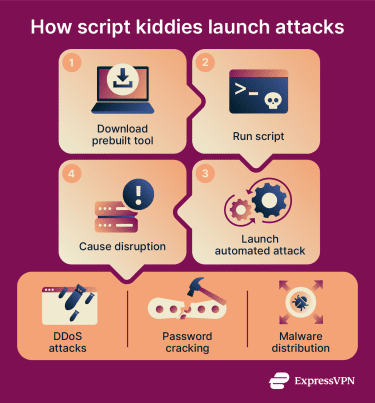 Script kiddies typically rely on readily available tools and instructions rather than developing new exploits or building their own attack tools. These tools may circulate through public repositories, tutorials, forums, chat groups, and underground marketplaces.
Behaviors associated with script kiddies include:
- Using prebuilt hacking tools: Downloading ready-made tools from public repositories or forums.
- Running scripts with little understanding: Executing code largely as-is, without reviewing how it works.
- Targeting weak or outdated systems: Scanning for exposed services and unpatched software.
- Launching basic automated attacks: Favoring automated activity such as brute-force attempts or denial-of-service (DoS) attacks.
- Seeking attention: Often chasing recognition or "street cred," though motivations can vary.
Why script kiddies are a security risk
Despite their lack of expertise, script kiddies can still pose a serious security risk.
The automated tools they rely on make it easy to trigger large-scale distributed DoS (DDoS) attacks that disrupt services with high volumes of traffic. Rate limiting can help mitigate certain types of abusive traffic, but it’s typically only one layer in a broader DDoS protection strategy, and some platforms may still be vulnerable.
Similarly, some password-cracking software is very easy to deploy. Multi-factor authentication (MFA) can significantly reduce the risk from password guessing and credential attacks, though it’s not foolproof, especially if attackers can trick users or steal sessions.
Some attackers may also distribute ransomware and other readily available forms of malware, delivering dangerous payloads through automated attacks or basic social engineering. This can cause serious financial harm to victims.
Because these tools allow attacks to be launched repeatedly and with minimal effort, poorly secured systems can be targeted at scale, increasing the likelihood of disruption.
Script kiddies vs. skilled cybercriminals
Though both can be dangerous, there are several key differences between script kiddies and skilled cybercriminals.
Experienced attackers are more likely to develop or customize malware and devise more advanced attack strategies. They may carry out more complex operations that are harder to detect, especially when they focus on stealth and persistence.
Their intentions are also usually different. Script kiddies are commonly associated with opportunistic attacks and motives like disruption, curiosity, or bragging rights. In popular perception, they do this for fun or to target personal enemies. In contrast, more advanced threat actors often operate with clearer objectives, such as data theft, espionage, financial theft, or maintaining long-term access.
How to protect yourself against script kiddie attacks
Basic security hygiene goes a long way in limiting the impact a script kiddie can have.
Keeping operating systems and applications up to date helps close off known vulnerabilities that automated tools often target.
Strong passwords and MFA reduce the risk of a successful brute-force attack, while firewalls and rate limiting can help reduce some automated abuse.
For DDoS, mitigation usually requires layered controls (e.g., internet service provider (ISP)/hosting support or dedicated DDoS protection) because large traffic floods can overwhelm upstream connections.
Further reading
- DoS vs. DDoS attacks: Key differences and how to protect yourself
- What is an IP stresser, and how do DDoS booters work?