Expressvpn Glossary
Network management system

What is a network management system?
A network management system is a centralized platform used to monitor, manage, and maintain computer networks. It provides visibility into devices, connections, services, and performance across connected systems and resources.
IT and security teams rely on network management systems to understand how networks behave, detect problems, and maintain reliable operations.
These systems commonly gather data using protocols such as Simple Network Management Protocol (SNMP), syslog, and NetFlow, while also integrating with mapping and configuration tools.
How does a network management system work?
A network management system continuously discovers devices connected to a network and builds a live inventory. It collects telemetry from routers, switches, wireless access points, firewalls, and servers. This data includes performance metrics, event logs, and traffic flow information.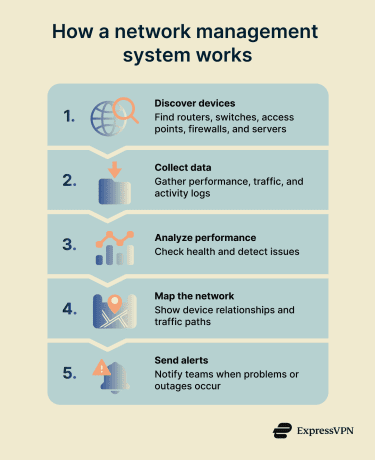
Using this information, the system builds topology maps that show how devices depend on one another. It establishes performance baselines and compares current behavior against historical trends. When thresholds are crossed or anomalies appear, alerts are triggered. Many platforms also automate configuration backups, patch management, and change tracking to reduce manual effort.
Types of network management systems
- On-premises network management system: Installed within an organization’s own data center or campus environment and managed internally.
- Cloud-based network management system: Hosted by a vendor and accessed through a web interface without local infrastructure.
- Open-source network management system tools: Community-driven platforms that allow customization and integration with existing systems.
- Domain-specific network management system: Designed for particular environments such as wireless networks, software-defined wide area networks (SD-WAN), or operational technology networks.
- Full suite platforms: Combine monitoring, mapping, and configuration management in one system rather than focusing on a single function.
Why is a network management system important?
A network management system improves visibility across complex environments. It allows teams to detect outages before users report them, identify misconfigurations and unauthorized devices, and troubleshoot issues using historical performance data.
By centralizing monitoring and automating repetitive tasks, it reduces downtime and supports compliance reporting and auditing processes.
Where are network management systems used?
Network management systems are utilized in any environment where reliable connectivity is essential:
- Enterprise campuses and data centers.
- Internet service providers (ISPs) and telecom networks.
- Managed service providers and security operations centers.
- Industrial networks and critical infrastructure.
- Cloud, hybrid, and branch office environments.
These systems scale from small business networks to global enterprise deployments.
Risks and privacy concerns
Network management systems have centralized access to infrastructure data, which makes them a target for attackers.
Compromised credentials can provide attackers with visibility to the entire network. Telemetry data can also reveal sensitive information about traffic patterns and system behavior.
To reduce risk, organizations apply role-based access control (RBAC), multi-factor authentication (MFA), encryption, and system hardening practices.
Further reading
- What is network configuration management?
- What is network mapping? Complete guide
- What is network discovery? How to enable it safely
- Network topology: Best practices for modern networks
- Network architecture: Building secure and modern networks
- What are network protocols? A complete guide