Expressvpn Glossary
Network administrator

What is a network administrator?
A network administrator is an IT professional who manages and secures an organization’s computer networks, aiming to ensure reliable connectivity and smooth performance. They troubleshoot issues and maintain network hardware, infrastructure, and configurations, and help keep systems protected by collaborating with security engineers.
What does a network administrator do?
A network administrator aims to maximize network performance by keeping an organization’s systems connected, secure, and dependable. They also work to ensure data passing through the network is kept private, unaltered, and accessible.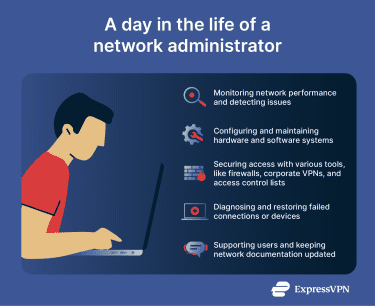
Network monitoring
Administrators use specialized tools to track network traffic, system logs, and device status in real time. They monitor for slow or failed connections, ensure services stay reachable, support network segmentation, and keep bandwidth and performance within normal ranges.
Network management
Administrators install and maintain the hardware and software that enable computers and devices to share information, such as routers and switches. They connect new teams or offices, set up secure wireless access and permissions, and upgrade or replace equipment to keep the network efficient and reliable.
Network security
Administrators protect the network by combining software tools, hardware controls, and careful configuration. They use firewalls to filter traffic and intrusion detection systems to spot suspicious activity, set up corporate virtual private networks (VPNs) so remote users can connect safely, and regularly update security settings to close vulnerabilities before they’re exploited.
Troubleshooting and recovery
When connections fail, administrators use diagnostic tools and logs to find the cause. They test paths, check configurations, and repair or replace faulty components to restore services. Regular backups and recovery plans can help rebuild systems quickly after failures.
User support and documentation
Administrators assist users with connection issues, access permissions, and setup. They also maintain detailed, up-to-date documentation that maps the network, lists configurations, and outlines standard procedures to speed up problem-solving and ensure smooth handovers when team members or roles change.
Why are network administrators important?
Network administrators play a vital role in keeping an organization’s operations running smoothly. They help prevent costly downtime by tackling unexpected problems, ensuring crucial operations can be kept online.
A strong network administration team also helps the organization adapt to change. As businesses expand, move to cloud systems, or introduce new tools, administrators can ensure these transitions happen smoothly and with minimal disruption.
Network administrator vs. system administrator
Both roles maintain an organization’s IT environment, but at different levels:
- A network administrator manages network connectivity: They maintain the infrastructure that keeps devices communicating, which includes routers, switches, wireless access points, and firewalls.
- A system administrator manages systems: They’re responsible for computers and servers. This includes installing and updating operating systems, managing user accounts and permissions, and making sure all software and hardware are running reliably.
In small and medium-sized enterprises, it's common for one person to manage both roles, though it ultimately depends on the organization. In larger businesses where networks are complex, these roles are typically distinct.
Skills and tools used by network administrators
Network administrators combine technical expertise with practical problem-solving to keep networks reliable and secure. Their work depends on:
- Understanding of networking protocols: They understand how information moves across a network and how different devices communicate, enabling them to design efficient connections and troubleshoot issues.
- Familiarity with monitoring and diagnostic tools: Network admins require software for monitoring network traffic, detecting anomalies, and verifying that systems are functioning correctly.
- Knowledge of security configuration: The proper application of firewall rules, encryption, and authentication measures is needed to protect data and control network access.
- Strong problem-solving and communication skills: A strong network administrator will be able to identify the cause of technical issues quickly, document their findings clearly, and communicate solutions.