Expressvpn Glossary
Data transfer
What is a data transfer?
A data transfer refers to the process of moving digital information between devices or over the internet. It enables communication, file sharing, and access to online services.
How do data transfers work?
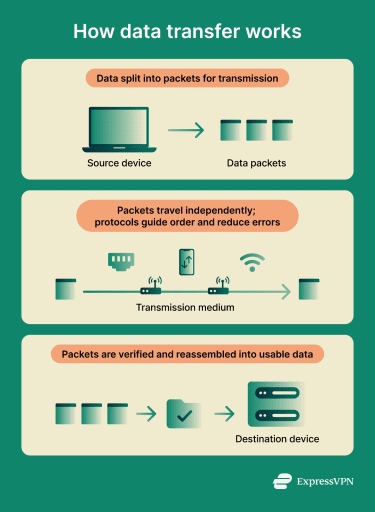 A data transfer starts by breaking the data into small packets, which makes it easier to send large files or continuous data. That’s because small pieces allow networks to manage traffic more efficiently; it also ensures that only missing or damaged packets need to be resent, rather than the entire file. These packets travel over local and/or global networks, guided toward their destination by routers, switches, and other devices.
Once they reach the receiving device, the packets are reassembled into the original data. Protocols like Transmission Control Protocol (TCP) / Internet Protocol (IP) help ensure packets arrive in the correct order, reducing errors and data loss.
Data transfer terms and metrics
Data transfer rates show how quickly information moves between devices or over a network. Key terms and metrics include:
- Upload/download: Upload is sending data from the device to a network or server; download is receiving data from a network or server.
- Megabits per second (Mbps) / gigabits per second (Gbps): These units measure data transfer speed, with Mbps representing millions of bits per second and Gbps representing billions of bits per second.
- Throughput/bandwidth: Throughput is the actual speed achieved; bandwidth is the theoretical maximum data rate of a channel.
- Latency: This is the time it takes for data to travel. It can refer to one-way delay (from source to destination) or round-trip time (RTT), which refers to the total time for a signal to travel to the destination and back.
- Propagation delay: Describes the time it takes for a signal or packet to travel from the sender to the receiver across a network. This time is usually longer when the devices are farther apart and often shorter on a faster network.
Transfer speeds can be affected by network congestion, device distance, hardware limits, protocol efficiency, and wireless interference.
Common data transfer methods
Data transfer methods are either online/network-based or local/short-range. Online methods move data over the internet or cellular networks, while local technologies enable direct data exchange between nearby devices.
Online/network-based examples include:
- HTTPS: Encrypts web communication.
- Cloud sync services: Keeps files and data synchronized across devices.
Local/short-range examples include:
- Bluetooth: Short-range wireless exchange between devices.
- Near Field Communication (NFC): Very short-range transfers for contactless payments or pairing.
How data is kept safe during a transfer
Data can be protected through the use of secure data transfer methods, which help prevent unauthorized parties from reading or modifying information as it moves between devices. Applications and websites that implement secure protocols, such as Transport Layer Security (TLS), Hypertext Transfer Protocol Secure (HTTPS), and Secure File Transfer Protocol (SFTP), encrypt data in transit. Services or apps that don’t use these methods can expose data to potential interception.
A virtual private network (VPN) adds an extra layer of security by encrypting all network traffic between a device and the VPN server. This encryption helps safeguard the data while it travels across networks.
Regular software updates may also help address vulnerabilities that could otherwise be exploited during data transfer.
Further reading
- Network connections: Everything you need to know
- What are network protocols? A complete guide
- Throughput vs. bandwidth: Key differences and why they matter