Expressvpn Glossary
Data protection policy

What is a data protection policy?
A data protection policy (DPP) is an internal document that explains how an organization handles personal data. It sets rules for collecting, using, storing, sharing, and deleting information to reduce the risk of data being leaked, mishandled, or unlawfully processed.
The policy generally establishes accountability for employees, systems, and external partners. Organizations rely on DPPs to operate in line with internal, contractual, and legal requirements. Some organizations maintain separate policies or procedures for different types of personal data, such as customer and employee information.
How does a data protection policy work?
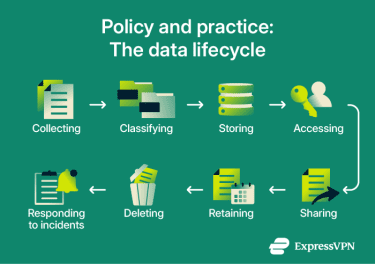
A DPP aims to translate data privacy goals into operational procedures. It documents how information should flow through an organization and assigns specific procedures for each stage of the data lifecycle.
Among other things, a good policy covers:
- Data mapping: Identifies what information is collected, where it comes from, how it's used, where it's stored, with whom it's shared, and the relevant roles involved in processing.
- Purpose limitation: Restricts collection and use to defined business purposes.
- Security rules: Requires safeguards such as authentication, encryption, and access restrictions.
- Retention schedules: Defines how long data is stored and when it's deleted.
- Incident handling: Establishes reporting and response procedures for a data breach. Together, these procedures aim to reduce unnecessary exposure, support lawful and consistent handling of personal data, and ensure that incidents are met with consistent responses.
What should it include?
The ideal scope of a DPP depends on an organization’s purpose and position. Factors such as the data a business collects, the risks it faces, and its regulatory obligations help determine how strict and comprehensive the policy should be.
That said, most DPPs cover the following:
- Data categories: Defines personal data and special categories of personal data, including biometric data where relevant.
- Legal basis: Records the lawful basis for processing, such as consent, contractual necessity, legal obligation, public task, vital interests, or legitimate interests.
- Individual rights: Supports data subject rights, including access, correction, portability, deletion, and other applicable rights.
- Third-party handling: Requires appropriate contracts, due diligence, and safeguards for processors, vendors, and data transfers.
- Governance: Establishes training, internal reviews, and policy updates.
Organizations often begin with a template or policy model associated with a broader compliance framework, such as the General Data Protection Regulation (GDPR). Beyond that, a document should reflect real workflows, systems, and storage practices.
Why is a data protection policy important?
Handling personal data creates both operational and regulatory responsibility. Without clear procedures, different departments may adopt inconsistent practices, increasing the likelihood of errors and unauthorized disclosure.
A defined policy helps demonstrate accountability, supports regulatory compliance, and clarifies roles and response procedures. It also helps organizations demonstrate to employees, partners, and customers that personal data is handled in accordance with documented standards.
Ultimately, having a DPP in place can strengthen an organization’s overall data security posture when it is supported by appropriate technical and organizational measures.
Where is it used?
DPPs are used wherever personal data is processed. A small retail business may adopt one to better protect customer account records, while healthcare and educational institutions use them to safeguard sensitive personal data. Online services and mobile applications rely on them to manage personal data used for analytics, authentication, and user-stored content.
Organizations that process personal data may need documented policies and procedures to meet applicable privacy and data protection requirements, including the GDPR, where it applies. Other regulatory frameworks apply in other regions, each with its own accountability and documentation expectations.
Risks and privacy concerns
A policy alone does not ensure protection. Weak implementation or unclear rules can create additional exposure.
Key concerns include:
- Vague wording: Can cause inconsistent decisions and applications.
- Over-collection: Increases exposure and can worsen the impact of a breach.
- Third-party sharing: Insufficient safeguards may result in violations of legal or regulatory requirements.
- Cross-border transfers: May violate transfer rules if required safeguards are missing.
- Missing logs: Can make investigation, breach assessment, and accountability more difficult after incidents.
Further reading
- What is the GDPR? Simple guide to EU data protection
- What is data privacy and why it matters: A complete guide
- What is a data breach? How to safeguard your information
- Data harvesting: What it is and how to stay protected
- Data sovereignty: What it is and compliance considerations