
Expressvpn Glossary
Data loss
What is data loss?
Data loss occurs when data becomes corrupted, destroyed, or inaccessible, preventing users or organizations from retrieving it. It can affect individual files, entire devices, cloud accounts, and data centers. It may occur because of accidents, such as deleting a document, or malicious actions, such as ransomware attacks.
How does data loss happen?
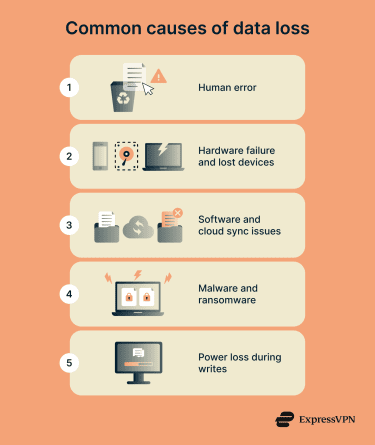 Data loss can occur in many ways. Here’s an overview of common causes:
- Human error: Files may be accidentally deleted, overwritten, or misplaced during routine operations.
- Hardware failure: Storage devices such as hard disk drives (HDDs), solid-state drives (SSDs), and mobile devices can fail unexpectedly, making stored data unusable.
- Software issues: Bugs, crashes, or faulty updates can corrupt files or damage operating systems and applications.
- Cloud synchronization errors: Misconfigured sync settings or version conflicts can cause files to be replaced or removed across connected devices.
- Malware and ransomware: Malicious software can delete, corrupt, or encrypt files, sometimes making them unrecoverable.
- Lost or stolen devices: Data stored on laptops, smartphones, or external drives may be permanently lost if the device can’t be recovered.
- Power outages: Sudden power loss during active write operations can corrupt files or leave them only partially written.
Impact of data loss
Data loss can affect individuals, students, and organizations in several ways, including operational disruption, financial costs, and security risks.
- Academic impact: Students and researchers may lose project files, coursework, or research data, leading to missed deadlines or the need to redo work.
- Operational disruption: Businesses and organizations may experience interrupted services or delays in critical operations if essential data becomes unavailable.
- Financial costs: Organizations may incur expenses for downtime, lost productivity, recovery software, or professional data recovery services.
- Regulatory consequences: Organizations may face compliance violations, legal penalties, or reputational damage if lost data includes sensitive information.
- Recovery challenges: Recovery may be slow and uncertain, and full restoration isn’t always guaranteed.
Risks and privacy concerns
Beyond availability issues, data loss can create additional privacy and security risks. Key concerns include:
- Third-party recovery services: Using external recovery tools or services may expose sensitive data if proper confidentiality protections aren’t in place.
- Ransomware payments: Paying attackers may increase the likelihood of repeated attacks or mark organizations as profitable targets.
- Lost or stolen devices: Devices may expose stored credentials, passwords, or other sensitive information if not properly protected.
- Misconfigured storage systems: Incorrect settings in cloud storage buckets, access controls, or retention policies can lead to accidental deletion or security vulnerabilities.
- Weak backup security: Poorly protected backups can become prime targets for cybercriminals.
Prevention and mitigation
Organizations and individuals often take proactive measures to reduce the likelihood and impact of data loss. Common approaches include:
- 3-2-1 backup rule: Keep three copies of data on two types of media, with one copy stored offsite.
- Versioning and immutable backups: Preserve historical data even if the latest version is compromised.
- Full-disk encryption: Encrypt data at rest to protect confidentiality, but note that this doesn’t prevent data loss. If encryption keys are lost, data may become permanently unrecoverable.
- System patching and updates: Keep systems up to date to reduce exposure to software vulnerabilities.
- Backup testing: Test restores regularly to verify that backups work and that data can be recovered when required.
- Documenting recovery procedures: Maintain clear recovery processes so responses to data loss are coordinated and efficient.
Further reading
- What is data encryption?
- How to back up files and encrypt them
- What is a data breach? How to safeguard your information
- Data theft: What it is and how to protect yourself
- Should you pay the ransom? What to consider before deciding