Expressvpn Glossary
Data loss prevention (DLP)

What is data loss prevention?
Data loss prevention (DLP) is a security strategy that aims to prevent sensitive or critical information from leaving an organization's systems and services without permission. It combines policies, procedures, and technologies to detect and block unauthorized access, use, or transmission of sensitive data. It also allows administrators to define and enforce how and where sensitive data can be transferred.
How does data loss prevention work?
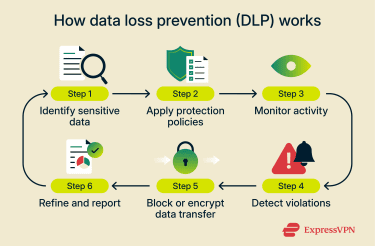 DLP software analyzes data movement by inspecting content and context. The process typically follows these steps:
- Identification: The system classifies sensitive data, which may include personal information, financial records, and intellectual property.
- Policy enforcement: Predefined security rules are applied to prevent unauthorized transfers of this data.
- Monitoring: Movement of sensitive data is tracked across devices, emails, and applications to see how the information is being used.
- Detection: If a rule is violated, the DLP tool logs the event and alerts administrators or security teams.
- Block: The tool can automatically stop the action, usually by blocking the transfer, quarantining the data, or temporarily stopping the transfer pending review.
- Refinement and reporting: Security teams review DLP alerts and reports, document incidents for audits, and adjust policies to improve accuracy and reduce false positives over time.
Types of data loss prevention
There are several types of DLP solutions, categorized by where they protect data:
- Endpoint DLP: Monitors and controls data use on laptops, desktops, and mobile devices. It can block or restrict the copying of sensitive files to USB drives, printers, or other external locations.
- Network DLP: Scans outgoing traffic to detect policy violations in emails or web uploads.
- Cloud DLP: Protects data handled by cloud platforms and applications, monitoring and enforcing policies around the storage and sharing of sensitive information.
- Storage (data-at-rest) DLP: Identifies and monitors sensitive data stored in databases and file servers.
Why is data loss prevention important?
DLP supports several security, legal, and business objectives, including:
- Prevention: Data breaches can be avoided by stopping leaks before they occur.
- Protection: Intellectual property and confidential information can be safeguarded from competitors or bad actors.
- Compliance: Organizations can better meet data standards and regulations such as the General Data Protection Regulation (GDPR) and the Health Insurance Portability and Accountability Act (HIPAA).
- Trust: Customers are more likely to trust organizations that take stringent measures to protect their personal and financial data.
Security and privacy considerations
Implementing DLP requires a layered approach to security. Here’s how organizations may enact this strategy:
- Encryption: Data in motion and at rest can be encrypted, ensuring it’s unreadable if intercepted or breached.
- Access control: Access can be restricted by role or data sensitivity, meaning only authorized personnel can view critical files.
- Auditing: Regularly audit and update protection policies to match current threats.
- Network security: Cloud-hosted business virtual private networks (VPNs) can increase data protection by encrypting traffic in transit between an organization’s devices and its VPN servers, reducing exposure risks during data transmission but not enforcing data loss prevention policies or controls.
Common causes of data loss
Data loss often stems from specific vulnerabilities or actions. Here are the common causes along with an example of each:
- Human error: Accidental deletion or sending emails to the wrong recipient.
- Malware: Ransomware attacks that primarily lock or steal data.
- Misconfiguration: Improperly secured cloud storage buckets.
- Insider threats: Employees intentionally sharing unauthorized files.
Further reading
- Zero-trust data protection explained
- What is data privacy and why it matters: A complete guide
- The 7 pillars of zero-trust security