Expressvpn Glossary
Data cloud
What is a data cloud?
A data cloud is a cloud-based data platform that centralizes data from multiple sources into a single, secure environment for storage, processing, and analysis. This allows consistent access and management across systems that were previously separate.
Data clouds are designed to handle large volumes of information. They rely on scalable cloud infrastructure and managed services to support security, performance, and reliability. They’re commonly used for tasks such as analytics, reporting, and machine learning, and they can reduce dependence on traditional on-premises infrastructure.
How does a data cloud work?
A data cloud consolidates data from applications, databases, devices, and cloud services into a shared environment.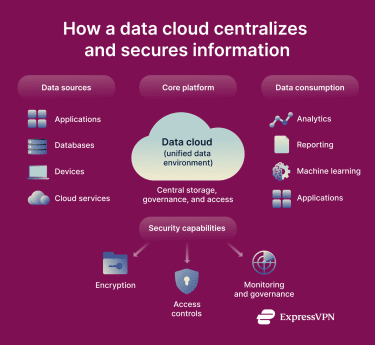
It can typically:
- Use APIs and data pipelines to ingest and synchronize data from multiple sources.
- Store data on cloud infrastructure that can scale as workloads change.
- Apply encryption and access controls to protect data at rest and in transit.
- Track usage and activity to support governance, auditing, and compliance needs.
- Enable data to be processed by analytical and machine learning tools.
Key features of a data cloud
Common characteristics of a data cloud include:
- A unified data layer intended to reduce data silos.
- Support for cross-cloud compatibility across multiple providers and regions.
- Near-real-time or low-latency data access for analytics and operational use cases.
- Security features such as encryption and identity management.
- Scalability to support growing data volumes and users.
- Support for executing workloads close to where data resides, reducing unnecessary data movement.
Benefits of using a data cloud
Key benefits can include:
- Improved access to data for remote teams.
- More consistent security practices across cloud environments.
- Reduced reliance on on-premises hardware.
- Faster insights by enabling data analysis in a single environment.
- Easier data governance and compliance management.
- Flexible scaling as data volumes grow over time.
Security and privacy considerations
Security is a key consideration in the design of data cloud platforms. Common practices include encrypting data in transit and at rest, controlling access through identity-based mechanisms, including role-based access controls (RBAC) and multi-factor authentication (MFA), and monitoring activity to help detect unusual or unauthorized behavior.
Misconfiguration is a common risk in cloud environments. This can include overly permissive access settings or insecure default configurations, which can expose data or allow unwanted access to personal or sensitive information.
To reduce this risk, organizations often use automated policy enforcement and regular security audits. Secure connectivity methods are also commonly used to protect access to cloud environments.
Common data cloud use cases
Data clouds support a range of use cases across different industries, including:
- Analytics and reporting involving multiple cloud environments.
- Synchronizing or replicating application data across regions and services.
- Controlled data sharing between internal teams or external partners.
- Supporting machine learning pipelines that run in the cloud.
- Supporting disaster recovery and backup workflows.
- Data operations designed to limit access to personal or sensitive information.
Examples of data cloud platforms
Well-known data cloud and cloud data platform providers include:
- Snowflake Data Cloud
- Google Cloud Platform (GCP)
- Amazon Web Services (AWS)
- Microsoft Azure
- Oracle Cloud Infrastructure
Further reading
- Security concerns in cloud computing and how to address them
- IoT cloud security: Threats and best practices
- Cloud VPN services explained
- Data sovereignty: What it is and compliance considerations