
Expressvpn Glossary
Data center architecture
What is data center architecture?
Data center architecture refers to the physical and logical design of a facility’s IT infrastructure. It defines how servers, storage, networking, virtualization, power, and cooling systems are organized and integrated to deliver performance, scalability, reliability, and security.
How does data center architecture work?
Data center architecture organizes compute, storage, and networking so that applications can run reliably and scale as needed.
In practice, it structures hardware, manages workloads, stores data, and maintains availability:
- Racks organize hardware: Servers and networking equipment are placed into racks to simplify power, cooling, and cabling.
- Servers run workloads through virtualization: Virtual machines (VMs) allow a single physical server to run multiple isolated applications at once.
- Storage systems handle data: Different storage types are used to meet performance, capacity, and reliability needs.
- Redundancy keeps systems running: Critical components are duplicated so operations continue even if one fails.
Types of data center architecture
There are several common types of data center architecture, including:
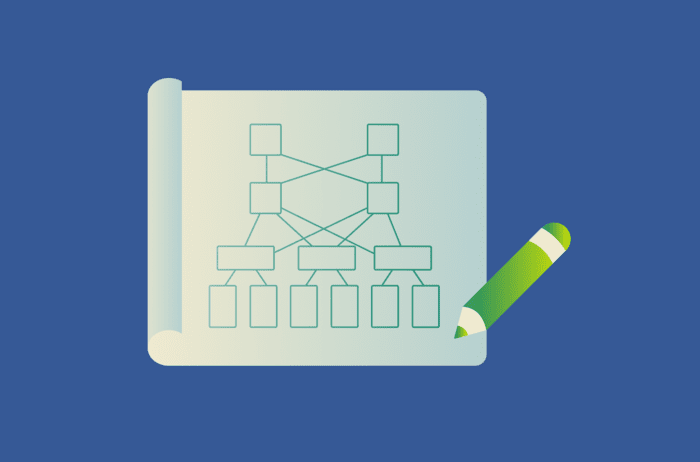
- Traditional three-tier architecture: Uses separate core, aggregation, and access layers to move data within the data center.
- Spine-leaf architecture: Flattens the network so servers connect to leaf switches, which link to spine switches, enabling fast and balanced traffic between workloads.
- Cloud-based data center architecture: Delivers computing resources over the internet using virtualization, allowing organizations to scale without owning all the hardware.
- Software-defined data center (SDDC): Extends virtualization from compute to storage and networking, with software managing all resources to enable automation, flexibility, and easier scaling.
- Edge data center architecture: Places small data centers closer to where data is created or used, reducing latency and improving application performance.
Why is data center architecture important?
Data center architecture is important for organizations because it:
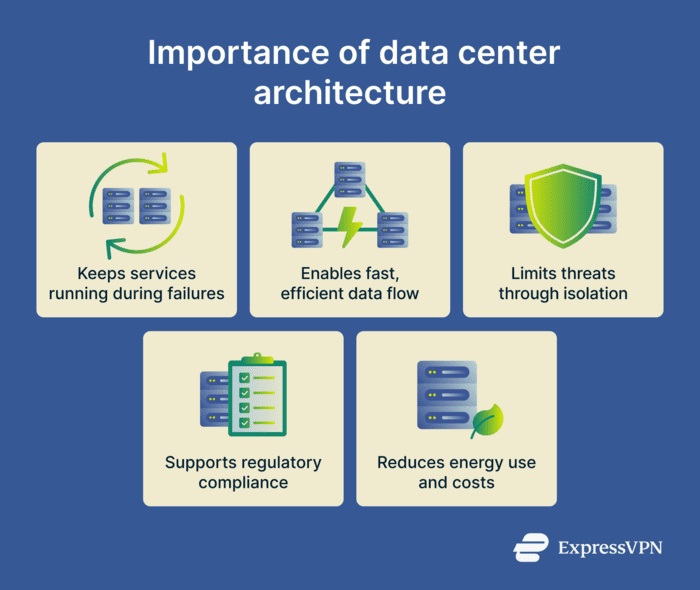
- Impacts uptime and fault tolerance: Well-designed architecture includes redundancy and backup paths so systems continue running if components fail.
- Controls latency and throughput: Efficient network and hardware design helps data move quickly across systems, keeping applications responsive.
- Reduces blast radius of breaches: Segmentation, access controls, and encryption limit how far an attack can spread and help protect sensitive data.
- Supports compliance and auditability: Strong architectural controls help organizations meet industry rules and standards.
- Lowers operational and energy costs: Efficient layouts, cooling strategies, and resource use reduce energy consumption and the cost of running and maintaining the facility.
Where is data center architecture used?
Data center architecture is used across different environments to support applications, data storage, and network services:
- Enterprise private data centers: Organizations design and operate their own architectures to control infrastructure, enforce security policies, and support critical workloads.
- Cloud provider regions and zones: Providers design architectures across regions and availability zones to distribute workloads, improve resilience, and reduce downtime.
- Colocation facilities and shared spaces: Businesses deploy their own architectures within third-party data centers, using shared power, cooling, and connectivity.
- Edge sites and micro data centers: Architectures are designed to run closer to users or devices, reducing latency and supporting real-time processing.
- Disaster recovery and backup sites: Architectures replicate systems and data across locations so services can recover quickly from failures.
Risks and privacy concerns
Data center architecture must proactively mitigate multiple risks, including:
- Lateral movement in flat networks: Flat network designs allow attackers to move more easily between servers once they gain access.
- Misconfigured segmentation: Weak separation between workloads, racks, or zones can expose internal services that weren’t intended to be reachable.
- Weak identity and access management (IAM): Poorly enforced access controls make it easier for attackers to escalate privileges across infrastructure layers.
- Insecure management planes: If the control plane lacks strong security, attackers can alter configurations or access sensitive data.
Further reading
- What is a cross connect in a data center?
- TrustedServer: Deep dive into the security of our server tech
- Network architecture: Building secure and modern networks
- What is cloud networking? A comprehensive overview
- What is a virtual private cloud (VPC)?