Expressvpn Glossary
Content delivery network (CDN)

What is a content delivery network?
A content delivery network (CDN) is a system of distributed servers employed by a service to give users faster options for downloading content. CDNs store cached versions of files (such as images, style sheets, JavaScript files, and videos) on servers placed in different regions.
This allows users to download content from a server that’s closer to them or faster than the original, central server. The reduced distance lowers latency, improves page loading speed, and avoids overloading a service’s main hosting system.
How does a CDN work?
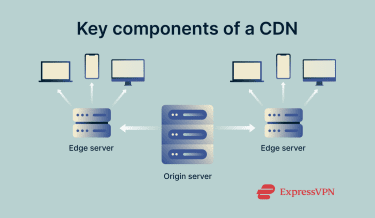 When a user visits a website or online service, their request is routed to an edge server in the CDN that is geographically close or able to respond quickly. If that server already holds a cached copy of the requested file, it sends that version back to the user.
If the file is not in the cache, the CDN retrieves it from the origin server that hosts the service’s original content. It then stores a copy for future requests from that region. As more users request the same files, copies are cached in additional regions for future use.
Key components of a CDN
Origin server
The origin server is the authoritative source of a service’s content. It stores the original files that the CDN requests when a cached copy isn’t available. The origin server can provide new or updated content, which the CDN then distributes to other regions as needed.
Edge servers
Edge servers are CDN servers placed in different locations. They store cached copies of selected web content and respond to user requests from those areas.
Points of Presence (PoPs)
A Point of Presence (PoP) is a physical location that houses one or more CDN servers. Each PoP serves a specific region and provides the infrastructure needed for routing, caching, and traffic management.
Caching and distribution mechanisms
Caching determines which files a CDN stores and how long they remain available before being refreshed. CDNs often cache content on demand, based on user requests. Distribution systems then route each request to a server able to respond quickly, helping maintain consistent performance across different locations.
Benefits of using a CDN
In addition to the performance improvements already covered, a CDN also provides several other advantages:
- Higher content availability: Content can still be served from other regions even if the main hosting location becomes unavailable.
- Better handling of traffic surges: Requests are spread across many servers, reducing the chance of slowdowns during peak demand.
- Lower bandwidth usage at the origin: Edge servers reduce the amount of data transferred from the website’s hosting server, which can help lower bandwidth costs.
- Additional security protections: Many CDNs include features that filter malicious traffic, reduce the impact of distributed denial-of-service (DDoS) attacks, and support secure, encrypted connections.
CDN and security considerations
Because CDNs operate across many servers and regions, certain security and data-handling factors need to be taken into account.
- Encryption of data in transit: CDN traffic should use Secure Sockets Layer (SSL) / Transport Layer Security (TLS) encryption. Encryption makes sure data cannot be intercepted or modified as it moves between the user, CDN servers, and the origin server.
- Handling of sensitive and dynamic content: CDNs should cache public files, not private or user-specific data. Sensitive or dynamic content should stay at the origin server. Cached files are stored in multiple locations across the CDN, which increases the risk of exposing information that is meant to remain private.
- Control over where data is stored: Cached content may be stored in different regions across the CDN. Organizations with data-residency or regulatory requirements need to check that their caching settings match those obligations.
CDN examples and providers
Many companies offer CDN services, including Cloudflare, Akamai, Amazon CloudFront, Fastly, and Google Cloud CDN. In addition to public CDN providers, several large platforms (such as Netflix, Meta, and Google) operate private CDNs to manage their own content delivery at scale.