What is GPS spoofing? Everything you need to know



Many devices rely on satellite-based Global Positioning System (GPS) signals to figure out their location and keep accurate time. Navigation apps, ride sharing, shipping and aviation systems, and financial tools all expect these signals to be correct. When GPS signals are changed or disturbed, systems that depend on them can act unpredictably.
GPS spoofing is one way of deliberately making these errors happen. The term is used for both signal-based attacks and software tools that make a device report a different location, which are more properly known as location spoofers or simulators.
This article explains how spoofing works, where it can have an impact, and the steps that help detect and limit exposure.
How GPS spoofing works
GPS spoofing refers to the act of giving a device false location or timing information that it reads as real. It can refer to the use of fake radio signals or software that makes a device report different GPS coordinates.
GPS spoofing works in different ways, depending on whether the manipulation happens at the signal level or inside the device’s software. Let’s first look at how signal-based GPS spoofing works.
How GPS signals are structured
GPS satellites send out radio signals in a predictable format. Each signal includes the core information a receiver needs to identify the satellite that sent it and its distance:
- Timing information: Used to measure how long the signal took to reach the receiver.
- Satellite and navigation data: Identifies the satellite and explains how to interpret the timing.
A receiver listens to several satellites at the same time and compares when each signal arrives. From those timing differences, it calculates its position and an accurate time reference.
Why is GPS vulnerable to spoofing?
GPS provides two services: one for military use and one for civilian use. The military signals have stronger protections. The civilian signals, which phones and everyday devices rely on, are unencrypted; the technical details are public, and receivers are built to read these signals without performing origin authenticity checks.
Because of that design, a civilian GPS receiver can’t confirm that a signal actually came from a satellite. It simply reads signals that appear valid and match the structure of a normal GPS signal. This process is what allows spoofing.
Some equipment used in aviation, shipping, or critical infrastructure adds extra safeguards. For example, they pair GPS with other sensors so devices aren’t reliant on one set of data. GPS works reliably in everyday conditions, but it has limited protection when someone deliberately sends signals that appear legitimate.
Hardware spoofing vs. location-changing apps
Hardware-based spoofing
Hardware spoofing uses transmitters that can broadcast radio frequency signals that appear similar to GPS signals. Because transmissions on these frequencies can deceive navigation and safety-critical systems, this type of equipment isn’t readily available as ordinary consumer gear.
Software-based location alteration
Location-changing apps work at a different level from hardware spoofing. They change how devices report location data. These tools can introduce privacy and security risks. Navigation, ride-sharing, and weather apps may not work properly with false GPS data, along with features like Find My Device.
Real-world impacts of GPS spoofing
GPS spoofing has consequences that affect a number of different services and industries.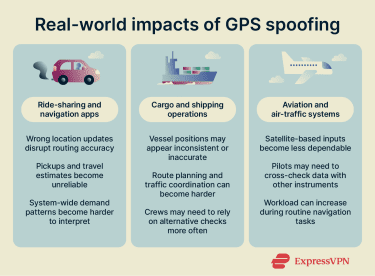
Transportation and ride-sharing risks
Navigation apps and ride-sharing platforms depend on accurate location updates to match drivers with passengers, calculate routes, and estimate arrival times. If a device receives misleading location data, it may show vehicles moving along the wrong streets or place them far from where they actually are. This can interfere with trip coordination, delay pickups, and cause drivers to take inefficient routes.
These services also look at patterns across many trips to understand where drivers are needed. When location readings are wrong, those patterns become less reliable, which can affect how well the system balances supply and demand.
Cargo and shipping industry threats
Commercial shipping depends on satellite-based tracking for routing and traffic coordination. When that data is wrong, planning becomes harder, and crews have to fall back on manual checks.
A recent example highlights the severity of the risk. In May 2025, the container vessel MSC Antonia ran aground in the Red Sea. Maritime intelligence firms such as Windward and Pole Star reported erratic AIS tracks and position jumps for the ship, describing the pattern as consistent with GPS interference. UK Maritime Trade Operations had also warned of navigation disruptions in the area. While the exact cause hasn’t been confirmed, the case has been cited as evidence of interference affecting multiple vessels at once.
On land, incorrect location data can cause similar issues for fleet and cargo logistics, triggering false alerts or misrouting when automated systems rely on inaccurate position updates.
Aviation safety concerns
GPS works alongside onboard motion sensors, radio beacons, and air-traffic control instructions, so no single source is meant to guide the aircraft on its own. When satellite signals are disrupted, crews switch to other navigation aids, but the interference can still create extra workload and make GPS readings less reliable.
Regulators have warned that jamming or spoofing can cause navigation inaccuracies, unexpected alerts in avionics, or delays while pilots verify information with other instruments.
For example, in 2025, the civil aviation minister for India confirmed in Parliament that major airports, including Delhi, Kolkata, and Bengaluru, had experienced GPS spoofing.
In response to that confirmation, airlines and air traffic services started to rely more heavily on the alternative navigation methods already in place. Incidents like this show how satellite interference can affect multiple flights at once, even when aircraft remain safe by cross-checking other systems.
Detection and prevention of GPS spoofing
No single measure can remove spoofing risks entirely. The most reliable approach is to combine monitoring, cross-checks, and sound operational practices so problems are noticed early and are harder to exploit.
How organizations detect GPS spoofing
Detection relies on equipment that can examine how satellite signals behave. Specialized receivers and monitoring systems allow professional operators in aviation, maritime, transport, and critical infrastructure to evaluate whether incoming signals follow the patterns expected from real satellites.
Signal analysis and timing checks
- Consistency between satellites: Receivers can compare signals from multiple satellites. They look for combinations that don’t fit normal patterns, such as signals with identical arrival times when they should differ.
- Changes in signal strength: Satellite signals are extremely weak by the time they reach the ground. If one signal suddenly arrives much stronger than the rest, it can indicate a nearby transmitter rather than a satellite.
- Timing behaviour: Receivers can watch for timing or frequency shifts that drift faster than they should, or move in ways that don’t match what real satellites are doing.
Available detection tools
Organisations that depend on accurate positioning and timing have several options:
- Receivers with built-in spoofing checks: Some modern satellite receivers include integrity features that estimate whether incoming signals make sense together. They can flag suspicious conditions or fall back to other inputs.
- Independent reference stations: Fixed receivers at surveyed locations can continuously compare their satellite-derived position with their known coordinates. When the two diverge, that difference can be used to flag possible interference or other problems with the signal.
- Monitoring and analytics platforms: Dedicated navigation-monitoring services can combine data from many receivers, track anomalies over time, and report regions where interference is likely.
How everyday users can recognize signs of GPS spoofing
Unlike professional navigation systems, personal devices don’t have access to the raw satellite data needed to directly detect GPS spoofing. That level of detection relies on specialized receivers and monitoring infrastructure.
What you can do is look for observable signs that suggest location data may be unreliable. These signs don’t confirm spoofing, but they can help indicate when GPS-based information shouldn’t be trusted on its own.
Common signs of unreliable GPS data
- Abrupt or strange location changes: Your device suddenly jumps to a distant location, shows movement while stationary, or places you somewhere you clearly are not.
- Navigation that conflicts with surroundings: Maps display roads, turns, or routes that don’t match what’s visible, or repeatedly reroute despite clear conditions.
- Inconsistent readings across apps: Location-based apps report noticeably different positions at the same time, even though they normally align.
- Unrealistic speed or direction readings: Tracking apps show sudden acceleration, sharp turns, or speeds that don’t match how you’re actually moving.
- Erratic behavior from location-dependent features: Ride pickups, delivery tracking, or device-finding tools show delays, incorrect positions, or stop updating as expected.
How organizations protect against GPS spoofing
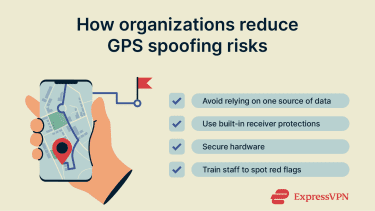
- Use more than one navigation source (transport operators, aviation, maritime, fleet systems): Check satellite data against other inputs such as onboard motion sensors, radio beacons, or distance-measuring equipment. Differences between these sources can highlight when satellite readings are unreliable.
- Enable receiver integrity checks (organizations selecting or configuring navigation receivers): Choose receivers that can evaluate whether incoming signals behave as expected, and make sure those features are correctly set up.
- Secure antennas and cabling (fixed installations and critical infrastructure): Place antennas in locations that are hard to access without authorization, and protect the cabling and mounting points so outside equipment can’t be added unnoticed.
- Train staff to spot anomalies (operations teams and control centers): Make sure operators know how to respond when positions shown on maps, instruments, or tracking dashboards do not match visual cues or other systems.
For personal devices, there’s no direct way to block GPS spoofing. When location data doesn’t match what you see around you, the practical response is simply to rely on other cues until readings make sense again.
Is GPS spoofing illegal?
Note: This information is for general educational purposes and not legal advice.
Rules around GPS spoofing depend on how it’s done and what the intent is. Many countries have laws that restrict equipment that interferes with radio or navigation signals. Broadcasting fake satellite signals can fall under regulations that protect the radio spectrum and authorized services.
Software-based location changes can also raise legal or contractual problems when they’re used to mislead others, commit fraud, or gain an advantage.
Penalties vary depending on location. Interference that affects aviation, maritime navigation, or other safety-critical systems can carry more serious consequences, which may include fines, loss of equipment, or criminal sanctions. Misuse tied to fraud or deception can fall under separate laws even when no radio signals are involved.
GPS spoofing apps vs. a VPN: What’s the difference?
GPS spoofing apps and virtual private networks (VPNs) do two different things. GPS spoofing apps change the location your device reports, so individual apps think the device is somewhere else. A VPN changes the IP address that websites and online services see. One affects device-level coordinates, and the other affects network traffic.
GPS spoofing can also confuse apps that depend on movement or distance data. A VPN usually doesn’t affect services like maps, weather forecasts, or ride-sharing services.
FAQ: Common questions about GPS spoofing
Can apps detect GPS spoofing?
No. Some apps can detect when the location they receive doesn’t match other clues they rely on, such as network-based location or normal movement patterns. They can flag inconsistencies, but they can’t confirm spoofing on their own. Most simply decide whether the data looks trustworthy enough to use.
Can you spoof GPS on iPhone or Android?
Both systems make GPS spoofing difficult. Neither platform offers a built-in way to falsify GPS, and workarounds often lower device security or put user privacy at risk.
What are the signs of GPS spoofing attacks?
The most common clues are sudden jumps on the map, speeds that don’t match real movement, or routes that drift away from roads or landmarks. In aviation and maritime reports, unreliable GPS often shows up as drifting tracks or abrupt position shifts. These issues can also come from weak signals or hardware faults, so they should be checked against other instruments or visible cues.
Are there legal consequences for GPS spoofing?
Yes. Transmitting signals that interfere with navigation systems is illegal in many countries and can lead to fines, confiscation of equipment, or other penalties when safety-critical systems are involved. Software-based location changes do not involve radio transmissions. However, using falsified coordinates to mislead others, commit fraud, or bypass rules can still break local laws or violate service policies.
Take the first step to protect yourself online. Try ExpressVPN risk-free.
Get ExpressVPN















 Support Center
  FAQ
FAQ  VPN Setup Tutorials