Expressvpn Glossary
Virtual data room (VDR)
What is a virtual data room?
A virtual data room (VDR) is a secure online repository for storing and sharing documents related to a business transaction. It provides a confidential space for storing materials relevant to processes such as sales, acquisitions, financing, restructuring, or other high-stakes corporate transactions.
Access is provided to approved third parties involved in the transaction through a controlled, internet-based environment, typically with permission settings and activity tracking. This structure supports efficient due diligence while helping protect sensitive information.
How a VDR works
A VDR follows a controlled workflow that governs how documents are stored, accessed, and monitored during a transaction.
- Upload documents: Files are uploaded to a centralized online repository using standard upload tools (e.g., drag-and-drop).
- Data protection: Documents are typically encrypted both at rest and in transit to help protect confidentiality.
- Permission-based user access: Administrators set role- and document-level permissions that determine who can view content and what actions are allowed.
- User activity is logged and reported: The system records access and file activity (for example, views, downloads, and updates) to create an audit trail.
- Additional authentication: Multi-factor authentication (MFA) can be used to verify identity before granting access.
- Document controls limit how files are used: Controls may include watermarking, restrictions on viewing, saving, and printing, which can help reduce unauthorized redistribution (though no control fully prevents all forms of capture).
To reduce disruption risk, many VDRs typically use backup and redundancy measures so that access can continue if part of the infrastructure fails.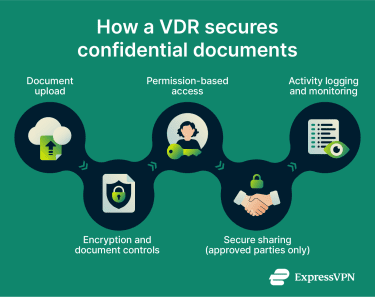
Common uses of virtual data rooms
VDRs are commonly used in high-stakes business and governance processes that require controlled access to sensitive information.
- Mergers and acquisitions due diligence: VDRs provide potential buyers and advisors with controlled access to transaction materials during due diligence.
- Legal document review and sharing: Draft agreements and related legal documents may be shared in a VDR for review by authorized parties.
- Investor and fundraising rounds: Organizations may use a VDR to share financial statements and disclosures with potential investors.
- Audits and compliance reviews: A VDR may support audits, valuations, or regulatory compliance reviews by organizing and restricting access to relevant materials.
Benefits of using a VDR
VDRs provide structural and security advantages when handling sensitive information in transaction and review processes.
- Centralized document management: A VDR provides a centralized, secure repository for storing and sharing confidential documents.
- Detailed tracking and reporting: VDRs typically provide time-stamped audit trails that record document access and other activity for oversight and accountability.
- Controlled access based on permissions: Access can be limited to authorized users and often restricted by document, role/group, or permitted action.
Security features of a VDR
- Strong security and encryption: Reputable VDR providers typically use encryption for data at rest, for example, 256-bit Advanced Encryption Standard (AES), and in transit, such as Transport Layer Security (TLS).
- MFA: VDRs may require MFA to verify user identity before access.
- Time-bounded and view-restricted access: Access can be limited to defined time periods and restricted to on-screen viewing, which may help reduce unauthorized redistribution
- Dynamic watermarking: VDRs may apply viewer-specific watermarks that identify the user accessing a document.
- Access revocation: Administrators can revoke access at the document, folder, or data-room level, invalidating permissions and shared links for future access (though previously downloaded copies may persist outside the VDR).
- Compliance: Many VDR providers maintain security certifications such as the International Organization for Standardization (ISO) 27001 and System and Organization Controls (SOC) 2 Type 2.
VDR vs. cloud storage
VDRs and cloud storage both support uploading and sharing files online, but they serve different purposes.
| VDR | Cloud storage | |
| Purpose and use case | Purpose-built for high-stakes transactions and controlled disclosure | Designed for general file storage and everyday collaboration |
| Access controls | Typically offers deal-focused controls (view-only, time-limited access, download/print restrictions) | Uses standard sharing permissions |
| Auditability | Document-centric logs and reporting designed for due diligence | Audit/activity logs are often available, but reporting is usually less deal-specific |
| Confidentiality and data leakage | Often includes dynamic watermarking, controlled viewing, and (in some platforms) non-disclosure agreement (NDA) acknowledgment/redaction workflows | May offer security features, but these are not usually packaged around due-diligence workflows |
| External parties | Built to manage many external reviewers with structured access | Supports external sharing, but is commonly optimized for internal team collaboration |
| Organization | Often uses deal-style indexing and structured workflows for due diligence | Generally uses standard folders and team workspaces |
Further reading
- What is a site-to-site VPN, and how does it work?
- VPNs, firewalls, endpoint security: What does your team really need?
- Security questions: Strengths and weaknesses