
Expressvpn Glossary
Transparent proxy

What is a transparent proxy?
A transparent proxy, also called an intercepting proxy, is a network system that handles internet traffic automatically without requiring proxy settings on users’ devices.
Such proxies sit between users and the services they access, processing requests and responses as intermediaries. They commonly filter, cache, or redirect web traffic across networks. Because they operate at the network level rather than on individual devices, they’re often invisible to users.
How does a transparent proxy work?
Transparent proxies redirect traffic using network-level routing rules instead of client settings. Network administrators configure routers, firewalls, or gateways to apply these rules and send web traffic to the proxy. Common methods include Network Address Translation (NAT), Web Cache Communication Protocol (WCCP), and policy-based routing.
The proxy intercepts web traffic as it passes through the network. For HTTP traffic, it can read the request, send it to the destination server, and return the server’s response to the user.
For HTTPS traffic, the connection arrives encrypted, so the proxy can’t read the contents unless HTTPS inspection is enabled. In that case, the proxy decrypts and inspects the traffic before re-encrypting and forwarding it. This typically requires managed end devices to trust the proxy’s certificate authority, usually by installing the proxy certificate as a root certificate authority, so the proxy can issue replacement Transport Layer Security (TLS) certificates for visited sites.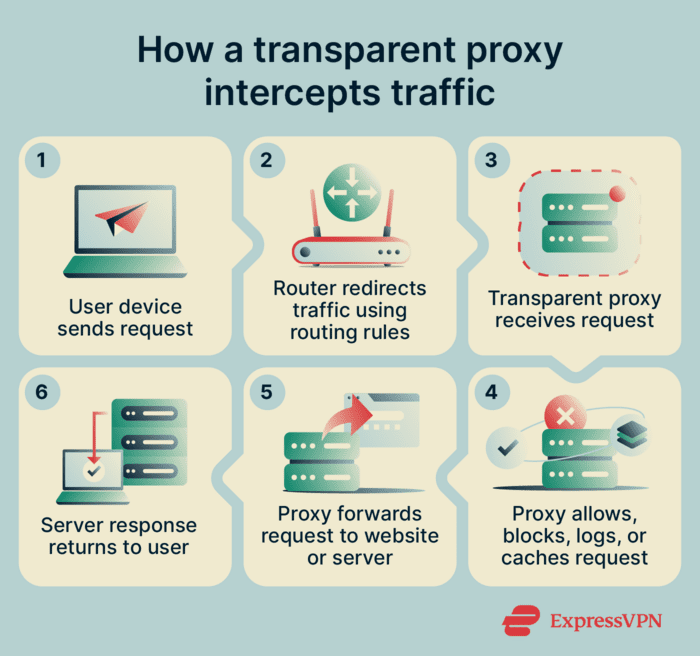
Types of transparent proxies
Transparent proxies can perform several functions beyond simple forwarding:
- Caching proxy: Stores copies of frequently requested content and serves cached versions to users.
- Filtering proxy: Blocks or restricts access to websites based on categories, domains, or security policies.
- TLS-intercepting proxy: Decrypts and inspects HTTPS traffic before forwarding it to the destination server.
- Authentication or identity-aware proxy: Associates network requests with user identities, enabling activity logging and helping enforce user-based policies.
A single transparent proxy may combine several of these functions.
Why is a transparent proxy important?
A transparent proxy gives organizations central control over network-wide activity, enabling monitoring, traffic optimization, and policy enforcement without configuring individual devices.
Some transparent proxies store and serve content locally, reducing bandwidth usage and speeding up repeated requests. Others, like filtering and identity-aware proxies, can block access to malicious links or restricted sites, enforce security policies, and log activity for investigation. More advanced deployments may also integrate with threat-inspection or data-loss-prevention tools to help identify suspicious behavior or potential data exfiltration.
Where is it used?
Many corporations, public institutions, and service providers use transparent proxies. For example:
- Internet service providers (ISPs): Some have used caching proxies to reduce bandwidth usage and improve network efficiency, especially for frequently accessed web content.
- Security platforms: Filtering proxies form part of Secure Web Gateways (SWG) and similar security systems.
- Corporate networks and schools: Administrators use proxies to enforce acceptable-use policies and control internet access.
- Public Wi-Fi hotspots: In cafés, hotels, or airports, gateways may use proxying or related controls to manage shared internet access, authentication, or bandwidth.
Risks and privacy concerns
Transparent proxies can raise privacy concerns because they monitor and log internet activity without visible proxy settings on the user’s device. In some networks, administrators may record browsing activity or connection metadata, which can create privacy risks if monitoring is not clearly disclosed or properly limited.
Misconfigured proxies can also introduce security risks. Proxies that use TLS interception change the normal end-to-end trust model of HTTPS by decrypting and re-encrypting traffic. If certificate validation or certificate authority management is weak, it can make interception less secure and increase the man-in-the-middle (MITM) risk.
Other misconfigurations can expose sensitive information, including logged identifiers, headers, or session-related data. Poorly managed caching systems may also deliver private pages to unintended recipients, especially on shared networks, unless caching controls are configured correctly.
Further reading
- What is a transparent proxy? A complete guide
- What are anonymous proxies, and how do they work?
- What is a reverse proxy? Secure guide for VPN users
- What is a man-in-the-middle (MITM) attack?
- What is an SSL stripping attack? How can you prevent it?