Expressvpn Glossary
Transparent data encryption (TDE)
What is transparent data encryption?
Transparent data encryption (TDE) is a method of automatically encrypting and securing data at rest, which is data stored in a database. It works below the application layer, protecting stored data even if the database files are stolen, but it doesn’t encrypt data in transit across internal or external networks.
How does transparent data encryption work?
TDE protects data stored in a database by encrypting it before it’s written to disk and decrypting it when it’s read into memory. It often extends this protection to database backups and transaction logs, ensuring that copies of the data are also secured.
TDE uses a Database Encryption Key (DEK), a symmetric key that encrypts the data itself, which is then protected by a certificate and a master key. Key management is critical: organizations can store these keys in an external key management system (EKM) for extra security. This means that even if someone steals the database files or backups, they can’t read the data without the proper decryption keys.
When applications need to access the data, TDE decrypts it as it’s loaded into memory. This allows authorized applications to read and use the data while it remains encrypted on disk.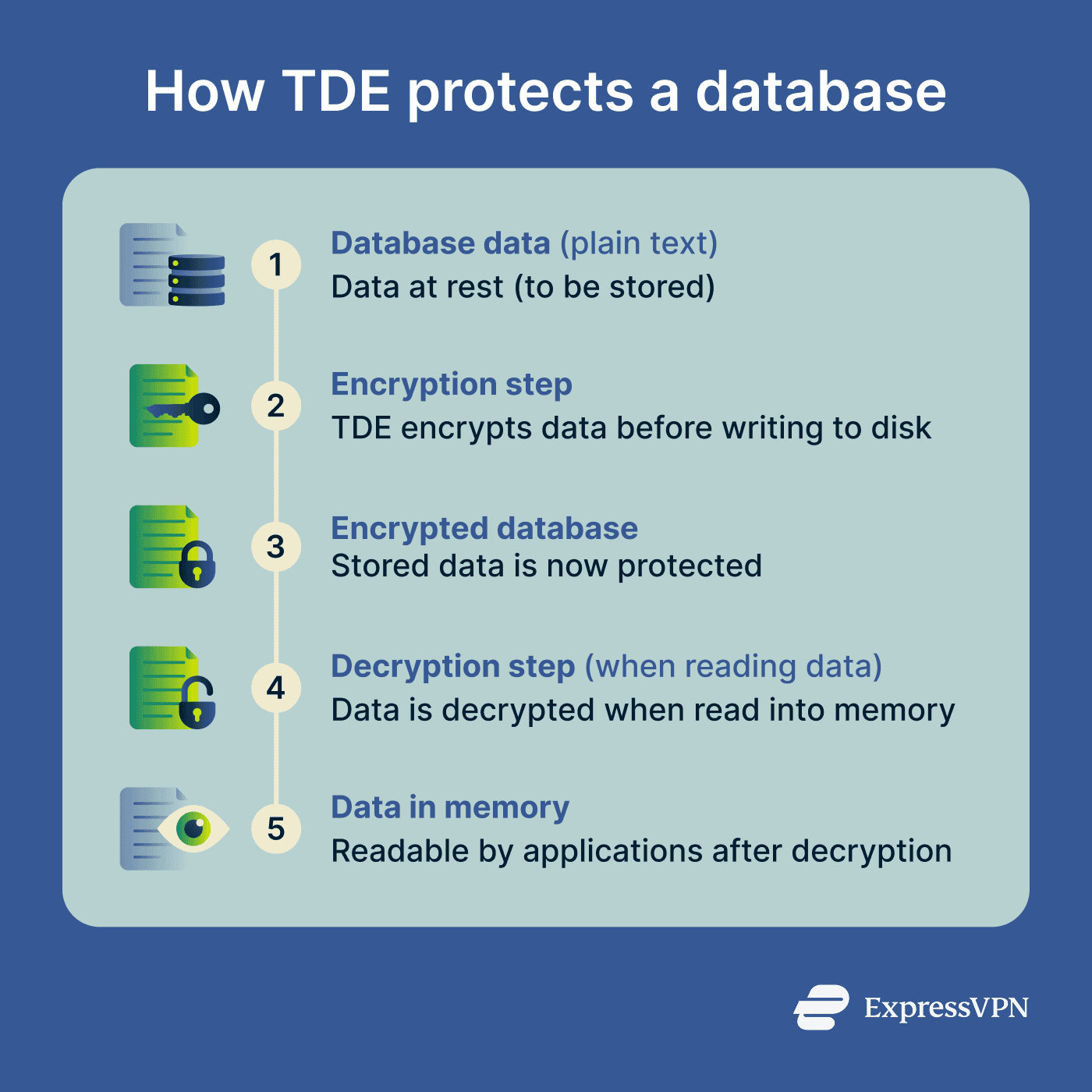
Why is transparent data encryption important?
TDE is widely used in modern database systems to protect sensitive personal and corporate information. By encrypting data at rest, it safeguards against unauthorized access and manipulation, even if media is lost or stolen. TDE also supports compliance requirements.
Where is it used?
TDE has a variety of use cases, including:
- Enterprise database servers: Large organizations use TDE across internal systems that store sensitive data. This includes HR databases for employee records, customer databases for personally identifiable information (PII), and business analytics systems.
- Cloud-managed databases: Services like Azure SQL Database and Google Cloud SQL use TDE to encrypt stored data automatically.
- Compliance-heavy industries: Institutions that have to abide by strict regulations require encryption for data at rest. This includes financial institutions and healthcare organizations.
- Government data platforms: Public sector databases may store tax records or ID data, while inter-agency data systems can store law enforcement or public service data. Encryption helps meet legal requirements and protect public and state-level sensitive data.
Benefits and limitations
The main benefit of transparent data encryption is that it provides always-on, at-rest protection for database storage with minimal changes needed to applications. It automatically encrypts data on disk and often extends this protection to backups and logs, helping secure sensitive information while reducing the impact of lost or stolen media. Automated encryption and decryption ensure security and ease of access for daily operations.
However, TDE has several limitations:
- Weak key management risks: Poorly protected encryption keys can compromise security.
- Doesn’t encrypt data in motion: TDE protects data at rest, but additional measures like TLS are needed for data in transit.
- Doesn’t encrypt data in memory: Data is readable by applications once decrypted, so server hardening and monitoring are still necessary.
- Can’t replace access controls or application-level protections: TDE can’t stop SQL injection or other attacks within the application.
Further reading
- What is data encryption?
- Security concerns in cloud computing and how to address them
- What is big data security and privacy?
- How to back up files and encrypt them
- What is AES encryption?