Expressvpn Glossary
Strong authentication
What is strong authentication?
Strong authentication generally refers to the practice of requiring users to provide secure, reliable proof of identity before accessing systems. Passwords are a common component of authentication, but stronger systems often use additional factors or passwordless methods to reduce the risk of unauthorized access.
How does strong authentication work?
The most common approach is to combine multiple independent identity checks to verify a user’s identity. Called factors, these individual pieces are usually divided into three categories: knowledge, possession, or inherence. While a single factor may be relatively easy to compromise, gaining access to multiple unrelated factors is significantly more challenging.
A username and password combination is one of the most common forms of authentication. The username identifies the account, while the password acts as a knowledge factor. This type of authentication is not particularly strong on its own, as usernames are often public and passwords may be guessed, reused, phished, or stolen.
Possession factors are usually tied to something the user has or controls, such as a hardware security key, an authenticator app, a smartphone, or a registered device. Biometric mechanisms like facial or fingerprint scans are considered inherence factors, although they are typically used with a device or other authenticator rather than as standalone credentials.
Requiring more than one factor is usually seen as an essential element of strong authentication. This is known as two-factor authentication (2FA) or multi-factor authentication (MFA). It’s generally accepted that the best practice is to use independent factors in more than one category.
Strong authentication may also be paired with tools that streamline login processes. Systems may use passkeys and single sign-on (SSO) technologies to authenticate users while enhancing convenience.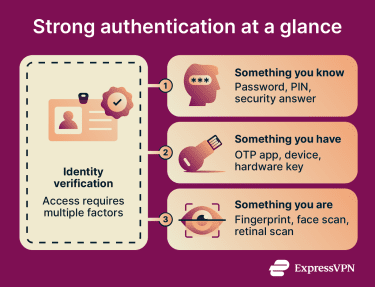
Types of strong authentication
Some common strong authentication methods include:
- Security questions: Users must answer pre-set questions, typically chosen during account setup. For example, the name of your first pet. Because answers may be guessed, discovered, or shared, security questions are generally weaker than other methods and are better treated as account recovery checks than strong authentication.
- One-time passwords (OTPs): Account holders receive a temporary code sent to a verified contact method or generated by an authenticator app or device. Entering incorrect or expired codes causes authentication to fail. OTPs add protection, but some delivery methods can be intercepted or phished.
- Authenticator apps or devices: People link an app or hardware token to their account, which continually generates temporary verification codes. The user must provide the correct code at the right time during authentication.
- Biometrics: Users are asked to provide a biological characteristic, such as a fingerprint, facial, or retinal scan. These characteristics are unique and inherent to all persons.
- Physical keys: Owners must present a physical security key during authentication, such as by plugging it into a computer or tapping it near a device. These keys use cryptographic methods to verify the login request and can provide phishing-resistant protection.
- Adaptive authentication: Systems consider additional risk signals, such as location, device, time, and typical behavior. If the activity appears unusual, the system may require additional verification.
- Cryptographic authentication: Users verify their identity using secure digital keys or certificates stored on a trusted device, security key, or smart card. These methods rely on cryptographic protocols, often public-key cryptography, rather than shared secrets.
Why is strong authentication important?
Strong authentication is important for both organizations and end-users. It allows people to better protect their accounts and help prevent account takeover, data theft, and unauthorized financial activity.
This is even more important for organizations and businesses, where a single compromised account may be used to access a larger system. This can lead to severe consequences, such as business disruptions, intellectual property theft, or reputational damage.
Phishing and brute-force attacks are two of the most common ways accounts are compromised. When used correctly, MFA can significantly reduce these risks, especially when organizations use phishing-resistant methods such as passkeys, hardware security keys, or certificate-based authentication.
Where is it used?
Virtually any digital app, service, or platform that manages user accounts and data or has links to valuable assets can benefit from strong authentication. This includes:
- Online banking and payment systems.
- Online stores and e-commerce platforms.
- Enterprise logins and remote access.
- Cloud platforms and admin accounts.
- Healthcare and government portals.
- Email and collaboration tools.
Risks and privacy concerns
Strong authentication aims to improve account security, but some common strong authentication methods raise concerns of their own. These include:
- Collecting and storing biometric data can seriously impact user privacy if the information is exposed.
- OTPs or authentication codes are ineffective if attackers steal the user’s verification device.
- Some OTPs and authentication codes can also be phished, intercepted, or relayed.
- SMS OTPs rely on mobile carrier networks, which are susceptible to SIM-swapping and other exploits.
- Poorly designed authentication flows hamper usability, potentially leading some users to fall back on unsafe practices.
- Misconfiguration or flawed recovery flows may result in security gaps and a false sense of security.
Further reading
- What is two-factor authentication (2FA), and how to set it up securely
- Passwordless authentication: What it is and why it matters
- What are passkeys? Here’s the next big sign-in method
- What is biometrics? A complete guide to modern identity technology
FAQ
What is the difference between strong authentication and multi-factor authentication (MFA)?
Is strong authentication the same as passwordless authentication?
Some see this as a safer alternative, which doesn’t rely as heavily on the user’s memory or personal security practices and isn’t as susceptible to data breaches or phishing attacks.