Expressvpn Glossary
Security audit
What is a security audit?
A security audit is a formal, systematic review of a company’s security readiness, posture, resources, and exposure to threats. It typically involves collecting and evaluating documented evidence about security controls, processes, and governance, often including technical safeguards, access controls, staff practices, and compliance processes.
Organizations may use an audit to identify gaps, evaluate risk, and recommend improvements to strengthen preparedness for cybersecurity threats.
Types of security audits
Security audits vary in terms of scope, focus, and who conducts them.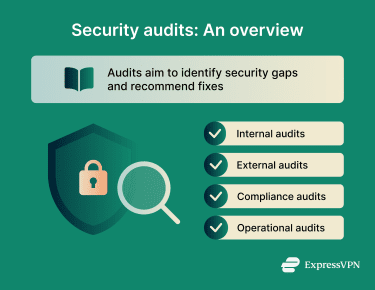
Internal audit
This is when an organization’s own employees conduct the audit, usually members of the cybersecurity team. Leveraging familiarity with the organization’s systems, internal audits can be fast and cost-effective. The downside is that they may be seen as less objective and can miss blind spots.
External audit
A company may also recruit a third-party firm to conduct an audit on its behalf. Providing an outside perspective, this approach can be more objective and add credibility, especially if internal teams lack specific expertise. Contractual or regulatory requirements may mandate that audits be conducted externally.
Compliance audit
The goal of a compliance audit is to assess whether an organization meets specific standards, frameworks, or regulatory requirements. These are usually undertaken due to legal requirements, shareholder demands, or management decisions. For example, an organization may undergo an audit or assessment to evaluate alignment with healthcare privacy and security requirements, such as the Health Insurance Portability and Accountability Act (HIPAA) requirements.
Operational audit
Operational audits aim to record how processes and systems work in practice, often assessing the effectiveness and efficiency of operations and controls. Auditors may review procedures and technical controls and also validate how work is carried out through interviews, walkthroughs, and observation. Operational audits help firms identify gaps between their stated policies and real-world practices.
Key components of a security audit
Depending on its scope and goals, a security audit may involve any of the following activities:
- Review of cybersecurity policies and procedures: Check if the organization follows general or technology-specific best practices or standards.
- Analysis of access control and authentication: Determine whether appropriate access controls (e.g., least privilege, account lifecycle controls) and strong authentication (e.g., multi-factor authentication, or MFA) are in place.
- Examination of network security controls: Review network safeguards, such as firewall rule management, segmentation, and detection controls, to confirm they are configured and monitored to reduce risk and detect suspicious activity.
- Evaluation of data protection and encryption practices: Assess whether the organization handles data in line with regulations or widely used standards.
- Assessment of incident response plans: Review documentation, roles, training/exercises, and procedures for preparing for and responding to security events.
- Review of logging and monitoring systems: Assess whether an organization has adequate resources to support detection, investigation, and audit trails.
- Interviews with stakeholders and personnel: Gather evidence and context on how security is implemented and operated day to day.
Why security audits are important
Audits help an organization gain a clearer understanding of its security situation. Organizations can use the outcome of an audit to:
- Identify security gaps before attackers do.
- Help reduce the risk of breaches and data loss by prioritizing fixes.
- Demonstrate or improve compliance with relevant standards and requirements.
- Strengthen cyber hygiene and organizational awareness.
- Better protect sensitive data and user information.
Security audit vs. security assessment
A security audit is a formal, evidence-based review that evaluates an organization’s overall cybersecurity posture. A security assessment evaluates security risks, weaknesses, or the effectiveness of controls within a defined scope (for example, specific networks, applications, or devices), and may be broader or narrower depending on its goal.
Challenges in conducting a security audit
Here are some of the most common difficulties that organizations and auditors face:
- Auditing techniques and methodologies need to keep up with a rapidly evolving threat landscape.
- Auditors shouldn't rely solely on internal documentation, as this may be incomplete or inaccurate.
- Large organizations often have legacy or poorly inventoried systems with low visibility, which can increase exposure and complicate testing and remediation.
- Auditors need to coordinate across multiple teams, stakeholders, locations, and systems/networks.
- Without a thorough initial briefing, the scope and complexity of the audit may become unmanageable.