Expressvpn Glossary
Scripting language
What is a scripting language?
Scripting languages are programming languages that are typically interpreted at runtime, meaning their code is processed and executed as the program runs. Well-known examples of scripting languages include Python, JavaScript, and PHP, and they’re often used for writing small programs (or scripts) that automate tasks.
How does a scripting language work?
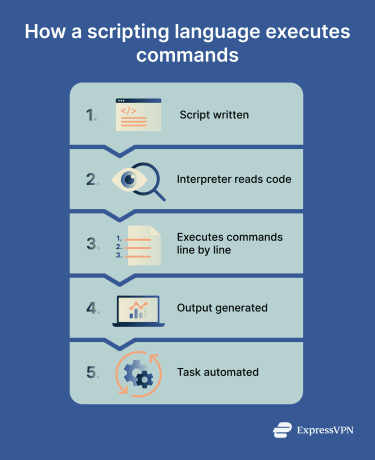 Scripting languages are usually executed by an interpreter, a program that reads and runs the code line by line as the script executes. This approach allows scripts to run across different operating systems (OSs) with minimal modification. They’re often used to automate repetitive or system-level tasks.
Types and examples of scripting languages
Scripting languages can be grouped by where and how they operate:
- Client-side scripting: Operates on the user’s device or browser. JavaScript is a popular example, widely used for interactive web pages and front-end development.
- Server-side scripting: Executed on web servers, with the resulting data being sent to the user. Scripting languages like PHP and Python are commonly used in this way in web applications.
- System scripting: Handles tasks and system administration on the OS. Bash on Linux/macOS and PowerShell on Windows are common choices.
- Embedded scripting: Integrated within applications or devices to extend functionality. For example, JavaScript can run inside some PDF readers.
Why are scripting languages important?
Scripting languages make software development faster and more flexible. They can enable quick prototyping, streamline complex workflows, and reduce the risk of human error. Many web applications, system administration tasks, and data processes rely on scripts, making them a key tool in modern software development.
Scripting vs. programming languages
The main difference is how the code is executed. Scripting languages are usually interpreted at runtime, while traditional programming languages are compiled into machine code before the relevant program is executed. Compiled languages generally run faster, but scripting languages excel at automating tasks, building web apps, and handling system-level workflows.
Security and privacy considerations
Scripting languages aren’t inherently secure or insecure, but using them carelessly can create vulnerabilities. For instance, attackers can exploit unvalidated user inputs.
Common approaches to reducing risks include validating inputs, restricting script permissions, and monitoring sources carefully. Security tools such as virtual private networks (VPNs) and firewalls can also help protect relevant data and networks when scripts are executed.
Further reading
- How ExpressVPN keeps its web servers patched and secure
- Prevent cross-site tracking: What it is and how to block it