Expressvpn Glossary
Routing Information Protocol (RIP)

What is the Routing Information Protocol?
Routing Information Protocol (RIP) is a distance-vector routing protocol that calculates the best path for network traffic. It tells routers and other network devices where to forward data packets so they reach their destination.
The main goal of RIP is to find the most efficient route for a packet based on hop count. Often, this means choosing the path with the fewest router hops. Because the protocol has a hop count limit of 15, RIP is only suitable for smaller networks or legacy environments.
How does the Routing Information Protocol work?
RIP operates at the network layer (layer 3) of the Open Systems Interconnection (OSI) model. This is the level at which routing logic takes place. Each router that supports RIP maintains a routing table containing known destination networks, their metrics, and the next hop used to reach them.
Routers update their tables by exchanging routing information with one another every 30 seconds. If there are any changes to the network topology, the routing software recalculates the best paths to destination networks and updates the corresponding values in the table. RIP also supports triggered updates when routes change.
When a data packet reaches a router, it inspects the packet header to identify the intended destination. It then checks the routing table to find the best-matching route and forwards the packet to the next hop. This process continues until the data packet reaches its destination.
Built-in mechanisms help prevent packets from being sent along failed routes. If a router doesn't receive an update for a route for 180 seconds, that route is marked invalid. Under the RIP specification, it's then temporarily kept in the table during a garbage-collection period before being removed; some implementations specify a default flush timer of 240 seconds.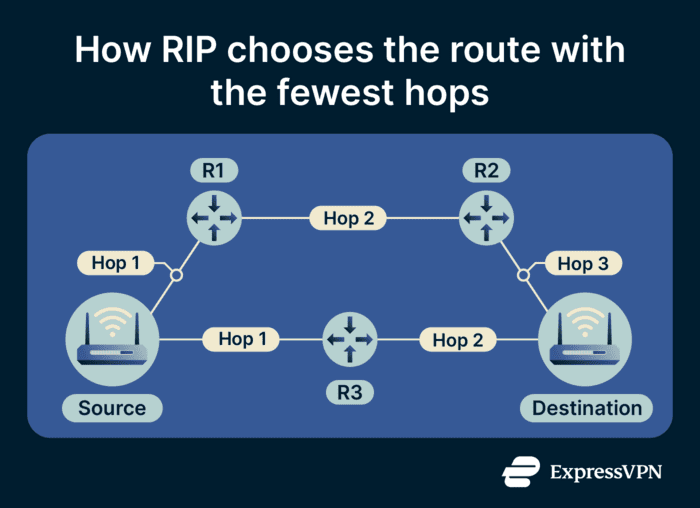
Types of Routing Information Protocol
RIP has been adapted across multiple versions as network requirements changed:
- RIP version 1 (RIPv1): First documented in 1988, RIPv1 supported only classful routing, meaning routing tables didn’t carry subnet information. This made it unsuitable for variable-length subnet masks and more complex subnetting designs. It also didn't provide authentication for routing updates.
- RIP version 2 (RIPv2): Introduced in 1994, RIPv2 added subnet-mask information while maintaining compatibility with RIPv1 environments. Using multicast instead of broadcast in normal RIP-2 operation, it reduced unnecessary processing on non-routing hosts. It also added authentication, although the base specification supports only simple password authentication; stronger cryptographic authentication was defined separately later.
- RIP next generation (RIPng): Standardized in 1997, RIPng was developed for IPv6. Instead of defining built-in RIP authentication fields, it relies on IPv6 security mechanisms such as the Authentication Header (AH) and the Encapsulating Security Payload (ESP). Its message format and transport were updated for IPv6 addressing and operation.
Although later versions can handle more complex network topologies, the 15-hop limit remained a core restriction. RIP was designed for moderate-sized networks and is not intended for more complex environments.
Why is the Routing Information Protocol important?
One of the core benefits of RIP is its simplicity, both conceptually and technically. Historically, that helped make it widely implemented and easy to deploy. It is also lightweight compared with more complex routing protocols.
In some networks, it's preferable to update routing tables at set intervals rather than every time a change occurs. Newer protocols tend to take the latter route.
Although RIP has largely been phased out from modern production networks, it's still commonly used to teach basic distance-vector routing concepts.
Risks and security concerns
There are several limitations and risks associated with RIP:
- RIPv1 doesn't support authentication, which makes it easier to spoof routing updates. RIPv2 adds authentication, but simple password authentication is weak unless stronger cryptographic protection is used.
- Periodic updates and hop-by-hop propagation can delay convergence, potentially causing outdated routes or routing loops.
- The 15-hop limit creates a hard restriction on network size and complexity.
- In larger or more complex networks, there’s a risk of pinhole congestion and slow convergence.
- Sending full routing updates at regular intervals is less efficient than more modern routing protocols, especially as the number of routes grows.
Further reading
- What is routing, and why does it matter in networking?
- What are network protocols? A complete guide
- What is traceroute, and how to use it for network diagnostics
- What is the OSI model? Understanding its layers and functions
- What is computer networking, and how do VPNs fit in
FAQ
What is RIP used for?
What is the difference between RIP and OSPF?
What is RIP’s maximum hop count?
Is RIP still used today?
Is the Routing Information Protocol (RIP) secure?
However, RIP generally offers fewer built-in security protections than modern routing deployments typically expect, and its protection depends heavily on the version and the surrounding security mechanisms in use.