Expressvpn Glossary
Reverse proxy
What is a reverse proxy?
A reverse proxy is a server that sits in front of one or more backend servers and forwards client requests to the appropriate server. Its main purpose is to protect backend servers from direct exposure or attacks and improve performance.
How does a reverse proxy work?
A reverse proxy receives incoming client requests and forwards them to the appropriate backend server based on predefined rules. Once the server responds, the reverse proxy sends the data back to the client as if it came directly from itself.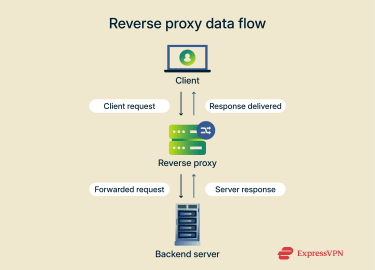 Because it acts as an intermediary, the reverse proxy:
- Hides backend servers’ IP addresses and internal details to prevent direct access or attacks.
- Manages Secure Sockets Layer (SSL) / Transport Layer Security (TLS) encryption so backend servers don’t have to.
- Caches accessed content to reduce load times and minimize repeated requests to the backend.
- Distributes traffic across multiple servers to balance demand and maintain stable performance.
Where are reverse proxies used?
Reverse proxies are common in:
- Content delivery networks (CDNs): Services such as Cloudflare use them to speed up access by serving content from servers located near users.
- Web application firewalls (WAFs): These use reverse proxies to inspect and block malicious traffic before it reaches backend servers.
- Enterprise network gateways: Organizations use them to manage and secure traffic between internal systems and the internet.
- API gateways: These rely on reverse proxies to authenticate users and route API requests to the correct backend service.
Benefits and limitations
Reverse proxy benefits
- Protects backend servers
- Balances traffic to prevent overload
- Improves scalability and availability
- Simplifies SSL certificate management
Reverse proxy limitations
- Adds setup and maintenance complexity
- May become a single point of failure
- Misconfiguration can create security gaps
Further reading
- SOCKS proxy explained: What is it and how it works
- Fake IP address: What it is and how to get one
- What is a web proxy, and how does it work?
FAQ
What is the difference between a forward proxy and a reverse proxy?
A forward proxy sits in front of clients and makes requests on their behalf, hiding their identity from the servers they contact. A reverse proxy sits in front of servers and handles requests from clients, hiding the servers from direct access.
Are reverse proxies secure?
Yes, when properly configured. They add a protective layer by masking backend details and filtering traffic, but an insecure setup or outdated software can introduce vulnerabilities.
What are popular reverse proxy servers?
Common examples include Nginx, Apache HTTP Server (with mod_proxy), and HAProxy, all widely used for load balancing and caching.
 Support Center
  FAQ
FAQ  VPN Setup Tutorials