Expressvpn Glossary
Personal area network (PAN)
What is a personal area network?
A personal area network (PAN) is a short-range network that connects an individual’s devices (such as smartphones, laptops, wearables, and peripherals) within a very close range, typically up to around 30 feet / 10 meters. Its main purpose is to enable direct communication and data exchange between these devices in a localized, personal space.
Common examples include wireless headphones paired with a phone, a smartwatch syncing with a mobile device, or a smartphone sharing its connection with a laptop. When a PAN relies on wireless links between devices, it is often referred to as a wireless personal area network (WPAN).
How does a personal area network work?
Devices pair directly with each other or connect through a central device acting as an access point, exchanging data over secure channels. In many PANs, a primary device such as a smartphone or laptop acts as a hub or gateway, coordinating traffic between other devices and, when required, forwarding data to wider networks such as a local area network (LAN) or the internet. Connections are often established automatically, with minimal manual configuration.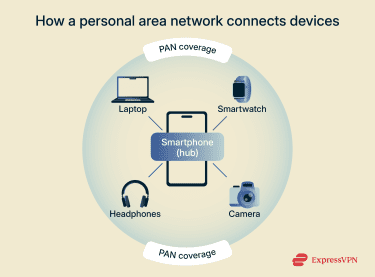
Common technologies used in PANs
PANs commonly rely on short-range communication standards such as:
- Bluetooth: Widely used for short-range wireless connections between personal devices.
- Wi-Fi Direct: Enables devices to connect directly without a router or external access point.
- Ultra-wideband (UWB): Used for precise spatial awareness and secure device discovery in smartphones, wearables, and tracking devices.
- Near-field communication (NFC): Supports very short-range communication for quick pairing, small data exchanges, and contactless transactions.
- Infrared (IR): Provides direct line-of-sight data transfer between nearby devices
- Zigbee: Used in smart home and Internet of Things (IoT) environments for low-power, low-bandwidth communication.
PANs can also use wired interfaces such as USB, Thunderbolt, or FireWire for high-speed connections to nearby peripherals like cameras or external drives.
Why are personal area networks important?
PANs allow personal devices to function as a coordinated system, keeping data, media, and application settings consistent across smartphones, laptops, and wearables.
They support flexible work and device usage by enabling direct device-to-device communication without relying on external networks, so tasks such as file transfer, peripheral control, and audio streaming remain available even when internet access is limited. PANs also provide a local environment for managing and monitoring nearby IoT devices.
PAN vs. LAN
A LAN connects multiple devices within a limited physical area, such as a home, office floor, or building, to share resources and internet access. By contrast, a PAN links devices around a single user in a much smaller area and is focused on short-range connectivity between that user’s own devices.
| PAN | LAN | |
| Range | Very short range, typically within 30 feet / 10 meters | Larger range, often covering a room, floor, or entire building |
| Devices | Personal devices such as smartphones, headphones, wearables, and laptops | Computers, printers, servers, access points, and other networked equipment |
| Purpose | Personal convenience and mobility | Business or home networking infrastructure |
Further reading
- Network topology: Best practices for modern networks
- 12 smart ways to secure your home Wi-Fi network
- VPN for dummies: Simple no-jargon guide for beginners
- What is my IP address location?
 Support Center
  FAQ
FAQ  VPN Setup Tutorials