Expressvpn Glossary
Network interface card
What is a network interface card?
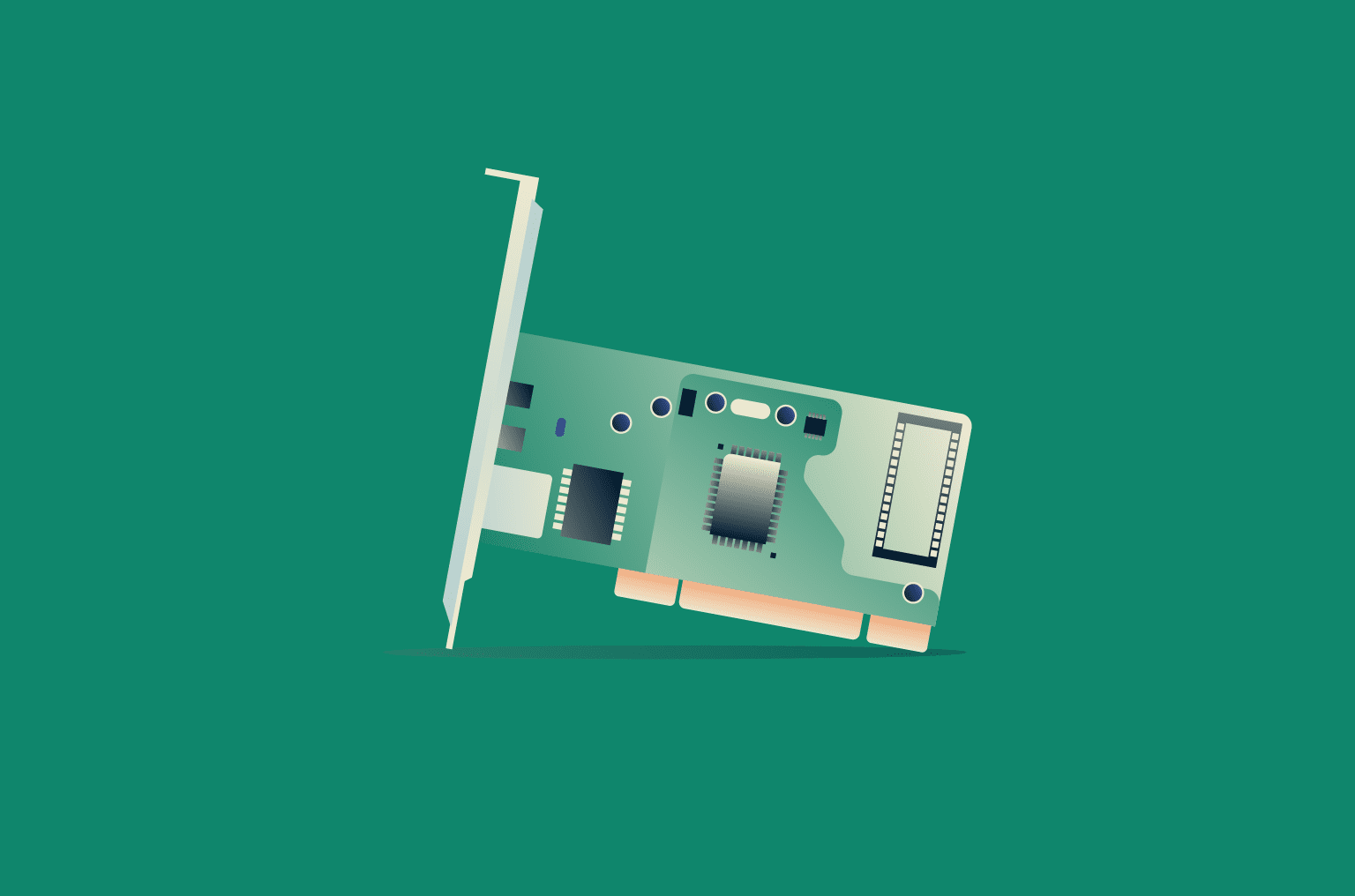
Network interface cards (NICs) are hardware components that enable electronic devices to connect to networks. They serve as the bridge between clients and communication media such as Ethernet cables or Wi-Fi signals.
How does a network interface card work?
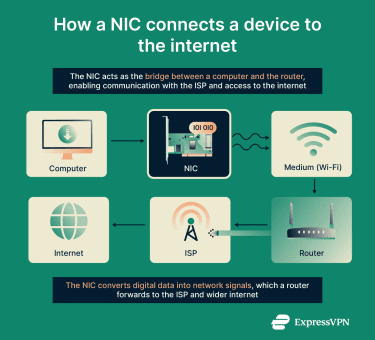 A NIC converts digital information from the device into transmissible signals and translates incoming data into a form that the device can interpret. A unique Media Access Control (MAC) address ensures that NICs can be identified by other devices on the same local network.
The flow of data and frame assembly is managed by a controller chip. Exactly how this data is broken into packets and transmitted is dictated by standard protocols like the Transmission Control Protocol (TCP) / Internet Protocol (IP). This is largely handled by the device’s networking stack, but the NIC is responsible for adding frame headers, computing checksums, and actually transmitting frames.
Types of network interface cards
A variety of NICs exist to suit different needs. Common types include:
- Ethernet NICs: Manage wired connections to maximize speed and stability (often included in desktops).
- Wireless NICs (Wi-Fi adapters): Enable wireless connections using built-in antennae (common in laptops, mobile devices, and IoT devices).
- Fiber optic NICs: Support high-speed, long-distance connections (ideal for data centers and some enterprise settings).
- Virtual NICs: Operate as software-based connections, supporting multiple environments in a single interface (widely used in cloud computing).
Why is a network interface card important?
A NIC is essential for networking. Without one, a device would be incapable of accessing the internet or communicating with other local devices. The specific hardware and configuration of a NIC also affect the maximum possible data transfer speed, reliability, and more.
Network interface card vs. network adapter
"Network interface card" and "network adapter" are mostly used interchangeably, but they can also refer to slightly different things. Strictly speaking, a NIC is a physical hardware component. Older NICs were expansion cards installed on a device’s motherboard, but newer iterations are often integrated directly into motherboards. For this reason, modern NICs are sometimes understood as network interface controllers rather than cards.
A network adapter can encompass both hardware and software components. Loopback adapters and other virtualization tools are network adapters, but not NICs.
Further reading
- How to choose a router: Top mistakes to avoid and pro buying tips
- TCP vs. UDP: Understanding the key differences
- 12 smart ways to secure your home Wi-Fi network
FAQ
What is the purpose of a network interface card?
A network interface card (NIC) allows a device to communicate with networks. It manages incoming and outgoing data, converting signals into information that the host device’s operating system can read. Without a NIC, a device cannot access the internet or any other network.
Is a network interface card (NIC) the same as a network adapter?
Not exactly. A NIC is a type of network adapter, but not all network adapters are NICs. The key distinction is that NICs are core physical components of devices. Network adapters, on the other hand, can also take the form of software.
Can a computer have more than one network interface card (NICs)?
Yes, some systems support multiple NICs. Having more than one NIC adds flexibility. Because there are different varieties of NICs optimized for various purposes, having access to multiple options can improve performance in certain settings.
How does a NIC affect internet speed and VPN performance?
A device’s network interface card (NIC) dictates the maximum amount of data it can process, effectively setting a hard limit on attainable internet speeds for both VPN and normal connections. In practice, this limit depends on the capabilities of both the device and the router. While ISP bandwidth often creates a lower ceiling, it’s increasingly common for the NIC or router to be the actual bottleneck.