Expressvpn Glossary
Metropolitan area network (MAN)

What is a metropolitan area network?
A metropolitan area network (MAN) is a network that connects multiple local area networks (LAN) within a metropolitan region, such as a large city, several towns, or a campus with many buildings. It’s larger than a LAN but smaller than a wide area network (WAN). This type of citywide network lets users share resources efficiently across a region.
How does a MAN work?
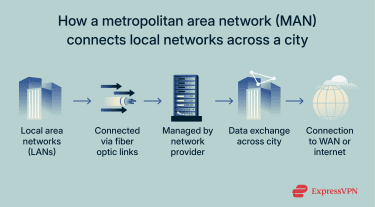 A MAN links multiple LANs across a city or large campus using high-capacity fiber-optic or wireless connections. Each site connects to the MAN’s metropolitan backbone, which aggregates and routes traffic between locations so they can communicate as if they were part of one larger network.
Because the MAN acts as a shared transport layer, it can also provide centralized access to external resources like a WAN or the public internet, so individual sites don’t need their own separate uplinks. Many MANs use ring or mesh topologies to maintain stability, offering alternative paths if a link fails.
Key components of a MAN
A MAN relies on specific hardware and software to function effectively. This includes:
- Routers and switches: These devices direct data packets between different network segments.
- Fiber optic cables: These high-speed cables form the backbone of most MANs.
- Access points: Wireless access points let devices connect to LANs that are linked to the MAN without physical cables.
- Network management systems: Software tools monitor and control the network to maintain performance.
- Security gateways: Firewalls and other security devices protect the network from unauthorized access.
Why are MANs important?
The core purpose of a MAN is to improve communication and data exchange within a specific geographic region. This is important for a number of reasons:
- Connectivity: MANs improve communication and data exchange between distributed sites.
- Speed: They provide reliable high-speed connections for public institutions, internet service providers (ISPs), and corporations.
- Application support: They support bandwidth-intensive applications like cloud computing, video conferencing, and data synchronization.
- Centralized management: They simplify policy enforcement and network monitoring.
Security and privacy considerations
Securing a MAN is a priority because it connects many sites and carries sensitive data. Considerations include:
- Encryption: To protect data as it travels between connected LANs.
- Access control: Firewalls and strict access control policies to secure entry points.
- Updates: Regular firmware updates on routers and switches to remove known vulnerabilities.
- Compliance: ISPs and municipalities managing MANs must follow applicable data protection laws to safeguard user privacy.
MAN vs. LAN vs. WAN
Understanding the difference between MAN, LAN, and WAN helps clarify network scales.
- LAN: Covers a small area, like an office or home.
- MAN: Spans a city or large campus, connecting multiple LANs.
- WAN: Connects networks across countries or continents.
A MAN serves as a bridge between local and global network scales.
Common use cases
MANs are used in various sectors to provide network connectivity, including:
- Universities: Connecting university campuses within a city.
- Government: Linking government departments or hospitals.
- Public access: Providing citywide Wi-Fi or municipal internet services.
- Business: Supporting real-time business communication across urban locations.
Further reading
- Is another device on the network using your IP address?
- Network connections: Everything you need to know
- How to set up a secure Wi-Fi guest network
 Support Center
  FAQ
FAQ  VPN Setup Tutorials