Expressvpn Glossary
IPv4
What is IPv4?
Internet Protocol version 4 (IPv4) is the fourth version of the internet’s core protocol. It provides the rules for how data is sent and received over the internet and other networks. A core part of this is the assigning of IP addresses, the unique numbers that identify specific devices and facilitate worldwide communication.
How IPv4 works
IPv4 breaks down data into smaller pieces called packets. Each packet contains a header with information such as the sender’s and receiver’s IPv4 addresses. When sending an email or visiting a website, the data is packaged up and labeled with these addresses.
Network routers then read the destination address in the packet header and forward it along the most efficient path toward its final destination. This process of addressing and routing enables information to reach the correct device efficiently.
What does an IPv4 address look like?
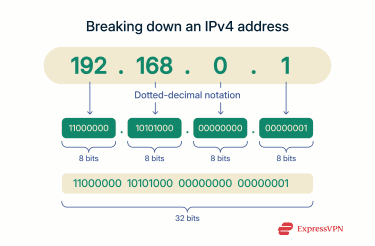 An IPv4 address is a 32-bit number. While computers read this as a string of 32 ones and zeros (binary), they’re represented in dotted-decimal notation (DDN) to make it easier for humans to read. This format consists of four numbers, each ranging from 0 to 255, separated by periods, e.g., 192.168.1.1 (DDN), which translates to 11000000.10101000.00000001.00000001 in binary.
IPv4 addresses come in two main types:
- Public IPv4 addresses are unique and assigned by an internet service provider (ISP). They are used to identify devices directly on the internet.
- Private IPv4 addresses are used within local networks. These addresses are not globally specific and allow multiple devices, each with its own network interface, to share a single public IP address through Network Address Translation (NAT).
IPv4 vs. IPv6
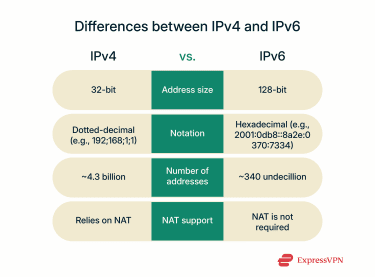 The 32-bit structure of IPv4 allows for approximately 4.3 billion specific addresses. But, as the internet grew, the supply of available IPv4 addresses began to run out. To solve this problem, IPv6 was introduced.
The key differences are:
- Address length: IPv6 uses a 128-bit address, creating a vastly larger pool of possible addresses (trillions upon trillions upon trillions) compared to IPv4’s 32-bit system.
- NAT support: IPv4 relies heavily on NAT to conserve addresses. IPv6 has enough addresses to make NAT unnecessary.
- Security: IPv6 has built-in security through Internet Protocol Security (IPSec), which handles encryption and authentication. IPv4 must rely on external protocols.
Why IPv4 is still in use
Despite the existence of IPv6, IPv4 is still widely used. This is largely due to the fact that migrating all existing systems and applications to IPv6 would be costly.
Despite IPv4 addresses being nearly exhausted, solutions like NAT have prolonged the protocol’s lifespan. As a result, there is no time-sensitive push to universally transition to IPv6. Many networks run both protocols side-by-side in a dual-stack configuration.
Common IPv4 use cases
IPv4 is still the backbone for most internet traffic today. Its common uses include:
- Home networks: Most home routers and devices are assigned private IPv4 addresses to communicate with each other.
- Virtual private network (VPN) services: A VPN often routes traffic through a server with an IPv4 address, masking the device’s true public IP.
- Mobile carriers and ISPs: These providers still manage large blocks of IPv4 addresses to assign to their customers.
Further reading
- IPv4 vs. IPv6: Which one is better?
- Are we running out of IP addresses? 5 facts to know
- What is DNS, and how does it work?
- How to configure a static IP address
- What is IPSec?
FAQ
Is IPv4 still used today?
Yes, IPv4 is still used today. In fact, the majority of traffic is handled using IPv4 rather than the newer IPv6 protocol.
Can IPv4 and IPv6 work together?
Yes, they can and do work together. Most modern networks and devices support both protocols in what is known as a dual-stack configuration. This lets devices communicate using either IPv4 or IPv6, depending on what the other end of the connection supports.
What happens when IPv4 runs out?
The unallocated pool of IPv4 addresses has already been exhausted. The transition to IPv6 is the long-term solution. In the meantime, techniques like Network Address Translation (NAT) and the trading of existing IPv4 address blocks allow the internet to accommodate further growth.
How does IPv4 work with VPNs?
When you connect to a VPN, your device establishes a secure tunnel to a VPN server. The server then forwards your traffic to the internet using its own IPv4 address. This hides your actual IPv4 address from the websites and services you access.
 Support Center
  FAQ
FAQ  VPN Setup Tutorials