Expressvpn Glossary
Internet troll

What is an internet troll?
An internet troll is a person who deliberately engages in online behavior intended to provoke emotional reactions, create conflict, or disrupt discussions. Trolls operate across social media platforms, forums, comment sections, and other online spaces where people gather to interact and share ideas.
How internet trolls operate
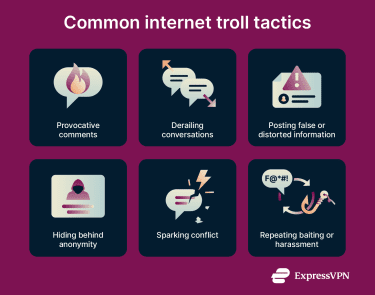
Internet trolls typically rely on recognizable behavior patterns to disrupt online discussions. Common behaviors include:
- Posting provocative comments: Making inflammatory, mocking, or controversial statements designed to upset others or trigger emotional responses.
- Derailing conversations: Introducing irrelevant points or shifting discussions off-topic to prevent meaningful dialogue.
- Posting false or distorted information: Posting rumors, debunked claims, or opinions presented as facts to confuse participants or undermine trust.
- Hiding behind anonymity or fake accounts: Operating through anonymous usernames or burner profiles and replacing accounts after being blocked or reported.
- Escalating conflict: Intensifying arguments with insults, inflammatory language, or personal attacks to provoke heated exchanges.
- Repeating baiting or harassment: Targeting the same individuals or threads multiple times to continue disruptive behavior over a longer period.
- Asserting false authority or expertise: Presenting oneself as an expert while dismissing others’ views, selectively using facts, or relying on technical-sounding language to shut down discussion.
Why people troll
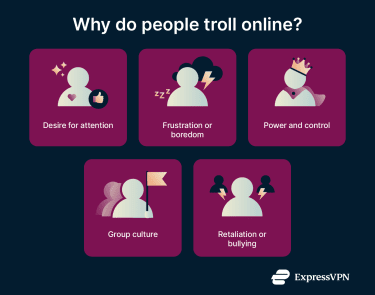
People troll for different reasons, but most motivations fall into a few common themes:
- Desire for attention: Some trolls enjoy watching others respond, argue, or become emotionally invested in their comments.
- Psychological distance and reduced social cues: Hiding behind usernames or anonymous profiles can make trolls feel less responsible for their actions. This makes it easier for them to make comments they wouldn't express face-to-face.
- Frustration or boredom: Some individuals may use online platforms as outlets for negative emotions, while others simply troll for entertainment.
- Power and control: By derailing discussions, upsetting others, or commanding attention, trolls may feel a sense of power or influence.
- Group culture: In some online communities, trolling is normalized or encouraged, and people participate to gain approval or status.
- Retaliation or bullying: Some people troll to punish or intimidate others after a perceived slight, disagreement, or public misstep. This can include targeting someone’s posts over time or using alternate accounts to continue harassment.
Effects of internet trolling
Internet trolling can harm both individuals and online communities by causing emotional stress, turning productive conversations into arguments, and lowering the overall quality of discussions. It can also spread misinformation, distort people’s understanding of topics, and reduce trust in shared information.
Over time, trolling can make online spaces feel unwelcoming and discourage participation as people choose to stay silent, avoid platforms, or disengage from topics they care about.
Common responses to internet trolling
Online platforms and communities commonly use the following approaches to address trolling behavior:
- Non-engagement: Trolling behavior often decreases when posts don’t receive responses, as the lack of interaction reduces the likelihood of further escalation.
- Blocking or muting: Blocking and muting are commonly used to reduce a troll’s visibility and prevent repeated disruption within discussions.
- Reporting of harmful behavior: When trolling crosses into harassment, threats, or rule violations, users typically report the behavior for review by the platform.
- Use of moderation tools in community spaces: Comments may be removed, warnings issued, or accounts restricted by community moderators to preserve the quality of discussion.
Security and privacy considerations
Internet trolling can create security and privacy risks, especially when it shifts from simple provocation to personal targeting. Trolls may misuse or expose personal information through doxxing, impersonate individuals or organizations to spread misinformation or damage reputations, and escalate into harassment through repeated messages or coordinated attacks across platforms.
These risks are often mitigated through limited sharing of personal information, along with the use of privacy settings and moderation tools that control who can interact with an account.
Further reading
- What is doxxing, and how can you stay safe online?
- What is Zoom bombing? A guide to secure virtual meetings
- What is netiquette? 10 essential online etiquette rules