Expressvpn Glossary
Electronic data interchange (EDI)
What is electronic data interchange?
Electronic data interchange (EDI) is the direct computer-to-computer exchange of business documents (such as purchase orders, invoices, and shipping updates) in a standardized electronic format. It replaces slow and error-prone traditional methods like mail, fax, and email.
The core purpose of EDI is to automate document exchange between business partners. Instead of having people read forms, re-enter data, or verify details by hand, an EDI system formats information according to shared standards and sends it straight from one system to another. This reduces manual work, minimizes errors, and helps organizations share data more reliably.
How does electronic data interchange work?
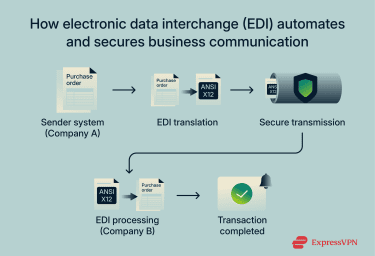 A business creates a digital document, such as an invoice or purchase order. The document is then converted into a standard EDI format like ANSI X12 or EDI for administration, commerce, and transport (EDIFACT) so both trading partners can interpret the data.
After conversion, it’s sent through a secure channel using EDI protocols such as Applicability Statement 2 (AS2) or Secure File Transfer Protocol (SFTP). These protocols include built-in encryption, so EDI data stays protected during transmission without needing extra tools.
Alternatively, a value-added network (VAN) may be used; this is a private hosted service with auditing capabilities that acts as an intermediary between two companies, ensuring the secure transfer of standardized and structured data.
Once received, the EDI file is mapped back into the recipient’s format, placing the data in the correct fields in their database or internal business system.
Common EDI standards
- ANSI X12, primarily used in North America, defines document structures for industries including supply chain, healthcare, and finance.
- EDIFACT is an international standard that’s mostly used by organizations outside North America or multinational companies.
- TRADACOMS was developed for the U.K. retail sector. Despite development ending in 1995, it’s still effective and widely used for retail EDI traffic within the country.
- Universal Business Language (UBL) is an extensible markup language (XML)-based format, and it’s used worldwide for its simplicity and flexibility.
Why is EDI important?
EDI streamlines how organizations exchange business documents by standardizing their structure and automating delivery between systems. Instead of relying on emails, PDFs, or manual data entry, EDI allows information like orders or invoices to move directly from one system to another without human intervention.
Key benefits of this include:
- Faster processing for orders, invoices, and payments by removing manual hand-offs and delays.
- Fewer human errors thanks to standardized, machine-readable document formats that eliminate the need for manual data entry.
- Clear audit trails through electronic records that log when documents are created, sent, and received.
- Lower operational costs by reducing manual labor, paper handling, printing, and postage.
- Improved scalability, as automated exchanges can use predefined rules to handle high transaction volumes without requiring additional staff.
Security and privacy considerations
EDI security is often shaped by how documents are transmitted and managed, whether exchanged directly between trading partners or routed through a VAN.
Common considerations include:
- Encryption protocols during data transmission, which can include AS1, FTPS, and HTTPS, or the encryption and secure handling provided by a VAN.
- Authentication and integrity checks, such as digital signatures, which are used to confirm the sender’s identity and detect unauthorized changes to data.
- Protected network connections, with some organizations routing EDI traffic through site-to-site virtual private networks (VPNs) to add an extra layer of network encryption, while others rely on the private networks offered by VAN providers.
- Access controls and system oversight, with organizations typically limiting access based on user roles while maintaining logs to monitor system activity and detect potential misuse.
EDI vs. API integration
EDI and API integration represent different approaches to system communication:
| Aspect | EDI integration | API integration |
| Communication type | File-based exchange, often batch-oriented. | Request-and-response calls over HTTP or similar, triggered on demand by systems or applications. |
| Data format | Standardized message sets such as ANSI X12 or EDIFACT. | Flexible formats such as XML, sometimes carrying EDI payloads if needed. |
| Speed and latency | Often processed in batches, so updates may take minutes or hours, although some setups run frequent transfers. | Near real time for most use cases, with responses returned in seconds. |
| Typical use cases | Business-to-business (B2B) documents such as purchase orders, invoices, shipping notices, and other supply chain messages. | Web and mobile apps, Software-as-a-Service (SaaS) products, microservices, and modern B2B connections that need real-time or near real-time data. |
Common use cases
EDI supports a wide range of business functions:
- In retail and e-commerce, it’s commonly used to streamline order management, invoicing, and coordination between suppliers and sellers.
- Within supply chain and logistics operations, EDI helps automate shipment notifications, inventory updates, and delivery confirmations, improving visibility as goods move between partners.
- Healthcare organizations use it to exchange claims, eligibility checks, and insurance information.
- Financial institutions rely on it to transmit payment instructions and transaction reports in a structured format.
Further reading
- What is data encryption?
- Protect your privacy: A guide to data removal services
- What is cybersecurity? A simple guide for beginners