Expressvpn Glossary
Dynamic website

What is a dynamic website?
A dynamic website is a type of website that generates and displays content based on data, user input, or predefined rules. Unlike static websites, which deliver the same fixed content to every visitor, dynamic websites can change content automatically, retrieve information from databases, and support interactive features.
Dynamic vs. static websites
| Dynamic website | Static website |
| Content is generated when a page is requested | Content is pre-built and served as-is |
| Can change based on user input, data, or context | Shows the same content to all visitors |
| Supports personalized and interactive features | Limited to basic, non-interactive content |
| Needs server-side processing | No server-side processing |
| Used for large or frequently updated sites | Used for small or informational sites |
How a dynamic website works
A dynamic website generates content using server-side code, client-side code, or a combination of both.
Server-side code runs on the web server and handles tasks such as processing requests, retrieving data from databases or APIs, and generating the page content sent to the browser. Client-side code runs in the browser and updates the page after it loads by responding to user actions, requesting additional data, or modifying displayed content without reloading the page.
Together, these components allow the website to change content automatically. The server controls what content is initially delivered, while the browser code controls how the page behaves and updates as users interact with it.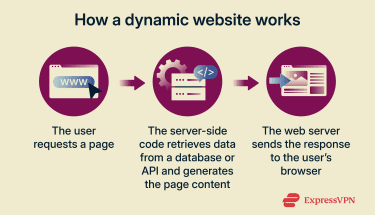
Common examples of dynamic websites
Dynamic websites are commonly used for applications that rely on user input, personalized content, or frequently updated data. Typical examples include:
- Social media platforms where posts, feeds, and notifications change in real time.
- Online shops and product catalogs that display products, pricing, and availability.
- News websites with frequently updated content, like breaking news or live coverage.
- User dashboards and account pages where information depends on login status.
- Forums and comment systems that display user-generated content as it’s added.
Advantages of dynamic websites
Dynamic websites allow personalized experiences and interactive features like user accounts, comments, and form submissions. They also support managing and updating large amounts of content through content management systems (CMSs), without editing individual pages. In addition, they scale more effectively for complex or content-heavy sites and enable functionality such as payments, search, authentication, and real-time updates.
Security considerations and disadvantages of dynamic websites
Dynamic websites also introduce several trade-offs:
- Increased development complexity: Reliance on server-side logic, client-side scripts, and backend integrations raises maintenance and testing requirements.
- Higher resource demands: Generating content at request time requires processing power and hosting capacity, particularly under high traffic.
- Performance variability: Page load speed can be affected if database queries, rendering processes, or caching mechanisms are not optimized.
- Expanded attack surface: Backend code, databases, user input handling, and third-party dependencies can introduce vulnerabilities.
- Dependency management risks: Outdated frameworks, plugins, or CMS components may expose known security weaknesses.
- Access control and data handling risks: Weak authentication, improper authorization, or insecure data transmission can allow unauthorized access or data exposure.
Further reading
- Static IP vs. dynamic IP
- With ExpressVPN, your IP changes for every site
- What is WWW2 and is it safe?