Expressvpn Glossary
Dynamic DNS (DDNS)
What is dynamic DNS?
Dynamic DNS (DDNS) is a service that automatically updates Domain Name System (DNS) records when a device’s public IP address changes. It lets users reach a server or device at a stable hostname, even if an internet service provider (ISP) regularly rotates the IP address.
How does dynamic DNS work?
A DDNS client runs on a router, server, or other always-on device and regularly checks the device’s current public IP address. When the IP changes, the client sends an authenticated update request to a DDNS provider, which updates the DNS record immediately, so the hostname points to the new IP. This process is automatic and usually takes only a few seconds.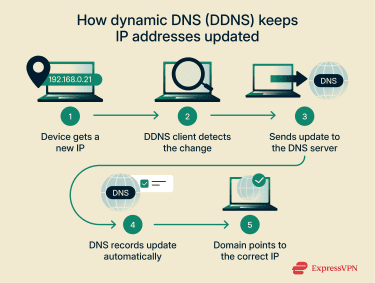
Why is dynamic DNS important?
DDNS removes the need to track or manually update IP addresses, which makes remote access more reliable and reduces configuration errors.
For individuals, DDNS makes it easier to reach self-hosted services, such as a home media server or network attached storage (NAS) device, without checking the IP for every new connection.
For small offices, it supports external access to services hosted on dynamic IP connections without paying for a static IP.
Common use cases
DDNS is commonly used for:
- Remote access: Stable hostnames for remote desktop, development environments, and self-hosted websites.
- Internet of Things (IoT) devices: Access IP cameras, NAS devices, and other smart home or office systems without manual reconfiguration when the public IP changes.
- Virtual private network (VPN) servers: Easy access to a self-hosted VPN server by assigning it a hostname that always tracks the current public IP.
Security and privacy considerations
DDNS needs additional considerations to be fully secure, including:
- Unauthorized access: Publishing a hostname for home or office services can make exposed devices easier to find. Weak passwords, open ports, or unpatched software greatly increase the chance of a compromise.
- DNS hijacking and traffic redirection: If attackers gain control of DNS records or of the DDNS provider account, traffic for the hostname can be redirected to malicious infrastructure.
- Dependence on provider security: DDNS users rely on the provider’s authentication systems and authoritative name servers, so weaknesses or outages at the provider affect the availability and integrity of DNS data.
Dynamic DNS vs. static DNS
| Feature | Dynamic DNS | Static DNS |
| IP Address | Changes frequently | Stays the same |
| Updates | Automatic | Manual |
| Best for | Dynamic IPs (home users) | Static IPs (business servers) |
| Cost | Usually free or low-cost | Typically higher cost |
| Maintenance | Low | Medium |
Further reading:
- Learn the difference between static and dynamic IPs
- What is Anycast DNS
- Understanding the difference between DHCP vs DNS
 Support Center
  FAQ
FAQ  VPN Setup Tutorials