
Expressvpn Glossary
Digital information

What is digital information?
Digital information is meaningful content represented in a binary format, using 0s and 1s, which computers can process and store. Almost any real-world information can be converted into this format so that computers and networks can interpret, store, and transmit it.
See also: Data transfer, biometric data, data at rest, data entry, data leakage, digital footprint
How does digital information work?
When information is digitized, it’s converted into bits. A bit is the smallest unit of digital data and has a value of either 0 or 1. Eight bits form a byte, which is the basic unit of digital storage.
Different types of content are broken down differently: text into characters, images into pixels, audio into sound samples, and video into frames. Each of these is ultimately stored and transmitted as bits, which a device reads and reconstructs into the original information for display or playback. When digital information crosses a network, it’s split into packets, transmitted, and reassembled by the receiving device.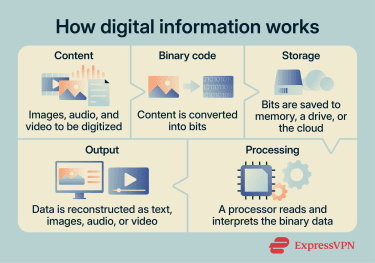
Digital vs. analog information
The fundamental difference between digital and analog information is how they represent values. Digital information represents values as fixed, separate steps. Analog information represents values as a continuous, unbroken range.
In a digital system, every value must be either a 0 or a 1, while in an analog system, a value can be anything within a range, with infinite gradations between any two points.
This difference determines how each handles errors. Because digital information only has two possible states, small errors that occur during storage or transmission are easier to detect and correct. With analog information, any distortion changes the value itself, and those distortions accumulate each time the signal is copied or transmitted.
| Characteristic | Digital Information | Analog Information |
| Signal type | Discrete signal | Continuous signal |
| Representation | Bits and bytes | Waves, voltage, and more |
| Copying | Copies remain identical | Copies can lose quality |
| Noise | More resistant | Affected by distortion |
Further reading
- What is data privacy and why it matters: A complete guide
- What is sensitive data? Understanding its importance
- What is personal information? Definition, examples, and protection