
Expressvpn Glossary
Data verification
What is data verification?
Data verification is the process of checking whether data matches a trusted source, original record, or expected reference value. Its role is to confirm that the data is accurate and consistent and that it has not been altered or recorded incorrectly during entry, transfer, or storage.
Its core purpose is to establish trust in the data by confirming that a record reflects the source it is meant to represent, rather than merely checking whether it meets a required format or rule. That is the main difference from data validation, which checks whether data meets defined rules or constraints.
How does data verification work?
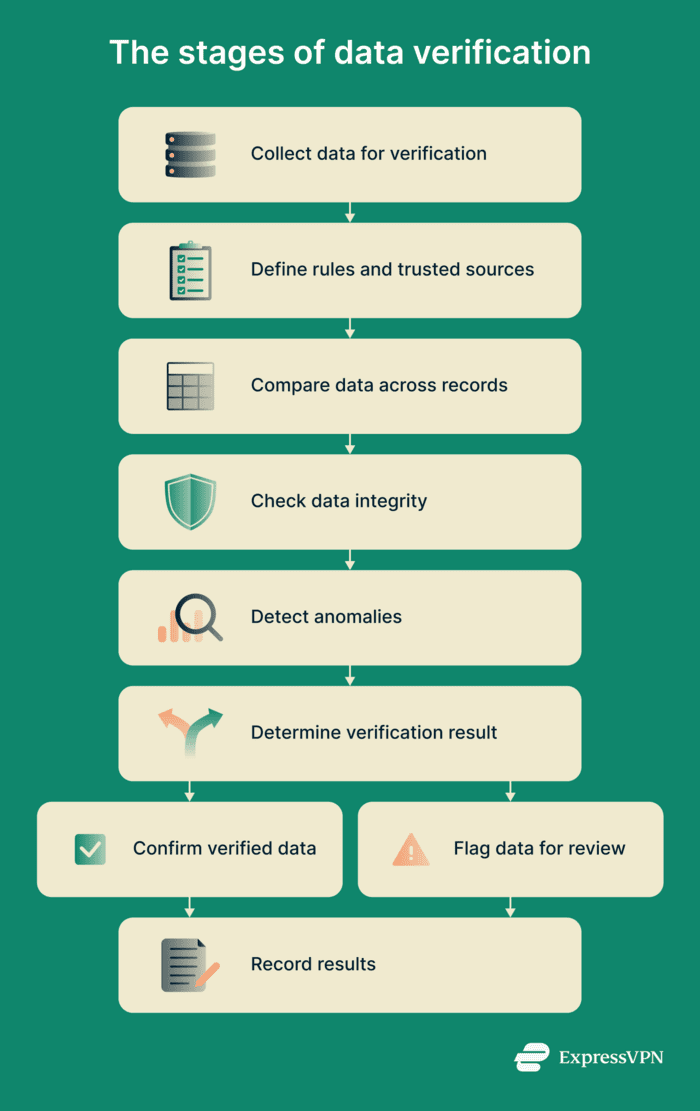
The data verification process can vary based on the type, size, and structure of the data set, but it usually includes these core steps:
- Define rules, sources, and acceptance criteria: Establish clear standards for what constitutes correct data, which sources are trusted, and the required level of accuracy. This creates a consistent basis for verification.
- Compare data across systems or records: Check whether information matches the original record or another authoritative source. For example, a customer record may be compared across billing and customer relationship management (CRM) systems to confirm that both contain the same details.
- Use checksums, hashes, or signatures to confirm integrity: Apply mathematical methods to create a unique value for a file or record. That value can then be compared later to confirm that the data has not been altered, corrupted, or tampered with.
- Run reconciliations or anomaly checks to detect inconsistencies: Use automated checks to compare totals, identify gaps, and flag unusual patterns. This helps detect missing, duplicate, or unexpected entries that may require review.
- Record verification results for auditing and traceability: Store the results of verification checks, including outcomes and timestamps, in a structured log. This supports issue tracking, compliance, and audit review.
Types of data verification
Data verification can be manual or automated, depending on the size and type of the data. Manual verification relies on human review, while automated verification uses checks such as record matching, reconciliation, and rule-based comparisons to review data at scale. Some systems also use integrity controls, such as hashes or digital signatures, to confirm that data has not been altered. When issues are found, the data is flagged for review.
Why is data verification important?
Data verification helps improve confidence that records are accurate, complete, and reliable. This matters because poor data quality can undermine analysis, reporting, and decision-making and lead to financial and operational costs. Data verification also supports compliance by helping organizations maintain accurate records where regulations require it.
In security work, verification checks and logs can help detect anomalies and support investigations. High-quality, verified data is also important in AI and analytics because model performance depends heavily on the data's quality and suitability.
Where is data verification used?
Data verification is used in many contexts where organizations manage large volumes of information and need to confirm that records are correct across systems and processes. Common examples include:
- Financial reporting and payment systems.
- Healthcare records and lab results.
- Cybersecurity logs and security information and event management (SIEM) workflows.
- Backups, migrations, and data synchronization.
- E-commerce inventory and fulfillment.
Potential security risks of the data verification process
The data verification process may require data to be copied, transferred across systems, or temporarily stored for comparison. This can create a security risk if the data is not properly protected during transmission or storage.
Verification logs can also pose a risk if they capture unnecessary full records or personally identifiable information (PII), or if they aren't properly protected. Weak authentication or poor access control may also expose trusted-source data to tampering, making verification results unreliable.
Further reading
- Hashing vs. encryption: Key differences
- What is data encryption?
- What is ChaCha20, and how does it work?
- How to set up and use Pretty Good Privacy (PGP)