Expressvpn Glossary
Data packet
What is a data packet?
A data packet is a small unit of data formatted for transmission across a network. Instead of sending large amounts of information as a single continuous block, packet-switched networks break data into packets so devices can transmit and route them efficiently.
Each packet contains two main parts: a header and a payload. The header carries control information such as source and destination IP addresses in an IP packet, while the payload contains the actual data.
How does a data packet work?
When a device sends data over a network, the data is divided into smaller packets or segments. Packet headers include addressing information, such as IP addresses, which routers check against their routing tables to determine where to forward the packet next. This continues from one router to the next until the packet reaches its destination.
Packets from the same transmission may travel along different paths. For example, a router might forward packets over a less congested link, or network administrators might configure rules that route certain traffic types through specific paths for security or performance reasons.
At the destination, the receiving system processes the packets and passes the data to the appropriate protocol or application. For reliable protocols such as Transmission Control Protocol (TCP), sequencing information helps reorder data, and missing or corrupted data can be retransmitted. Other protocols, such as User Datagram Protocol (UDP), don't guarantee delivery or ordering, so retransmission must be handled by the application if needed.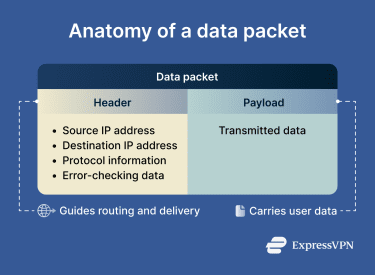
Why do data packets matter?
Data packets make modern networks efficient, scalable, and reliable. By dividing information into smaller units, packet-switched networks can share bandwidth across multiple transmissions and reduce bottlenecks. Packets can also take different routes across a network, helping traffic continue moving when paths change or become unavailable.
Packet-based communication supports routing and switching decisions at different stages, so data can be forwarded according to network conditions, routing tables, and configured policies. It can also improve reliability. For reliable transport protocols such as TCP, lost or corrupted data can be detected and retransmitted without restarting the entire transmission.
Where are data packets used?
Nearly every modern networked service relies on data packets, including:
- Websites, apps, and streaming services.
- Email, messaging platforms, and Voice over Internet Protocol (VoIP) calls.
- Local and enterprise networks.
- Cloud platforms and data centers.
- Virtual private network (VPN) tunnels encapsulate and encrypt data packets between secure endpoints.
Risks and privacy concerns
Data packets that aren’t properly secured introduce several security risks, such as:
- Traffic interception: Unencrypted packets may reveal their contents in transit, making sensitive data visible to someone monitoring the network.
- Metadata exposure: Packet headers may reveal source and destination addresses, revealing communication patterns even when the payload is encrypted.
- Packet sniffing: Attackers can capture and analyze network traffic using sniffing tools. If the traffic is unencrypted or poorly protected, they may be able to extract credentials, session tokens, or other sensitive information.
- Packet spoofing: Attackers can forge packet headers to disguise the origin of traffic, enabling attacks such as IP spoofing and supporting broader attacks against a connection or session.
Further reading
- How does the internet work?
- What is traceroute and how to use it for network diagnostics
- Deep packet inspection (DPI): How it works and why it matters
- What is packet loss? Everything you need to know
- How to fix packet loss for a stable connection