Expressvpn Glossary
Data modernization
What is data modernization?
Data modernization is the process of updating how an organization stores, manages, and uses data to support modern applications and workloads.
It often involves replacing legacy systems with cloud or hybrid platforms, improving data structure, and introducing automation and governance controls.
Data migration is usually part of this process, but modernization focuses on redesigning the overall data architecture rather than just moving data.
See also: Data migration, data lake, data governance framework, data loss prevention
How does data modernization work?
Modernization follows a staged process. It starts with an audit of existing databases, data flows, and the automated systems that move and process information between applications. These systems are often called data pipelines. The goal is to identify what's outdated, fragile, or poorly secured.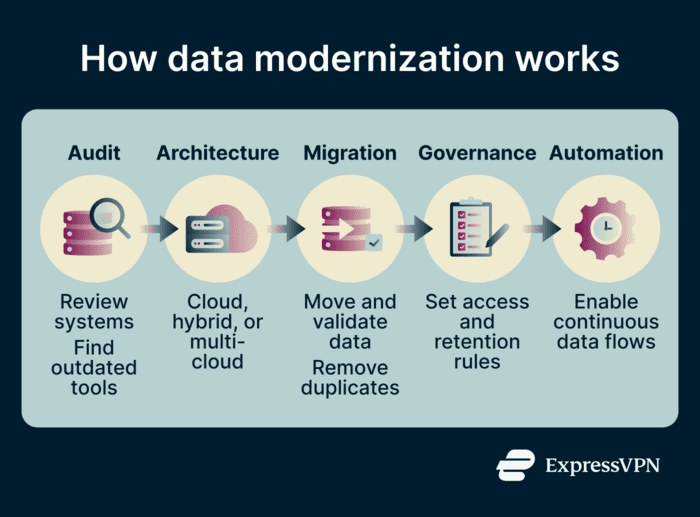
The organization then selects a target architecture. Some move all their data to a cloud provider. Others keep certain databases on local servers while running the rest in the cloud, a hybrid approach. Larger organizations sometimes spread workloads across multiple cloud providers to avoid vendor lock-in.
During migration, data is transferred and checked for accuracy. This includes verifying that the data's structure is compatible with the new system (a concept called schema validation), removing duplicates, and confirming that records transfer without corruption or loss.
Once migration is complete, teams implement governance controls. These are the formal policies that define who can access specific datasets, how data is classified by sensitivity, and how long it's retained.
The final stage is automation. Rather than relying on manual batch updates, modern systems continuously process and deliver data, supporting applications such as fraud detection, operational monitoring, and security analytics.
Why is data modernization important?
Data modernization improves visibility into where data is stored and who can access it, supports efficient analytics, and strengthens access control and data protection. It also helps organizations meet regulatory requirements by improving data classification, tracking, and retention.
Common use cases for data modernization
Data modernization is used in several common scenarios:
- Retiring legacy systems: Replacing traditional data warehouses with cloud platforms or data lakes.
- Centralizing security data: Consolidating logs for monitoring and threat detection.
- Improving compliance visibility: Tracking data access and retention in regulated industries.
- Post-merger consolidation: Combining data systems after organizational changes.
Benefits and limitations
Data modernization can improve how organizations store, analyze, and protect information, but it also introduces operational challenges.
Benefits
- Improved resilience: Cloud and distributed systems reduce reliance on a single hardware and simplify backup and recovery.
- Support for AI workloads: Machine learning systems depend on large volumes of clean, accessible data, which modernized platforms are better equipped to provide.
- Unified data access: Consolidating scattered databases into a single platform makes it easier for teams across the organization to work from the same dataset.
Limitations
- Temporary downtime: Some systems may need to pause during transitions, especially legacy applications that are tightly connected to older databases.
- Integration challenges: Older applications designed for legacy databases may not connect easily to modern platforms.
- Cost and expertise: Modern data tools often demand specialized knowledge that organizations may not yet have in-house.
Risks and privacy concerns
Modernization can introduce new vulnerabilities if security isn’t addressed alongside the migration.
- Cloud misconfiguration: Storage permissions or access settings configured incorrectly can leave sensitive data exposed to unauthorized users.
- Overly broad access: Teams sometimes grant broad permissions during migration to avoid delays. If those permissions aren't reduced once migration is complete, users and automated processes retain access to data they no longer need. This violates the principle of least privilege, which limits access to only what is necessary.
- Unintended data copies: Migration can create duplicate datasets across multiple systems. Without a clear record of where each copy exists, sensitive data becomes harder to protect.
- Weak security during data transfer: Data moving between platforms should be encrypted and authenticated at every step. Without both protections, it can be intercepted during transfer.
Further reading
- What is big data security and privacy?
- Key security concerns in cloud computing
- What is cloud networking? A comprehensive overview
- Zero-trust data protection explained