Expressvpn Glossary
Data marketplace
What is a data marketplace?
A data marketplace is a platform where users find and access data products. These products can include data files, data tables, and data APIs. Providers publish listings that describe their datasets, and users can access free or paid listings.
How does a data marketplace work?
A data marketplace follows a process that connects providers and customers through listing, subscription, delivery, and oversight features. It can involve the following steps: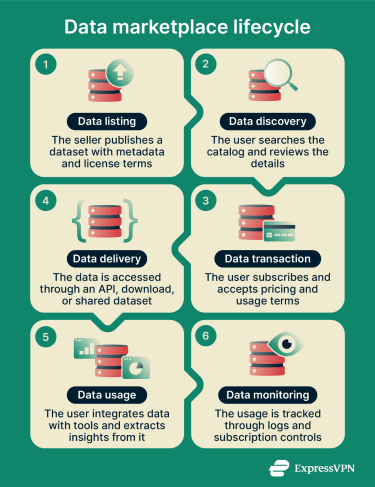
- Data listing: Providers list data products in a marketplace catalog.
- Data discovery: Users search listings, filter by name or description, and explore the catalog to find data of interest.
- Data transaction: Users subscribe or pay for a data set.
- Data delivery: Users export assets to cloud storage, download selected assets, access shared datasets upon subscription, or use API assets.
- Data usage and integration: Users extract insights from the data and incorporate it into their analysis workflows.
- Data monitoring and auditing: Providers monitor listing performance and usage through analytics dashboards.
Types of data marketplaces
Some organizations run internal marketplaces to share data products securely within their own organization. Meanwhile, external marketplaces help customers share and manage data entitlements from other organizations at scale.
Marketplaces can also operate as public or private exchanges. In public exchanges, users can discover and subscribe to listings. By default, some exchanges remain private and allow only specific users or groups to view or subscribe to listings. A hybrid data marketplace integrates features of both public and private marketplaces.
Why is a data marketplace important?
Data marketplaces influence how organizations find, use, monetize, and control data across teams and partners.
- Discovery and access: Easy discovery of business-ready, reusable data and centralized exchanges let organizations quickly find and procure the data they need.
- Analytics and AI support: Organizations can access data for informed decision-making, enhanced business intelligence, and the application of AI and machine learning (ML) models.
- Revenue generation for providers: Platforms let providers list, sell, and distribute data, creating scalable revenue streams from data assets.
- Governance and compliance controls: Some marketplaces operate under policies, standards, and compliance requirements that govern how participants exchange and use data. They also simplify governance when customers set up access permissions.
Where are data marketplaces used?
Data marketplaces support marketing and attribution use cases by matching customer data with media performance data to measure results. They also support fraud and risk use cases, including detecting money laundering and payment fraud, and supporting trading risk computations.
In healthcare and life sciences, data exchanges allow doctors and pharmaceutical researchers to share data to study treatment outcomes. Marketplaces also support supply chain, logistics, and transportation use cases.
Organizations use marketplace datasets to train ML algorithms. Some platforms also support feature engineering workflows that identify and extract additional features used to train downstream models.
Further reading
- What are data brokers? A complete guide to privacy and protection
- How to stop data brokers from selling your online data
- How to remove yourself from data broker sites