Expressvpn Glossary
Data fabric
What is a data fabric?
A data fabric is a way of organizing enterprise data so that it feels like a single, connected system. It bridges the gaps between different data sources and platforms, effectively creating a single unified “fabric” or network on which data can be discovered and accessed consistently, subject to governance and permissions. It’s particularly useful for bigger businesses with remote or hybrid teams and numerous data sources.
How does a data fabric work?
A data fabric uses metadata, automation, and integration technologies to create a virtual layer across various data sources. It typically connects directly to existing data sources and collects metadata that describes their structure and meaning.
It then uses automation and, in some implementations, AI to classify data, detect relationships between datasets, and choose efficient paths for queries. Once that’s done, it enforces centrally defined governance and access-control rules across all linked systems, where supported, enabling secure data flow between devices and systems.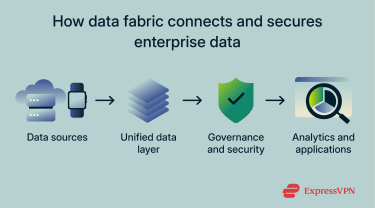
Key components of a data fabric
Different organizations may implement data fabric in their own ways, but most include these core components:
- Data management: Sets the rules for governance, security, and data quality.
- Data ingestion: Brings data into the fabric from various systems and platforms.
- Data processing: Cleans, standardizes, and prepares data for use.
- Data orchestration: Coordinates how data moves across systems so it’s available when needed.
- Data discovery: Helps teams find and understand data through cataloging and metadata.
- Data access: Delivers data to users and applications with the right permissions.
Why is it important?
A data fabric is important because it helps organizations manage and use data more effectively across different systems. This means having:
- Unified access: Provides one consistent way to work with data stored across many different systems.
- Lower complexity: Reduces the effort required to connect, prepare, and maintain data from multiple sources.
- Consistent controls: Applies the same governance and security rules everywhere, supporting accuracy and compliance.
- Reliable information: Creates a more consistent and dependable view of data that is easier to find, understand, and use.
- Automation: Handles routine data tasks automatically, reducing errors and saving time.
- Faster insights: Links operational and analytical data more closely to support quicker decision-making.
- Flexibility: Makes it easier for organizations to adapt and scale their data operations as needs evolve.
Security and privacy considerations
To protect data effectively, organizations need strong identity and access controls, regular auditing, and continuous monitoring to detect unusual activity. Strong encryption should be used for data in motion and at rest, and connected systems should be updated and reviewed to ensure they meet the same security standards as the fabric itself.
Data fabric vs. data mesh
Unlike a data fabric, a data mesh is an organizational approach where different teams manage their own data separately but follow shared rules. Here are the main differences between the two:
| Feature | Data fabric | Data mesh |
| Approach | Centralized architecture | Decentralized, domain-based model |
| Governance | Unified and automated | Distributed among data owners |
| Focus | Integration and management | Ownership and collaboration |
| Use case | Enterprise-scale data control | Scalable, federated analytics |
Further reading
- Network architecture: Building secure and modern networks
- How does the internet work?
- Internet infrastructure: What it is and how it works
 Support Center
  FAQ
FAQ  VPN Setup Tutorials