Expressvpn Glossary
Data driven
What is “data driven”?
The term “data driven” refers to decision-making processes that are based on the interpretation of collected information instead of intuition. The purpose of data-driven decision-making (DDDM) is to reduce bias and reliance on false assumptions by using a solid and objective foundation for decisions, allowing organizations to minimize risk and function effectively.
How does being “data driven” work?
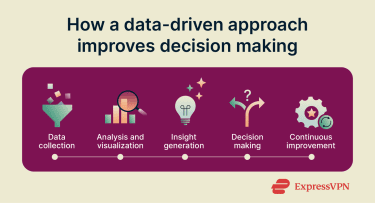 A data-driven approach is a systematic process that incorporates the following key principles:
- Data collection: Relevant data is gathered from various sources, such as customer-relationship management (CRM) tools or internal employee performance reports. This data can go through a validation and/or cleaning process to ensure that future decisions are based on accurate information.
- Analytics platforms: These help make data sets more digestible by representing information through visual formats such as graphs and dashboards, allowing users to quickly gain accurate insights. Organizations may also use predictive analytics, which uses statistical models and machine learning (ML) to forecast trends and allow for proactive decisions.
- Emphasis on accuracy and evidence: The fundamental principle of DDDM is to base decisions on objective, measurable evidence rather than subjective factors.
- Ongoing performance tracking and optimization: Key performance indicators (KPIs) and real-time dashboards are used to constantly monitor outcomes, enabling quick adjustments and optimization.
- Application across multiple domains: These data-driven principles can be adapted to business, cybersecurity, and marketing, where they guide optimization, risk detection, and trend forecasting.
Why is a data-driven approach important?
A data-driven approach offers several key advantages:
- Improves decision-making accuracy and transparency: Decisions are based on verified data, making their rationale and expected outcomes clear.
- Helps identify patterns, risks, and opportunities: Data analysis reveals trends and correlations in large datasets, supporting proactive planning and risk mitigation.
- Strengthens cybersecurity strategies: Evidence-based insights from network and system data help detect anomalies, prevent attacks, and enhance threat response.
- Enables better personalization: Analyzing user behavior allows organizations to deliver more relevant experiences.
- Supports compliance and accountability: Continuous measurement and reporting help track adherence to regulations and ensure responsible data use.
Examples of data-driven applications
Data-driven methodologies can help solve practical problems and optimize performance across various domains. Here are a few examples:
- Marketing: Marketers analyze data like click-through and conversion rates to allocate resources to the best-performing channels.
- Business strategy: Companies use predictive analytics on sales and market data to forecast demand and understand customer behavior, such as cart abandonment.
- Network management: AI-powered tools analyze historical data to define normal network performance, enabling them to detect anomalies and resolve issues faster.
Challenges of being data driven
Implementing a data-driven methodology presents the following challenges:
- Data privacy and user consent issues: Organizations may need to navigate privacy regulations like the General Data Protection Regulation (GDPR). This can add a level of complexity and potential risk, and may restrict the amount of data the organization can collect.
- Potential bias in data collection or interpretation: Biased historical data or flawed interpretation can lead to skewed models that amplify societal biases.
- High costs of data infrastructure and analytics tools: Significant investment is required for the necessary infrastructure, analytics tools, and specialized personnel needed to manage them.
- Overreliance on metrics: Focusing exclusively on quantitative data can be a pitfall, as it often lacks the context provided by human experience.
- Vulnerabilities and compliance risks: Organizations that store and/or process vast amounts of data can be a high-value target for cybercriminals.
Further reading
- Protect your personal data with Identity Defender
- What are data brokers? A complete guide to your privacy and protection
FAQ
How is a data-driven approach used in cybersecurity?
In cybersecurity, a data-driven approach uses analytics and machine learning (ML) to proactively identify and respond to cyber threats. It involves analyzing network logs and user behavior to detect anomalies, predict attacks, and automate incident response.
What’s the difference between data-driven and data-informed decisions?
If strictly defined, a data-driven decision is based solely on data, whereas a data-informed decision uses data as a key factor but doesn’t solely rely on it, adding a layer of human interpretation. However, these terms are often used interchangeably; most organizations use an approach that would be defined as “data informed” but may still refer to it as “data driven.”
What are the risks of relying solely on data?
Relying solely on data when making decisions can cause organizations to miss important context that can only come from human experience and feedback.
 Support Center
  FAQ
FAQ  VPN Setup Tutorials