
Expressvpn Glossary
Data corruption

What is data corruption?
Data corruption is the unintended or unauthorized alteration of digital information, rendering it inaccurate, inconsistent, or invalid. Corruption can be either visible or hidden. Visible corruption prevents files from opening or makes them obviously unreadable. Hidden (or silent) corruption introduces errors that go undetected because the data appears normal on the surface.
In information security, corruption primarily threatens data integrity. This distinguishes it from data loss, which affects availability, and data exposure, which concerns confidentiality.
Common causes of data corruption
Data corruption can result from both non-malicious errors and intentional actions. Non-malicious corruption typically stems from human or system faults occurring during data writing, storage, processing, or transfer. Common examples include:
- Network errors: Can affect data in transit through packet loss, bit errors, duplication, or reordering. Reliable protocols often detect and correct these problems, but undetected errors or inadequate application-level checks can still result in corrupted data.
- Power outages: Can interrupt write operations mid-process, leaving data in an incomplete or inconsistent state.
- Hardware failures: Disk or memory faults can introduce errors during reads or writes. Over time, storage media can also degrade gradually, a process known as data degradation or bit rot, leading to silent corruption.
- Software bugs: Can write incomplete or incorrect data to storage or into the wrong memory locations.
- Human error: Accidental overwriting, deletion, or modification can damage or invalidate data.
Malicious corruption occurs when an attacker deliberately alters data, typically through malware, ransomware, or unauthorized access and tampering.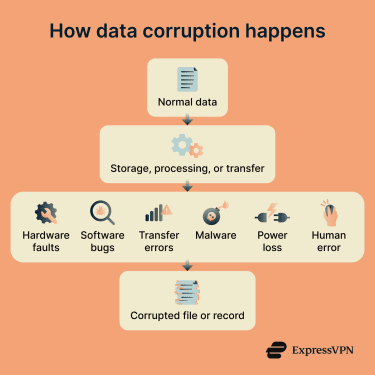
Where does data corruption occur?
Data corruption can affect both active and stored data, and it can occur across any system that stores, processes, or transfers information, including:
- Databases and applications: Where data is actively created, read, or modified.
- Local storage devices: Hard drives, solid-state drives, and other media in computers and phones.
- Cloud platforms: Remote infrastructure used for storage, processing, or hosting services.
- Networked systems: Where data is shared or transferred between devices, services, or applications.
- Backups and archives: Where data is stored for recovery or long-term retention.
Risks and impact of data corruption
Data corruption affects both information accuracy and the systems that depend on it. When businesses and operations teams rely on corrupted data, it can lead to poor decisions, financial losses, and operational issues. For example, financial systems may calculate incorrect balances, and reporting tools may produce unreliable metrics.
The risk increases when corruption goes undetected. Errors can spread across systems, making recovery more difficult, especially if backups also contain corrupted data.
Corrupted logs and records can also weaken security. If attackers alter or remove entries, it becomes harder to detect incidents, investigate activity, or maintain compliance. In severe cases, corruption can disrupt operations, cause system failures, and lead to downtime.
Further reading
- How to back up files and encrypt them
- Malware vs. virus: Key differences explained
- What is a data breach? How to safeguard your information
- How to know if your computer has a virus (Windows and Mac)
- Customer data protection: Practical steps to keep information safe