Expressvpn Glossary
Data bank

What is a data bank?
A data bank is a centralized system for storing and organizing large collections of related information. It allows an organization to maintain data in a structured format so it can be accessed and managed as needed.
How a data bank works
A data bank stores information across one or more storage systems, which may include physical hardware, databases, data warehouses, or cloud-based infrastructure. In larger setups, data can be distributed across multiple storage media to support availability and system reliability.
It may contain structured, semi-structured, or unstructured data, with indexing and metadata commonly used to organize information and help users locate specific records.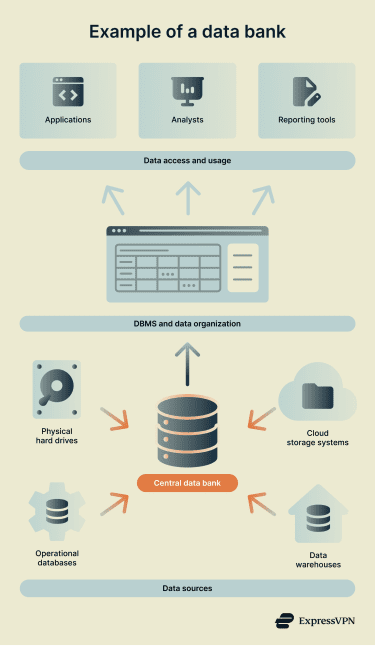 Information within a data bank is typically managed using database management system (DBMS) software. These systems handle tasks such as storing records, updating entries, and retrieving data, often through standardized query languages like Structured Query Language (SQL).
By consolidating records into a centralized repository, a data bank supports large-scale data processing and analysis. Centralization also makes it possible to apply uniform data management, access controls, and security policies across stored information.
Types of data banks
Data banks can vary based on the information they store. Different categories of data may involve distinct organizational, security, and regulatory considerations.
Common types of data banks include the following:
- Financial data banks: Used by banking and financial institutions to store records such as customer details, account information, and transaction histories. These data banks often support financial oversight, reporting, and risk-related processes.
- Medical data banks: Maintained by healthcare providers, insurers, and related organizations to store patient records, test results, and clinical histories. Medical data banks are typically subject to strict privacy and security regulations, including healthcare data protection laws.
- Research and statistical data banks: Used by government bodies, academic institutions, and research organizations to store scientific datasets, survey results, demographic statistics, or historical records. These data banks commonly support long-term analysis, reporting, and research activities.
- Enterprise data banks: A broad category of data banks used within large organizations to store operational, customer, commercial, and internal research data. These systems often serve as shared repositories across multiple departments.
Why data banks matter
Data banks play a central role in how organizations store and manage large volumes of information. Without one, information may exist across multiple departments, systems, or locations, which can make oversight more complex and introduce challenges related to data integrity, accuracy, retrieval, security, and regulatory alignment.
By consolidating information into a shared system, data banks provide a common structure for storing and accessing records. This structure supports large-scale data processing and analysis, including the use of automated or algorithm-driven systems such as AI and machine learning (ML).
Security and privacy considerations
Centralizing large volumes of information in a data bank can introduce security and privacy risks that require careful oversight. Common considerations include the following:
- Data breach risk: Data banks can be attractive targets for cyberattacks because they aggregate large amounts of information in a single system. If compromised, a breach may result in the exposure of sensitive data, with potential legal, operational, or reputational consequences.
- Identity and access management (IAM): Access to a data bank is typically controlled through identity and access management mechanisms. Weak or poorly enforced access controls can increase the risk of unauthorized access, whether from internal users or external actors.
- Regulatory and legal compliance: Organizations that maintain large data banks may be subject to data protection, privacy, or security regulations, depending on the type of data stored. Compliance requirements can include formal standards, reporting obligations, or periodic audits.
- Encryption and data protection: Data banks often rely on technical safeguards to protect information from unauthorized access and alteration. These safeguards can include encryption and other data protection measures applied during storage or transmission.
- Data governance and oversight: Effective data bank management typically involves defined policies and accountability for how data is collected, stored, accessed, and removed. Without clear governance structures, even technically secured systems can face increased risk from misuse or mismanagement.
Further reading
- How data leaks are fueling the surge in identity theft cases
- Why your old email is a goldmine for hackers
- Protect your privacy: A guide to data removal services